Join us

ContentUpdates and recent posts about Unsloth..
Story
@jamesmiller shared a post, 1 day, 1 hour ago
Penetration Tester, ZeroThreat.ai

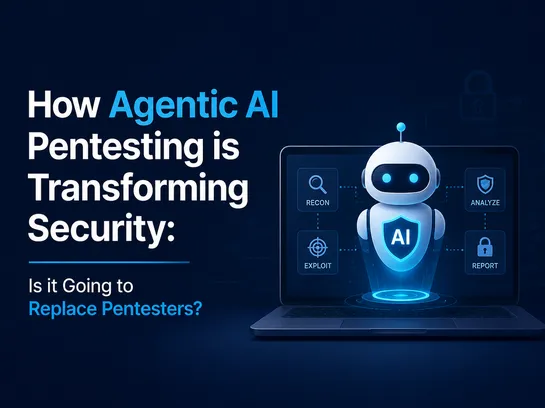
How Agentic AI Pentesting is Transforming Security: Is it Going to Replace Pentesters?

Agentic AI pentesting is transforming security by moving beyond traditional, point-in-time assessments to continuous, autonomous attack simulation. It can map attack surfaces, chain vulnerabilities, and validate real risks at scale. While it won't replace human pentesters, it will amplify their capabilities, enabling faster, deeper, and more effective security testing.
How Agentic AI Pentesting is Transforming Security
Story Levelop.dev Team
@basit001 shared a post, 1 day, 1 hour ago
Co-Founder, Levelop.dev

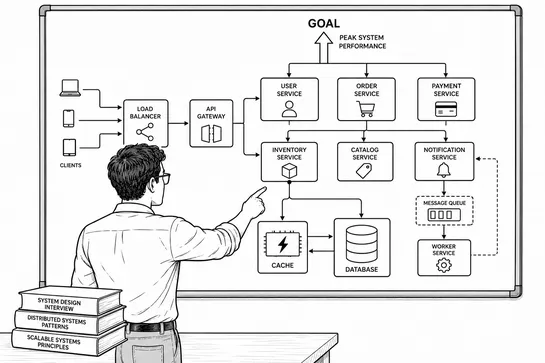
Beyond the Canvas: How Big Tech Approaches High-Level Design (And Why Most Interviewees Fail It)

Why big tech interviewers are tired of seeing the exact same blueprint, and how to fix it in 60 seconds.

System Design
Link
@neel_devops shared a link, 1 day, 1 hour ago
Developer Advocate, StackGen

Top 10 CI/CD Tools Every DevOps Engineer Should Know in 2026

CI/CD stands for Continuous Integration and Continuous Delivery (or Continuous Deployment). It’s the practice of automating the process of integrating code changes, testing them, and delivering them to production — often dozens or hundreds of times a day.

Story
@alok00k shared a post, 1 day, 1 hour ago

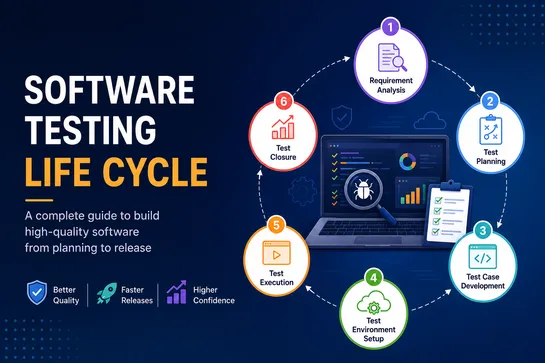
Software Testing Life Cycle: Building Reliable Software From Planning to Release

The Software Testing Life Cycle (STLC) is a structured process that helps teams ensure software quality through different testing phases such as requirement analysis, test planning, test case development, environment setup, test execution, and test closure. It enables organizations to identify defects early, improve test coverage, and deliver stable applications with greater confidence.

ChatGPT Image May 20, 2026, 02_03_54 PM
Story
@alok00k shared a post, 1 day, 1 hour ago

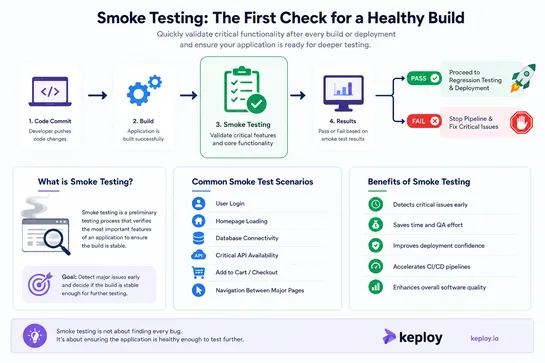
Why Smoke Testing Is Essential for Modern Software Teams

Smoke testing is a quick testing method used to verify whether the core functionality of an application works properly after a new build or deployment. It helps teams detect critical issues early, avoid wasting QA effort on unstable builds, and improve deployment confidence in CI/CD pipelines.

ChatGPT Image May 18, 2026, 02_32_13 PM
Story Keploy Team
@sancharini shared a post, 1 day, 1 hour ago

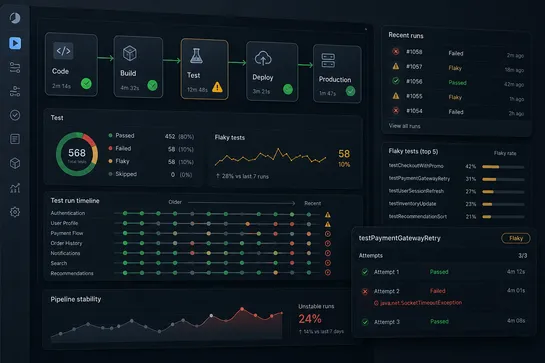
Regression Testing Tools and the Balance Between Coverage and Pipeline Speed

Explore how modern regression testing tools balance test coverage and CI/CD pipeline speed, and why smarter validation strategies matter more than larger test suites in distributed systems.

Regression Testing Tools and the Growing Problem of Flaky CICD Pipelines
Story
@alok00k shared a post, 1 day, 1 hour ago

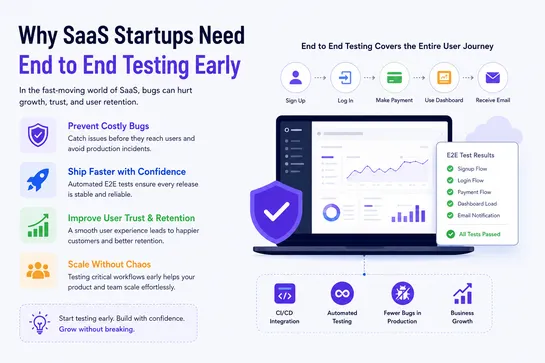
Why SaaS Startups Need End to End Testing Early

SaaS startups move fast, but rapid deployments can introduce bugs that hurt user trust and retention. End to end testing helps teams validate complete user journeys like signup, payments, and integrations before release. By adopting automated testing early, startups can reduce production issues, ship faster with confidence, and scale their products more reliably.

e2e testing
Story
@harshilmalvi shared a post, 1 day, 1 hour ago
CEO, Tabdelta Solutions

Why Enterprises Are Investing in Power BI Development?

Enterprises are investing in Power BI development to transform complex business data into real-time insights, interactive dashboards, and AI-driven analytics. Power BI helps organizations improve decision-making, centralize data, automate reporting, enhance operational visibility, and support digital transformation initiatives. Its scalability, Microsoft ecosystem integration, cost-effectiveness, and advanced AI capabilities make it one of the most preferred business intelligence platforms for modern enterprises across healthcare, finance, ecommerce, manufacturing, and other industries.

Power BI For Enterprise
Story
@fidelissecurity shared a post, 1 day, 1 hour ago
Marketing, Fidelis Security

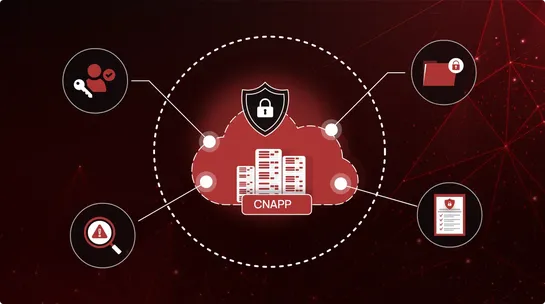
What Is CNAPP? A Complete Guide to Cloud-Native Application Protection Platforms

Learn what CNAPP (Cloud-Native Application Protection Platform) is, how it works, its key components, benefits, use cases, and why it is essential for securing modern cloud-native applications.

CNAPP
Story Keploy Team
@sancharini shared a post, 1 day, 1 hour ago

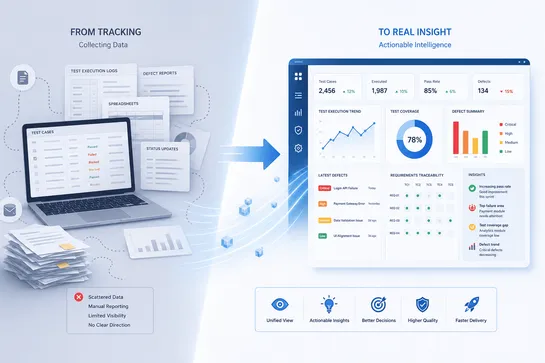
Making Test Management Tools Actually Work: From Tracking to Real Insight

Understand why test management tools fail and how leading teams make them work. Practical strategies for tracking, insights, and data-driven testing decisions.

Test Management Tools That Work: From Tracking to Insight
Unsloth is an open-source toolkit for training and fine-tuning large language models faster and with less memory than a standard Hugging Face stack. Its core library replaces PyTorch's default autograd with custom backpropagation kernels written in OpenAI's Triton language, which is where most of its speed and memory savings come from. It supports LoRA, QLoRA, full fine-tuning, reinforcement learning, pretraining, and 4-bit, 16-bit, and FP8 training, across more than 500 text, vision, audio, and embedding models.

The practical draw is hardware reach. QLoRA workflows in Unsloth let you fine-tune an 8B model on a single 12 GB consumer GPU, and the project headlines roughly 2x faster training with about 70 percent less VRAM versus baseline implementations, though the exact figures vary by model, GPU, and config. A 2026 update added faster mixture-of-experts training, with models like Qwen3-30B-A3B fine-tunable on about 17.5 GB of VRAM. It runs on NVIDIA (including Blackwell and DGX Spark), AMD, and Intel GPUs, with free Colab and Kaggle notebooks for trying it without local hardware.

It fits cleanly into the local-AI workflow. Unsloth integrates with Hugging Face transformers and TRL, and uses llama.cpp to save and run models, exporting to GGUF for Ollama or LM Studio as well as safetensors. As of 2026 it also ships Unsloth Studio, a local no-code GUI that covers the full lifecycle from dataset creation to training to running and comparing GGUF and safetensors models, with tool-calling, web search, and an OpenAI-compatible API, all running offline on Mac and Windows, with the core library under the Apache 2.0 license.