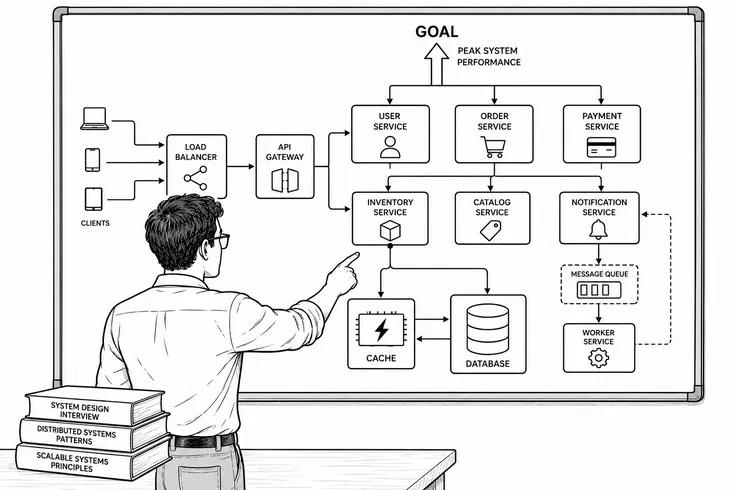
Most engineers fail High-Level Design (HLD) interviews by showing up with a pre-baked blueprint:
Load Balancer -> Gateway -> Microservices -> DB.
They think it looks clean. The interviewer thinks it looks like a textbook copy-paste.
In big tech, architectures aren’t built on templates; they are built on concessions. If you want to clear senior or staff loops, you have to stop naming tools and start evaluating friction.
Here are 3 ways to inject actual engineering depth into a 45-minute loop:
- Audit the Ingress, Don’t Just Drop a Gateway: Anyone can draw an API Gateway box. Stand out by discussing the actual protocol overhead. Will you use HTTP/2 multiplexing, long-polling, or WebSockets? Frame the choice around your client-side constraints, not just server-side convenience.
- Pick Your Poison (The Architecture Tax): Stop selling your design like a marketing pitch. If you introduce a distributed cache for speed, explicitly tell the interviewer: “This gives us low latency, but we are accepting the operational complexity of cache stampede protection and eventual consistency.”
- Design for the Crash, Not the Happy Path: Don’t assume network lines always work. Spend less time on your database schema and more time on data recovery. Talk about idempotent consumers, backpressure mechanisms, and how your system degrades gracefully when a downstream service completely blacks out.
Moving Beyond the Whiteboard
Reading static blueprints doesn’t make you an architect. If you’re tired of memorising templates and want to master first-principles system design through interactive practice, come join us at Levelop.