Modern software development moves fast. Teams ship updates weekly, sometimes daily, and users expect applications to work flawlessly across devices, APIs, and cloud environments. In this environment, testing cannot be treated as a final step before deployment. It must be integrated throughout the development process.
That’s where the Software Testing Life Cycle (STLC) becomes essential.
The STLC provides a structured framework that helps teams plan, execute, monitor, and improve software testing activities. Instead of performing random tests at the end of development, teams follow defined phases that improve software quality, reduce production defects, and increase release confidence.
This guide explains the Software Testing Life Cycle, its phases, challenges, best practices, and how modern automation platforms like Keploy help teams scale testing in modern distributed systems.
What Is the Software Testing Life Cycle?
The Software Testing Life Cycle is a sequence of activities performed during software testing to ensure applications meet functional and non-functional requirements. It defines how testing should be planned, designed, executed, and evaluated before software reaches production.
The STLC focuses entirely on quality assurance activities, unlike the Software Development Life Cycle (SDLC), which covers the broader development process.
A structured testing lifecycle helps teams:
- Detect defects early
- Improve test coverage
- Reduce release risks
- Standardize testing processes
- Increase collaboration between QA and development teams
- Support continuous delivery pipelines
Modern engineering teams increasingly rely on automation, real-user flows, and API-driven validation to make testing scalable across complex systems.
Why STLC Matters in Modern Development
Applications today are far more complex than traditional monolithic systems. Teams now manage:
- Microservices architectures
- Distributed APIs
- Cloud-native infrastructure
- Continuous deployment pipelines
- Third-party integrations
- Real-time applications
Without a proper testing lifecycle, defects become difficult to track and production failures become more common.
The STLC creates a repeatable process that ensures testing activities remain organized and measurable throughout development. It also supports modern practices such as continuous testing, shift-left testing, and automated regression validation.
Phases of the Software Testing Life Cycle
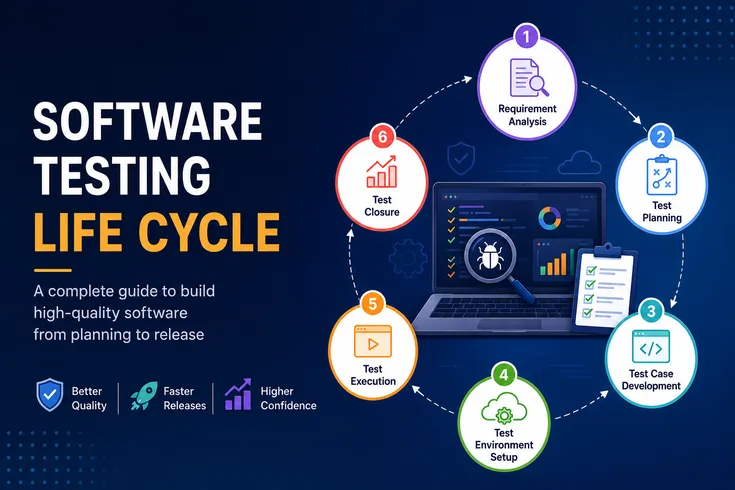
The Software Testing Life Cycle typically consists of six major phases.
1. Requirement Analysis
The lifecycle begins with understanding project requirements.
During this phase, QA teams analyze functional and technical requirements to identify what needs testing and determine whether automation is feasible.
Key activities include:
- Reviewing business requirements
- Identifying testable features
- Understanding system architecture
- Clarifying ambiguities with stakeholders
- Defining testing scope
The primary goal is to ensure the testing team fully understands the expected system behavior before test planning begins.
2. Test Planning
Test planning defines the overall testing strategy.
This phase determines:
- Testing objectives
- Testing types
- Resource allocation
- Timelines
- Automation scope
- Risk management
- Reporting processes
A detailed test plan acts as the roadmap for the entire testing effort.
Common deliverables include:
- Test strategy documents
- Resource planning
- Effort estimation
- Tool selection
- Environment planning
Effective planning is especially important in Agile and DevOps environments where releases occur frequently.
3. Test Case Development
Once planning is complete, testers begin designing test scenarios and creating test cases.
Activities include:
- Writing manual test cases
- Preparing automated test scripts
- Creating test data
- Mapping tests to requirements
- Reviewing test coverage
The objective is to ensure all critical business flows are validated.
Modern teams increasingly automate repetitive scenarios to reduce manual effort and improve execution speed.
Tools like Keploy simplify this process by capturing real API interactions and converting them into reusable automated tests. This reduces the time required to manually create regression suites while improving test realism.
4. Test Environment Setup
Testing environments must closely resemble production systems for reliable validation.
This phase involves:
- Configuring servers and databases
- Setting up dependencies
- Preparing testing tools
- Validating environment stability
- Deploying application builds
Environment instability is one of the most common causes of failed testing cycles.
Modern teams often use:
- Docker containers
- Kubernetes environments
- Service virtualization
- API mocking
- Infrastructure as Code
Traffic-based testing approaches help reduce dependency problems by replaying real API interactions even when external services are unavailable.
5. Test Execution
This is the phase where actual validation occurs.
Teams execute:
- Functional testing
- Integration testing
- Regression testing
- Performance testing
- Security testing
- API testing
Defects identified during execution are logged, prioritized, and shared with development teams for resolution.
Once fixes are implemented, testers perform retesting and regression validation.
Regression testing becomes especially difficult in large distributed systems because applications constantly evolve. Modern testing approaches focus on validating realistic production-like behavior rather than relying only on manually written scripts.
Platforms like Keploy help teams improve regression confidence by replaying previously captured API flows across builds and environments.
6. Test Closure
The final phase evaluates the overall testing process and documents outcomes.
Activities include:
- Measuring test coverage
- Reviewing defect metrics
- Documenting lessons learned
- Evaluating release quality
- Preparing test summary reports
Key metrics often tracked include:
- Defect density
- Test execution rates
- Regression stability
- Automation coverage
- Flaky test percentages
The closure phase helps organizations continuously improve their testing strategies for future releases.
Common Challenges in the Software Testing Life Cycle
Despite having structured processes, teams still face several testing challenges.
Flaky Tests
Automated tests that fail inconsistently create noise and reduce trust in CI/CD pipelines.
Environment Dependency Issues
Distributed systems often depend on multiple APIs and third-party services that may not always be available during testing.
Growing Regression Suites
As applications scale, maintaining regression coverage becomes increasingly expensive.
Limited Testing Time
Agile release cycles reduce the available testing window.
Incomplete Test Coverage
Complex systems make it difficult to validate every possible user scenario.
These challenges explain why many organizations are shifting toward automation-first and traffic-based testing strategies.
Best Practices for Effective STLC Implementation
Start Testing Early
Shift-left testing helps teams identify defects earlier when they are cheaper to fix.
Prioritize Automation
Automating repetitive scenarios improves testing speed and consistency.
Focus on Real User Flows
Production-like testing provides stronger release confidence than isolated synthetic test cases.
Maintain Stable Test Environments
Containerized environments and dependency virtualization improve reliability.
Integrate Testing Into CI/CD
Continuous testing enables rapid feedback during development.
Measure Testing Effectiveness
Track metrics such as defect leakage, flaky test rates, and automation coverage.
The Role of Automation in Modern STLC
Automation has become central to modern testing workflows.
Continuous integration and continuous delivery pipelines require fast, repeatable validation across builds. Manual testing alone cannot keep pace with modern release frequencies.
Automation platforms now support:
- API testing
- Regression testing
- Load testing
- Mocking dependencies
- CI/CD integration
- Real traffic replay
Modern tools like Keploy support automated API test generation using real application traffic, helping developers build reliable regression coverage without manually creating every test case.
STLC vs SDLC
Although closely related, STLC and SDLC serve different purposes.
AspectSTLCSDLCFocusSoftware testing activitiesEntire software developmentGoalEnsure software qualityBuild software productsParticipantsQA engineers, testersDevelopers, analysts, QA teamsScopeTesting processFull development lifecycleOutputValidated software qualityFunctional software product
The STLC operates within the broader SDLC framework.
Future of Software Testing Life Cycle
Software testing continues evolving alongside cloud-native development and AI-powered engineering workflows.
Key trends shaping the future include:
- AI-assisted test generation
- Self-healing test automation
- Traffic-based regression testing
- Continuous quality engineering
- Intelligent flaky test detection
- Shift-left and shift-right testing
As applications become increasingly API-driven, automated validation based on real production behavior will become more important for maintaining release stability.
Conclusion
The Software Testing Life Cycle provides the foundation for delivering reliable, scalable, and high-quality software. By following structured testing phases, organizations can reduce production defects, improve release confidence, and maintain software stability across rapidly changing environments.
Modern testing is no longer limited to manual execution and static test scripts. Teams increasingly rely on automation, continuous testing, and real-world traffic validation to keep pace with modern development cycles.
Platforms like Keploy help teams modernize their testing workflows by capturing real API interactions and transforming them into reusable automated tests, making regression testing faster, more reliable, and production-aware.