TL;DR
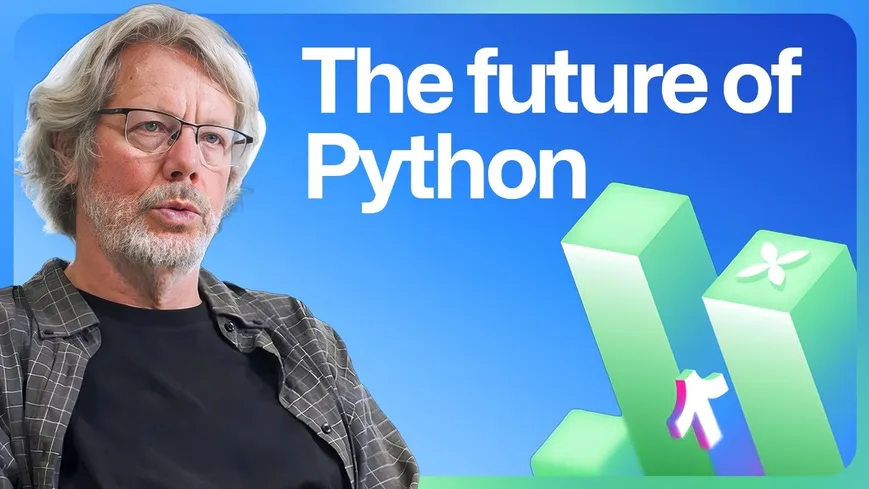
Guido van Rossum discussed Python's enduring relevance in AI and education at GitHub's Octoverse, emphasizing its clarity, accessibility, and community-driven growth despite TypeScript's rise.
Key Points
Highlight key points with color coding based on sentiment (positive, neutral, negative).Python was created by Guido van Rossum as a solution to the complexity of C and the limitations of shell scripting.
Python emphasized clarity, friendliness, and minimal friction, contributing to its widespread adoption in AI, data science, and education.
The name "Python" was inspired by Monty Python, reflecting a desire for the language to be approachable and fun.
Python has become integral to AI development due to its extensive ecosystem, including libraries like NumPy and PyTorch.
Python maintains stability through careful consideration of backward compatibility, ensuring it remains relevant and reliable for developers.
Guido van Rossum, the creator of Python, recently shared some candid thoughts at GitHub's Octoverse event. He was a bit surprised to see TypeScript leapfrogging Python as the most used language on GitHub. But let's not jump to conclusions - Python isn't exactly fading away. In fact, it saw a strong 49% growth in 2025 and remains a powerhouse in fields like AI, science, and education. Guido took a trip down memory lane, recalling how Python was born out of a desire to simplify the complexities of C and the limitations of shell scripting. He designed Python to be safer than C, with features like memory management and out-of-bounds indexing, all while keeping it user-friendly. From the start, Python was built on principles of clarity, friendliness, and minimal friction.
The name "Python" itself, inspired by Monty Python's Flying Circus, was chosen to inject a bit of fun into the programming world. This playful choice reflects the language's approachable nature, enhanced by its readability and a welcoming community. Python's ecosystem, with projects like NumPy, pandas, and PyTorch, has solidified its role in AI development. Guido highlighted that Python's optional typing system is perfectly adequate, suggesting that AI should adapt to developers, not the other way around.
Python's accessibility is a major draw for newcomers, thanks to its supportive community and abundant resources. Its clear syntax and helpful error messages make it an ideal starting point for beginners. Sure, some folks grumble about Python's use of indentation for grouping, but it's generally seen as a positive feature. The language's stability and backward compatibility are maintained through careful consideration of new features, like the introduction of soft keywords.
In the grand scheme of things, Python's values of readability, approachability, and stability keep it relevant in the changing world of software development, especially as AI continues to rise. Its thoughtful design and strong community support make it a powerful tool for both senior developers and those just starting out.
Key Numbers
Present key numerics and statistics in a minimalist format.Python's year-over-year growth rate on GitHub in 2025.
The month and year when TypeScript overtook Python as the most used language on GitHub.
The number of years since Guido van Rossum created Python, reflected in multiple decades of evolution.
The number of months Python existed before Guido demoed the early prototype to colleagues.
The number of new developers added in India in 2025 according to GitHub Octoverse.
The rate at which new developers join GitHub globally.
Percentage of new developers on GitHub using GitHub Copilot in their first week.
The number of new context-sensitive soft keywords introduced in recent Python syntax features.
Stakeholder Relationships
An interactive diagram mapping entities directly or indirectly involved in this news. Drag nodes to rearrange them and see relationship details.People
Key entities and stakeholders, categorized for clarity: people, organizations, tools, events, regulatory bodies, and industries.Discussed the origins, evolution, and growing influence of Python in an interview for GitHub Octoverse.
Organizations
Key entities and stakeholders, categorized for clarity: people, organizations, tools, events, regulatory bodies, and industries.Hosted the Octoverse event and interviewed Guido van Rossum about Python’s growth and relevance.
The research lab where Guido van Rossum created Python and where the first internal adoption occurred.
Tools
Key entities and stakeholders, categorized for clarity: people, organizations, tools, events, regulatory bodies, and industries.A widely used language known for readability, clarity, and accessibility in fields such as AI, science, and education.
A foundational numerical computing library that contributed heavily to Python’s dominance in AI and machine learning.
A widely used Python library for manipulating, cleaning, and analyzing structured data.
A major deep learning framework built in Python, widely adopted in AI research and industry.
A Python-based library that powers many modern NLP and LLM applications.
A tool for running large language models locally, part of Python’s broader modern AI ecosystem.
Events
Key entities and stakeholders, categorized for clarity: people, organizations, tools, events, regulatory bodies, and industries.The context of the interview, highlighting trends such as Python's 49% growth and changes in language popularity.
Industries
Key entities and stakeholders, categorized for clarity: people, organizations, tools, events, regulatory bodies, and industries.A field where Python remains dominant due to its ecosystem of scientific and machine learning libraries.
Researchers rely on Python for numerical computing, data processing, and simulation.
Python’s readability makes it one of the most widely taught first programming languages worldwide.
Timeline of Events
Timeline of key events and milestones.Guido van Rossum began developing Python during the Christmas holidays as a hobby project aimed at improving on the limitations of shell scripting and the complexity of C.
Python’s first prototype spread through CWI in Amsterdam, where researchers began using it for internal tools, providing feedback and early bug fixes.
Guido released Python 0.9.0 publicly, establishing Python as an open-source project from the start.
Python 2.0 introduced significant features such as list comprehensions and garbage collection, accelerating the language’s adoption.
A major redesign focused on long-term clarity and consistency, emphasizing backward-incompatible improvements.
GitHub’s Octoverse report revealed that TypeScript overtook Python as the most used language in repositories built during the previous 12 months.
Despite losing the #1 spot to TypeScript, Python grew 49% YoY on GitHub, driven by AI, data science, education, and rapid ecosystem expansion.
Octoverse data highlighted India’s rapid developer growth, contributing significantly to the global Python community.
GitHub recorded an in-depth interview with Guido van Rossum discussing Python’s origins, design philosophy, AI influence, and future direction.
Additional Resources
Enjoyed it?
Get weekly updates delivered straight to your inbox, it only takes 3 seconds!Subscribe to our weekly newsletter Kala to receive similar updates for free!
Give a Pawfive to this post!
Share with your friends and followers
Start writing about what excites you in tech — connect with developers, grow your voice, and get rewarded.
Join other developers and claim your FAUN.dev() account now!

FAUN.dev()
FAUN.dev() is a developer-first platform built with a simple goal: help engineers stay sharp withou…



Kala #GenAI
FAUN.dev()
@kalaDeveloper Influence
21
Influence
1
Total Hits
131
Posts