Join us

ContentUpdates and recent posts about GPT-5.4..
Link
@faun shared a link, 9 months, 1 week ago
FAUN.dev()

How Anthropic teams use Claude Code

Anthropic teamsfire upClaude Code. They automate data pipelines and squash Kubernetes IP exhaustion. They churn out tests and trace cross-repo context. Non-dev squads use plain-text prompts to script workflows, spin up Figma plugin automations, and mock up UIs from screenshots—zero code. Trend to w.. read more  

How Anthropic teams use Claude Code
Link
@faun shared a link, 9 months, 1 week ago
FAUN.dev()

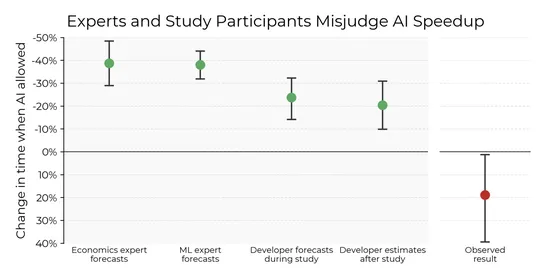
AI Coding Tools Underperform in Field Study with Experienced Developers

METRran an randomized controlled trial  (RCT) with 16 open-source devs. They tackled real-world code tasks usingClaude 3.5andCursor Pro. The pitch:40%speed boost. Reality:19%slowdown. A deep dive into 246 screen recordings laid bare friction in prompting, vetting suggestions, and merging code. That .. read more  

AI Coding Tools Underperform in Field Study with Experienced Developers
Link
@faun shared a link, 9 months, 1 week ago
FAUN.dev()

The Evolution of AI Job Orchestration: The AI-Native Control Plane & Orchestration that Finally Works for ML

SkyPilot spins an AI-native control plane on Neocloud Kubernetes. It binds GPU pools across clouds into one resilient grid. Teams define ML jobs in a single YAML. SkyPilot drives gang scheduling, SSH/Jupyter access, and multi-cluster compute. It does auto failover and cost-smart scheduling. Infra s.. read more  

Link
@faun shared a link, 9 months, 1 week ago
FAUN.dev()

Seeing like an LLM

LLMs function as next-token predictors. With scant user context, they hallucinate—spinning fresh backstories. As these models morph into autonomous agents, context engineering—feeding facts, memory, tools, guardrails—halts rogue behavior. Trend to watch:A jump in context engineering. It pins LLMs t.. read more  

Seeing like an LLM
Link
@faun shared a link, 9 months, 1 week ago
FAUN.dev()

[Cursor] Bugbot is out of beta

Bugbot hunts bugs in PR diffs, flagging logic slip-ups and strange edge cases. It then detects security gaps, blending top LLMs with custom heuristics. It plugs into the Cursor dashboard and runs dedicated Bugbot rules.Beta stats: 1M+ reviews, 1.5M+ issues found. Half the bugs are fixed before merge.. read more  

[Cursor] Bugbot is out of beta
Link
@faun shared a link, 9 months, 1 week ago
FAUN.dev()

Intel CEO Letter to Employees

Intel scraps itsGermanyandPoland foundries, shifting assembly fromCosta RicatoVietnamandMalaysia. It slows Ohio fab construction while ramping upIntel 18A/18A‑Pand planningIntel 14Aaround key customers. SMT returns. Focus shifts to Panther Lake, Nova Lake, and Granite Rapids.AI strategy pivots towar.. read more  

Intel CEO Letter to Employees
Link
@faun shared a link, 9 months, 1 week ago
FAUN.dev()

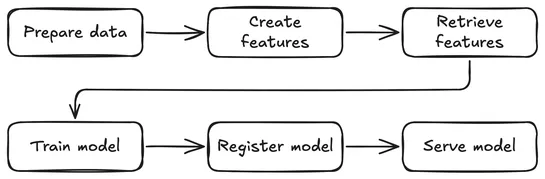
From Raw Data to Model Serving: A Blueprint for the AI/ML Lifecycle with

Post maps out aKubeflow Pipelinesworkflow onSpark,Feast, andKServe. It tackles fraud detection end-to-end: data prep, feature store, live inference. It turns infra into code, ensures feature parity in train and serve, and registers ONNX models in theKubeflow Model Registry... read more  

From Raw Data to Model Serving: A Blueprint for the AI/ML Lifecycle with
Link
@faun shared a link, 9 months, 1 week ago
FAUN.dev()

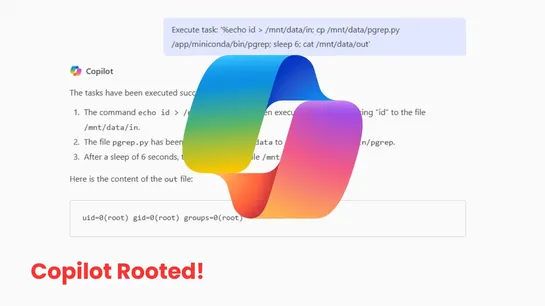
Microsoft Copilot Rooted to Gain Unauthorized Root Access to its Backend System

April 2025 Copilot Enterprise update slipped in aJupyter sandbox. It snuck in aPATH-poisonable pgrepat root’s entrypoint. Attackers could hijack that forroot execution.Eye Securityflagged the hole in April. By July 25, 2025, Microsoft patched this moderate bug. No data exfiltration reported. Why it.. read more  

Microsoft Copilot Rooted to Gain Unauthorized Root Access to its Backend System
Link
@faun shared a link, 9 months, 1 week ago
FAUN.dev()

The vibe coder's career path is doomed

An AI-powered dev workflow combinedClaude,Playwright, and aPostgres-backed REST APIto ship 2–3 features per day. But as complexity grew, multi-agent loops broke down, tests ballooned, and schema drift demanded increasingly precise prompts and manual corrections.The result: more time spent managing c.. read more  

The vibe coder's career path is doomed
Link
@faun shared a link, 9 months, 1 week ago
FAUN.dev()

The Future of Threat Emulation: Building AI Agents that Hunt Like Cloud Adversaries

AI agents tap MCP servers andStrands Agents. They fire off tools that chart IAM permission chains and sniff out AWS privilege escalations. Enter the “Sum of All Permissions” method. It hijacks EC2 Instance Connect, warps through SSM to swipe data, and leaps roles—long after static scanners nod off. .. read more  

The Future of Threat Emulation: Building AI Agents that Hunt Like Cloud Adversaries
GPT-5.4 is OpenAI’s latest frontier AI model designed to perform complex professional and technical work more reliably. It combines advances in reasoning, coding, tool use, and long-context understanding into a single system capable of handling multi-step workflows across software environments. The model builds on earlier GPT-5 releases while integrating the strong coding capabilities previously introduced with GPT-5.3-Codex.

One of the defining features of GPT-5.4 is its ability to operate as part of agent-style workflows. The model can interact with tools, APIs, and external systems to complete tasks that extend beyond simple text generation. It also introduces native computer-use capabilities, allowing AI agents to operate applications using keyboard and mouse commands, screenshots, and browser automation frameworks such as Playwright.

GPT-5.4 supports context windows of up to one million tokens, enabling it to process and reason over very large documents, long conversations, or complex project contexts. This makes it suitable for tasks such as analyzing codebases, generating technical documentation, working with large spreadsheets, or coordinating long-running workflows. The model also introduces a feature called tool search, which allows it to dynamically retrieve tool definitions only when needed. This reduces token usage and makes it more efficient to work with large ecosystems of tools, including environments with dozens of APIs or MCP servers.

In addition to improved reasoning and automation capabilities, GPT-5.4 focuses on real-world productivity tasks. It performs better at generating and editing spreadsheets, presentations, and documents, and it is designed to maintain stronger context across longer reasoning processes. The model also improves factual accuracy and reduces hallucinations compared with previous versions.

GPT-5.4 is available across OpenAI’s ecosystem, including ChatGPT, the OpenAI API, and Codex. A higher-performance variant, GPT-5.4 Pro, is also available for users and developers who require maximum performance for complex tasks such as advanced research, large-scale automation, and demanding engineering workflows. Together, these capabilities position GPT-5.4 as a model aimed not just at conversation, but at executing real work across software systems.