Join us

ContentUpdates and recent posts about GPT-5.4..
Link
@faun shared a link, 7 months, 2 weeks ago
FAUN.dev()

Paused Kubernetes project finds path forward

TheExternal Secrets Operator (ESO)is moving again. After hitting pause from maintainer burnout, it’s back under CNCF incubation—with a rebooted structure in place. New governance, clear contributor paths, and support tracks for CI, core dev, and testing are all in. But don’t expect fresh releases ju.. read more  

Paused Kubernetes project finds path forward
Link
@faun shared a link, 7 months, 2 weeks ago
FAUN.dev()

The Hidden AWS Cost Traps No One Warns You About (and How I Avoid Them)

Calling outfive sneaky AWS cost traps—the kind that creep in through overlooked defaults and quiet misconfigs, then blow up your bill while no one's watching... read more  

The Hidden AWS Cost Traps No One Warns You About (and How I Avoid Them)
Link
@faun shared a link, 7 months, 2 weeks ago
FAUN.dev()

24 Best Command Line Performance Monitoring Tools for Linux

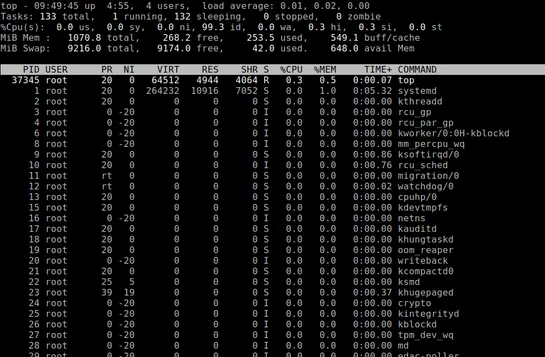
A fresh look at Linux monitoring tools shows the classics still hold—but the visual crowd’s moving in. Old-school command-liners liketopandvmstatremain go-to’s for quick reads. But picks likeNetdata,btop, andMonitbring dashboards, colors, and actual UX. Tools likeiftop,Nmon, andSuricatastretch deep.. read more  

24 Best Command Line Performance Monitoring Tools for Linux
Link
@faun shared a link, 7 months, 2 weeks ago
FAUN.dev()

Subverting code integrity checks to locally backdoor Signal, 1Password, Slack, and more

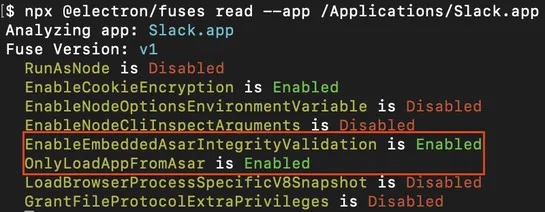
A fresh CVE (2025-55305) just put Electron apps in the hot seat. The bug? Chromium-based apps fail to treatV8 heap snapshot filesas potential attack vectors. That crack lets unsigned JavaScript slip past code signing and run inside heavyweight targets like Slack, 1Password, and Signal. The heart of.. read more  

Subverting code integrity checks to locally backdoor Signal, 1Password, Slack, and more
Link
@faun shared a link, 7 months, 2 weeks ago
FAUN.dev()

Amazon EKS Enables Ultra-Scale AI/ML Workloads with Support for 100K Nodes per Cluster

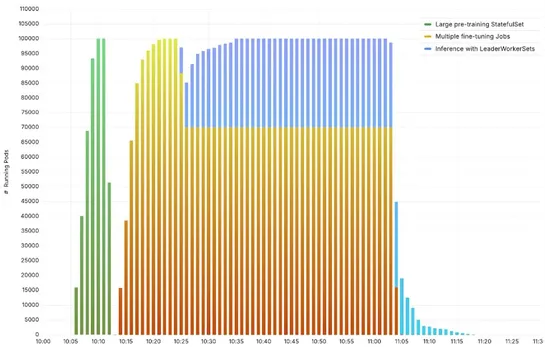
Amazon EKS just cranked its Kubernetes cluster limit to100,000 nodes—a 10x jump. The secret sauce? A reworkedetcdwith an internaljournalsystem andin-memorystorage. Toss in tightAPI server tuningand network tweaks, and the result is wild: 500 pods per second, 900K pods, 10M+ objects, no sweat—even un.. read more  

Amazon EKS Enables Ultra-Scale AI/ML Workloads with Support for 100K Nodes per Cluster
Link
@faun shared a link, 7 months, 2 weeks ago
FAUN.dev()

Kubernetes right-sizing with metrics-driven GitOps automation

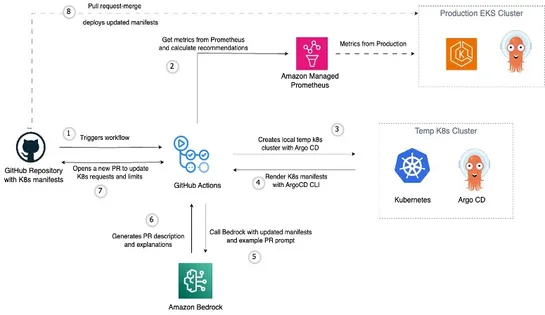
AWS just dropped a GitOps-native pattern for tuning EKS resources—built to runoutsidethe cluster. It’s wired up withAmazon Managed Service for Prometheus,Argo CD, andBedrockto automate resource recommendations straight into Git. Here’s the play: it maps usage metrics to templated manifests, then sp.. read more  

Kubernetes right-sizing with metrics-driven GitOps automation
Link
@faun shared a link, 7 months, 2 weeks ago
FAUN.dev()

Kubernetes Primer: Dynamic Resource Allocation (DRA) for GPU Workloads

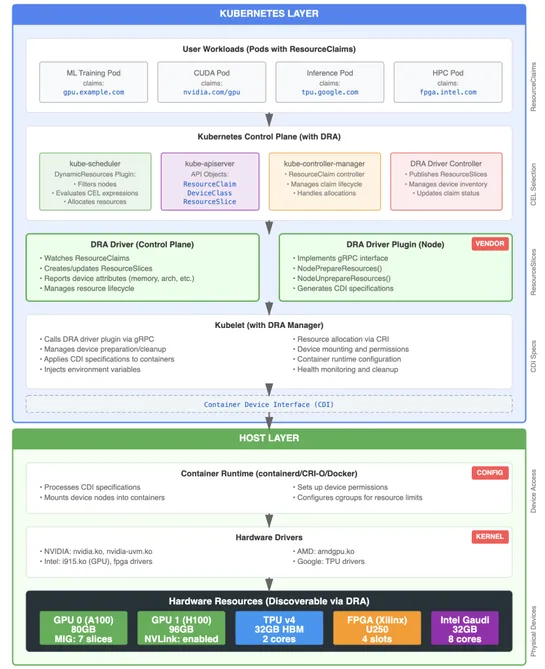
Kubernetes 1.34 brings serious heat for anyone juggling GPUs or accelerators. MeetDynamic Resource Allocation (DRA)—a new way to schedule hardware like you mean it. DRA addsResourceClaims,DeviceClasses, andResourceSlices, slicing device management away from pod specs. It replaces the old device plu.. read more  

Kubernetes Primer: Dynamic Resource Allocation (DRA) for GPU Workloads
Link
@faun shared a link, 7 months, 2 weeks ago
FAUN.dev()

Lucidity turns spotlight onto Kubernetes storage costs

Lucidity has upgraded itsAutoScaler. It now handles persistent volumes on AWS-hosted Kubernetes, automatically scaling storage and reducing waste. The upgrade bringspod-level isolation,fault tolerance, andbulk Linux onboarding. Azure and GCP are next on the list... read more  

Lucidity turns spotlight onto Kubernetes storage costs
Link
@faun shared a link, 7 months, 2 weeks ago
FAUN.dev()

The Quiet Revolution in Kubernetes Security

Nigel Douglas discusses the challenges of security in Kubernetes, particularly with traditional base operating systems. Talos Linux offers a different approach with a secure-by-default, API-driven model specifically for Kubernetes. CISOs play a critical role in guiding organizations through the shif.. read more  

Link
@faun shared a link, 7 months, 2 weeks ago
FAUN.dev()

Kubernetes DNS Exploit Enables Git Credential Theft from ArgoCD

A new attack chain messes withKubernetes DNS resolutionandArgoCD’s certificate injectionto swipe GitHub credentials. With the right permissions, a user inside the cluster can reroute GitOps traffic to a fake internal service, sniff auth headers, and quietly walk off with tokens. What’s broken:GitOp.. read more  

Kubernetes DNS Exploit Enables Git Credential Theft from ArgoCD
GPT-5.4 is OpenAI’s latest frontier AI model designed to perform complex professional and technical work more reliably. It combines advances in reasoning, coding, tool use, and long-context understanding into a single system capable of handling multi-step workflows across software environments. The model builds on earlier GPT-5 releases while integrating the strong coding capabilities previously introduced with GPT-5.3-Codex.

One of the defining features of GPT-5.4 is its ability to operate as part of agent-style workflows. The model can interact with tools, APIs, and external systems to complete tasks that extend beyond simple text generation. It also introduces native computer-use capabilities, allowing AI agents to operate applications using keyboard and mouse commands, screenshots, and browser automation frameworks such as Playwright.

GPT-5.4 supports context windows of up to one million tokens, enabling it to process and reason over very large documents, long conversations, or complex project contexts. This makes it suitable for tasks such as analyzing codebases, generating technical documentation, working with large spreadsheets, or coordinating long-running workflows. The model also introduces a feature called tool search, which allows it to dynamically retrieve tool definitions only when needed. This reduces token usage and makes it more efficient to work with large ecosystems of tools, including environments with dozens of APIs or MCP servers.

In addition to improved reasoning and automation capabilities, GPT-5.4 focuses on real-world productivity tasks. It performs better at generating and editing spreadsheets, presentations, and documents, and it is designed to maintain stronger context across longer reasoning processes. The model also improves factual accuracy and reduces hallucinations compared with previous versions.

GPT-5.4 is available across OpenAI’s ecosystem, including ChatGPT, the OpenAI API, and Codex. A higher-performance variant, GPT-5.4 Pro, is also available for users and developers who require maximum performance for complex tasks such as advanced research, large-scale automation, and demanding engineering workflows. Together, these capabilities position GPT-5.4 as a model aimed not just at conversation, but at executing real work across software systems.