Join us

ContentUpdates and recent posts about Flask..
Link
@faun shared a link, 8 months, 3 weeks ago
FAUN.dev()

Building Agents for Small Language Models: A Deep Dive into Lightweight AI

Agent engineering with **small language models (SLMs)**—anywhere from 270M to 32B parameters—calls for a different playbook. Think tight prompts, offloaded logic, clean I/O, and systems that don’t fall apart when things go sideways. The newer stack—**GGUF** + **llama.cpp**—lets these agents run loc.. read more  
Link
@faun shared a link, 8 months, 3 weeks ago
FAUN.dev()

Magical systems thinking

AI now writes over **25% of Google’s** and as much as **90% of Anthropic’s** code. That’s not a trend—it’s a regime change. Still, the mess in large public systems reminds us: clever analysis isn’t enough. Complex systems don’t behave; they misbehave. When the machines are churning out code, the .. read more  

Magical systems thinking
Link
@faun shared a link, 8 months, 3 weeks ago
FAUN.dev()

Writing an operating system kernel from scratch

A barebonestime-sharing OS kernel, written inZig, running onRISC-V. It leans onOpenSBIfor console I/O and timer interrupts. Threads? Statically allocated, each running inuser mode (U-mode). The kernel stays insupervisor mode (S-mode), where it catchessystem callsandcontext switchesvia timer ticks. .. read more  

Writing an operating system kernel from scratch
Link
@faun shared a link, 8 months, 3 weeks ago
FAUN.dev()

Scaling Prometheus: Managing 80M Metrics Smoothly

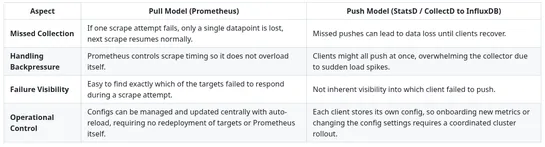
Flipkart ditched its creakyStatsD + InfluxDBstack for afederated Prometheussetup—built to handle 80M+ time-series metrics without choking. The move leaned intopull-based collection,PromQL's firepower, andhierarchical federationfor smarter aggregation and long-haul queries. Why it matters:Prometheus.. read more  

Scaling Prometheus: Managing 80M Metrics Smoothly
Link
@faun shared a link, 8 months, 3 weeks ago
FAUN.dev()

PostgreSQL maintenance without superuser

PostgreSQL’s moving in on superusers. As of recent releases—starting way back in v9.6 and maturing through PostgreSQL 18 (coming 2025)—there are now **15+ built-in admin roles**. No need to hand out superuser just to get things done. These roles cover the ops spectrum: monitoring, backups, fil.. read more  

PostgreSQL maintenance without superuser
Link
@faun shared a link, 8 months, 3 weeks ago
FAUN.dev()

Accelerate serverless testing with LocalStack integration in VS Code IDE

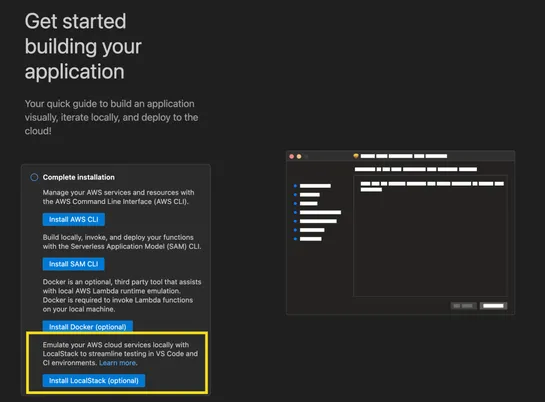
The AWS Toolkit for VS Code now hooks straight into **LocalStack**. Run full end-to-end tests for **serverless workflows**—Lambda, SQS, EventBridge, the whole crew—without bouncing between tools or writing boilerplate. Just deploy to LocalStack from the IDE using the **AWS SAM CLI**. It feels like .. read more  

Accelerate serverless testing with LocalStack integration in VS Code IDE
Link
@faun shared a link, 8 months, 3 weeks ago
FAUN.dev()

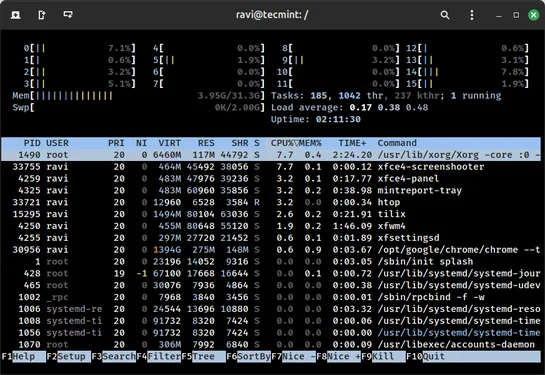
Best 20 Linux Commands for Daily Use in Production Servers

A fresh roundup drops20 go-to Linux commandsfor production sysadmins, dialing in on modern defaults likehtop > top,ss > netstat, andip > ifconfig. The shift? Faster tools that actually get updates. Built with systemd in mind, too. Expect the usual suspects—journalctl,rsync,crontab—all still pulling.. read more  

Best 20 Linux Commands for Daily Use in Production Servers
Link
@faun shared a link, 8 months, 3 weeks ago
FAUN.dev()

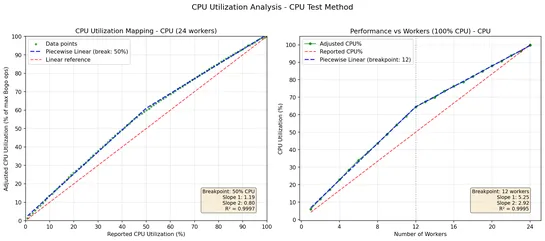
%CPU Utilization Is A Lie

Stress tests on the Ryzen 9 5900X uncovered a big gap between **reported CPU utilization** and what the chip actually pushes. Around 50% on paper? Could mean close to full throttle in reality—thanks to sneaky behaviors from **SMT resource sharing** and **Turbo frequency scaling**. **Takeaway:** Raw.. read more  

%CPU Utilization Is A Lie
Link
@faun shared a link, 8 months, 3 weeks ago
FAUN.dev()

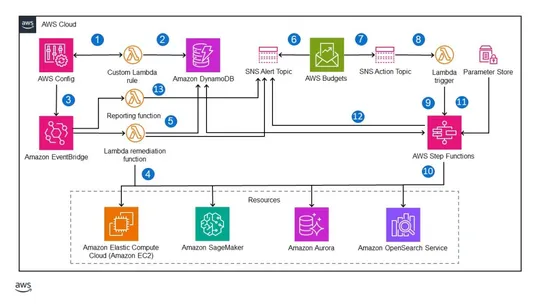
Introducing Budget Controls for AWS: Automatically Manage Your Cloud Costs

**Budget Controls for AWS** just got better. The open-source tool now reins in more than just EC2. It wrangles **RDS Aurora**, **SageMaker**, and **OpenSearch** too. Under the hood, it taps **AWS Budgets**, **AWS Config**, and **custom tags** to watch spend like a hawk. Hit a budget threshold? It c.. read more  

Introducing Budget Controls for AWS: Automatically Manage Your Cloud Costs
Link
@faun shared a link, 8 months, 3 weeks ago
FAUN.dev()

SLI Evolution Stages

A new SLI evolution model lays out a maturity roadmap—from rebranded latency/error metrics to ones that actually track business impact. It replaces shallow signals and pulls in the stuff that matters: how service failures hit user goals, tasks, and bottom lines... read more  

SLI Evolution Stages
Flask is an open-source web framework written in Python and created by Armin Ronacher in 2010. It is known as a microframework, not because it is weak or incomplete, but because it provides only the essential building blocks for developing web applications. Its core focuses on handling HTTP requests, defining routes, and rendering templates, while leaving decisions about databases, authentication, form handling, and other components to the developer. This minimalistic design makes Flask lightweight, flexible, and easy to learn, but also powerful enough to support complex systems when extended with the right tools.

At the heart of Flask are two libraries: Werkzeug, which is a WSGI utility library that handles the low-level details of communication between web servers and applications, and Jinja2, a templating engine that allows developers to write dynamic HTML pages with embedded Python logic. By combining these two, Flask provides a clean and pythonic way to create web applications without imposing strict architectural patterns.

One of the defining characteristics of Flask is its explicitness. Unlike larger frameworks such as Django, Flask does not try to hide complexity behind layers of abstraction or dictate how a project should be structured. Instead, it gives developers complete control over how they organize their code and which tools they integrate. This explicit nature makes applications easier to reason about and gives teams the freedom to design solutions that match their exact needs. At the same time, Flask benefits from a vast ecosystem of extensions contributed by the community. These extensions cover areas such as database integration through SQLAlchemy, user session and authentication management, form validation with CSRF protection, and database migration handling. This modular approach means a developer can start with a very simple application and gradually add only the pieces they require, avoiding the overhead of unused components.

Flask is also widely appreciated for its simplicity and approachability. Many developers write their first web application in Flask because the learning curve is gentle, the documentation is clear, and the framework itself avoids unnecessary complexity. It is particularly well suited for building prototypes, REST APIs, microservices, or small to medium-sized web applications. At the same time, production-grade deployments are supported by running Flask applications on WSGI servers such as Gunicorn or uWSGI, since the development server included with Flask is intended only for testing and debugging.

The strengths of Flask lie in its minimalism, flexibility, and extensibility. It gives developers the freedom to assemble their application architecture, choose their own libraries, and maintain tight control over how things work under the hood. This is attractive to experienced engineers who dislike being boxed in by heavy frameworks. However, the same freedom can become a limitation. Flask does not include features like an ORM, admin interface, or built-in authentication system, which means teams working on very large applications must take on more responsibility for enforcing patterns and maintaining consistency. In situations where a project requires an opinionated, all-in-one solution, Django or another full-stack framework may be a better fit.

In practice, Flask has grown far beyond its initial positioning as a lightweight tool. It has been used by startups for rapid prototypes and by large companies for production systems. Its design philosophy—keep the core simple, make extensions easy, and let developers decide—continues to attract both beginners and professionals. This balance between simplicity and power has made Flask one of the most enduring and widely used Python web frameworks.