Join us

ContentUpdates and recent posts about Snap..
News FAUN.dev() Team
@devopslinks shared an update, 4 hours ago
FAUN.dev()

Ubuntu's Next Chapter: Local AI, Confined Agents, and a Bet Against the Cloud-First OS

Ubuntu Ollama Snap

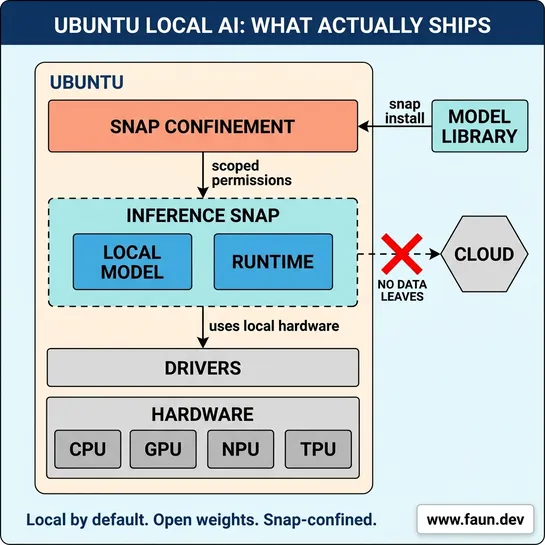
Ubuntu is getting local AI as a native capability over the next year, with inference snaps that install models like any other package, AI-powered accessibility features, and confined agentic workflows for both desktops and server fleets. Canonical is betting on open weight models, local-by-default inference, and snap confinement, a deliberate counter to the cloud-first AI direction Microsoft, Apple, and Google are taking with their operating systems.

Ubuntu's Next Chapter: Local AI, Confined Agents, and a Bet Against the Cloud-First OS
 Activity
@devopslinks added a new tool Snap , 5 hours, 6 minutes ago.
Snap is a software packaging and deployment system developed by Canonical for Linux distributions. A snap is a self-contained package that bundles an application together with its dependencies, making it runnable across any distribution that supports the snapd daemon. Snaps run under strict confinement using a combination of AppArmor, seccomp, and cgroups, with explicit interfaces controlling access to system resources, hardware, and user data.

Updates are delivered automatically and atomically through the Snap Store (snapcraft.io), with built-in rollback support if an update fails.

Snap supports multiple release channels (stable, candidate, beta, edge) and tracks for parallel version streams, making it suitable for both end-user applications and server software.

While Snap originated as Canonical's solution for Ubuntu, it works across most major distributions including Fedora, Arch, Debian, and openSUSE. It is the foundation for several Canonical initiatives including Ubuntu Core, IoT deployments, and inference snaps for local AI model distribution.