Join us

ContentUpdates and recent posts about Slurm..
Link
@faun shared a link, 8 months, 3 weeks ago
FAUN.dev()

Google Develops KFuzzTest For Fuzzing Internal Linux Kernel Functions

Google droppedKFuzzTest, a lean fuzzing tool built to hit Linux kernel internals—way past just syscalls. It brings a clean API, docs, and sample targets to get fuzzing fast. Why it matters:KFuzzTest marks a shift. Kernel fuzzing’s no longer just about hammering syscalls—it’s going deeper into the g.. read more  

Link
@faun shared a link, 8 months, 3 weeks ago
FAUN.dev()

v1.34: User preferences (kuberc) are available for testing in kubectl 1.34

Kubernetes v1.34 pusheskubectlinto the future with a betauser preferencessystem. Drop a.kubercfile in place, and you can bake in default flags, toggle features likeinteractive deleteorServer-Side Apply, and wire up custom aliases—including pre- and post-args... read more  

Link
@faun shared a link, 8 months, 3 weeks ago
FAUN.dev()

Battle for Resources or the SSA Path to Kubernetes Diplomacy

A full-stack engineer and systems architect with hands-on time incloudandIoT, building real-world tools for theoil and gas sector. Think connected rigs, smart pipelines, and infrastructure that doesn’t flinch at scale. Market signal:Industrial tech’s going deep. Cloud and IoT aren’t side projects a.. read more  

Link
@faun shared a link, 8 months, 3 weeks ago
FAUN.dev()

Kubernetes in an AI-Native World: Can It Stay Relevant?

At KubeCon + CloudNativeCon Hyderabad 2025, CNCF leads made it clear:cloud-native infraisn’t just supporting AI—it’s becoming its backbone. The conversation’s moved on from“Can Kubernetes run AI?”to“How does it evolve for AI-first everything?”.. read more  

Kubernetes in an AI-Native World: Can It Stay Relevant?
Link
@faun shared a link, 8 months, 3 weeks ago
FAUN.dev()

An introduction to platform engineering

Platform engineering is stepping in where DevOps didn’t quite land. Think fewer duct-taped pipelines, more thoughtful systems. The fix? Internal Developer Platforms (IDPs), usually riding on Kubernetes, built to tame the sprawl. Gartner says 80% of big engineering orgs will run platform teams by 20.. read more  

An introduction to platform engineering
Link
@faun shared a link, 8 months, 3 weeks ago
FAUN.dev()

kube-bench Tutorial: Features, Use Cases, How It Works

kube-benchjust leveled up. Aqua Security’s CIS compliance scanner now snaps into CI/CD, runs pre-deploy checks, and helps dig through forensics after incidents. It plays nice with managed K8s—EKS, AKS, GKE—and handles custom YAML test suites if you’re going off the beaten path. Reports land in stru.. read more  

kube-bench Tutorial: Features, Use Cases, How It Works
Link
@faun shared a link, 8 months, 3 weeks ago
FAUN.dev()

CNCF Incubates OpenYurt for Kubernetes at the Edge

OpenYurt just leveled up—now officially an incubating project under the CNCF. It pushes Kubernetes out past the data center, into the messy edges of the network, without breaking upstream compatibility. No forks, no duct tape. The maintainer roster’s growing too. Folks fromVMware,Microsoft, andInte.. read more  

CNCF Incubates OpenYurt for Kubernetes at the Edge
Link
@faun shared a link, 8 months, 3 weeks ago
FAUN.dev()

v1.34: Of Wind & Will (O' WaW)

Kubernetes v1.34 drops with58 updates, and23 just hit stable. Highlights: Dynamic Resource Allocation (DRA), per-Pod resource limits, and secure image pulls using Pod-specific ServiceAccount tokens. Scalability gets a lift from streaming list responses. Security tightens with finer anonymous auth r.. read more  

v1.34: Of Wind & Will (O' WaW)
Link
@faun shared a link, 8 months, 3 weeks ago
FAUN.dev()

Kubernetes v1.34 brings networking refinements for cloud-native infrastructure

Kubernetes 1.34 comes packed withnetworking upgradesbuilt for scale. Less overhead. Fewer headaches. Easier to run big clusters without sweating packet flows. This triannual release keeps pushing the envelope for both cloud-native setups and the on-prem diehards... read more  

Link
@faun shared a link, 8 months, 3 weeks ago
FAUN.dev()

Evolving Kubernetes for generative AI inference

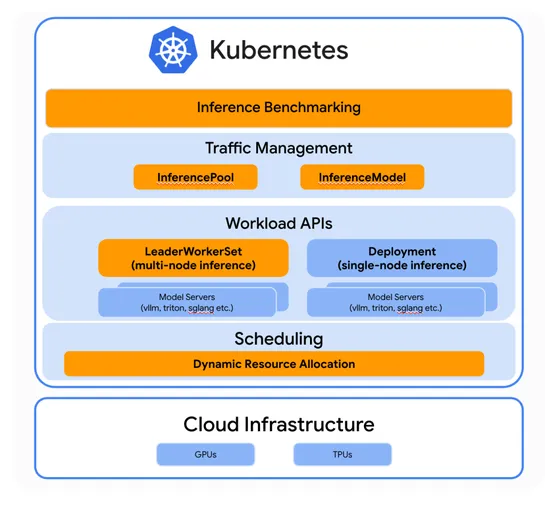
Google Cloud, ByteDance, and Red Hat are wiring AI smarts straight intoKubernetes. Think: faster inference benchmarks, smarter LLM-aware routing, and on-the-fly resource juggling—all built to handle GenAI heat. Their new push,llm-d, bakesvLLMdeep into Kubernetes. That unlocks disaggregated serving .. read more  

Evolving Kubernetes for generative AI inference
Slurm Workload Manager is an open-source, fault-tolerant, and highly scalable cluster management and scheduling system widely used in high-performance computing (HPC). Designed to operate without kernel modifications, Slurm coordinates thousands of compute nodes by allocating resources, launching and monitoring jobs, and managing contention through its flexible scheduling queue.

At its core, Slurm uses a centralized controller (slurmctld) to track cluster state and assign work, while lightweight daemons (slurmd) on each node execute tasks and communicate hierarchically for fault tolerance. Optional components like slurmdbd and slurmrestd extend Slurm with accounting and REST APIs. A rich set of commands—such as srun, squeue, scancel, and sinfo—gives users and administrators full visibility and control.

Slurm’s modular plugin architecture supports nearly every aspect of cluster operation, including authentication, MPI integration, container runtimes, resource limits, energy accounting, topology-aware scheduling, preemption, and GPU management via Generic Resources (GRES). Nodes are organized into partitions, enabling sophisticated policies for job size, priority, fairness, oversubscription, reservation, and resource exclusivity.

Widely adopted across academia, research labs, and enterprise HPC environments, Slurm serves as the backbone for many of the world’s top supercomputers, offering a battle-tested, flexible, and highly configurable framework for large-scale distributed computing.