Join us

ContentUpdates and recent posts about Sigstore..
Link
@kala shared a link, 5 months, 1 week ago
FAUN.dev()

The 1 Billion Token Challenge: Finding the Perfect Pre-training Mix

Researchers squeezed GPT-2-class performance out of a model trained on just1 billion tokens- 10× less data - by dialing in a sharp dataset mix:50% finePDFs, 30% DCLM-baseline, 20% FineWeb-Edu. Static mixing beat curriculum strategies. No catastrophic forgetting. No overfitting. And it hit90%+of GPT-.. read more  
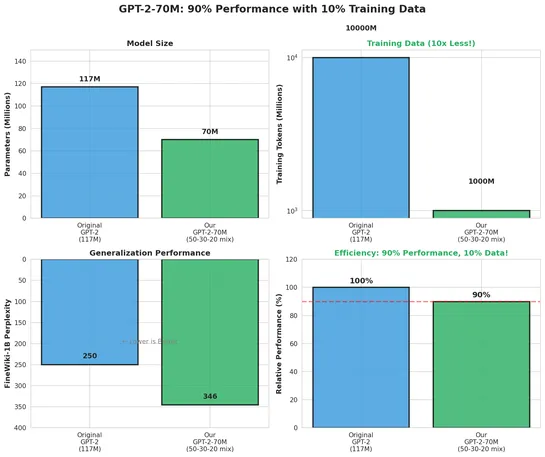
The 1 Billion Token Challenge: Finding the Perfect Pre-training Mix
Link
@kala shared a link, 5 months, 1 week ago
FAUN.dev()

Jensen Huang's Stark Warning: China's 1 Million AI Workers vs America's 20,000

Nvidia CEO Jensen Huang, in some leaked comments, didn’t mince words: U.S. export bans aren’t hobbling China’s AI game - they’re fueling it. He pointed to Huawei’s 910C chip edging close to H100 territory, a forecast putting China ahead in AI compute by 2027, and a fast-growing local chip industry n.. read more  

Jensen Huang's Stark Warning: China's 1 Million AI Workers vs America's 20,000
Link
@kala shared a link, 5 months, 1 week ago
FAUN.dev()

Context Management in Amp

Amp stretches the context window into something more useful. It pulls in system prompts, tool info, runtime metadata, even AGENTS.md files - fuel for agentic behavior. It gives devs serious control: edit messages, fork threads, drop in files with @mentions, hand off conversations, or link threads to.. read more  

Context Management in Amp
Link
@kala shared a link, 5 months, 1 week ago
FAUN.dev()

Inside Cursor - Sixty days with the AI coding decacorn

Cursor is shaking up recruiting by treating the hiring process as more about the person than the job, resulting in a fast-growing team of exceptional individuals drawn in by the company's compelling mission and focus on challenging technical problems. Women in product and engineering roles are a kno.. read more  

Link
@kala shared a link, 5 months, 1 week ago
FAUN.dev()

Google to release Nano Banana Pro next week

Google dropsGemini 3and the newNano Banana Pronext week. Big swing at image generation - now tied tight to Gemini 3 Pro. Early glimpses in Google Vids hint Nano Banana Pro is built for sharper visuals in creative tools. System shift:Google’s stacking its apps behind a single backbone: Gemini 3 Pro. .. read more  

Google to release Nano Banana Pro next week
Link
@kala shared a link, 5 months, 1 week ago
FAUN.dev()

LaTeX, LLMs and Boring Technology 

LLMs are tearing down LaTeX's old walls. Syntax hell, cryptic errors, clunky formatting - easier now. Whether baked into editors or running solo, these models smooth the pain. Why does it work so well? LaTeX has history. Mountains of examples. It's the perfect training set. That puts newer contender.. read more  

Link
@kala shared a link, 5 months, 1 week ago
FAUN.dev()

Introducing structured output for Custom Model Import in Amazon Bedrock

Amazon Bedrock’s Custom Model Import just got structured output support. Now LLMs can lock their responses to your JSON schema - no prompt hacks, no cleanup after... read more  

Link
@kala shared a link, 5 months, 1 week ago
FAUN.dev()

The Fatal Math Error Killing Every AI Architecture - Including The New Ones

LLMs are fading as JEPA (Joint Embedding Predictive Architecture) emerges with joint, embedding, predictive architecture. JEPA is a step towards true intelligence by avoiding the flat, finite spreadsheet trap of Euclidean space and opting for a toroidal model... read more  

Link
@kala shared a link, 5 months, 1 week ago
FAUN.dev()

Building a Healthcare Robot from Simulation to Deployment with NVIDIA Isaac

NVIDIA just droppedIsaac for Healthcare v0.4, and it’s a big one. Headliner: the newSO-ARM starter workflow- a full-stack sim2real pipeline built for surgical robotics. It covers the whole loop: spin up synthetic and real-world data capture, train withGR00t N1.5, and deploy straight to 6-DOF hardwar.. read more  

Link
@devopslinks shared a link, 5 months, 1 week ago
FAUN.dev()

Visibility at Scale: How Detects Sensitive Data Exposure

Segment gutted its old permissions table—bloated, slow, tangled in logic - and replaced it with a lean, service-based setup. The new stack runs onPostgres,Redis, and a sharply tunedGo API, cutting query times from 1400ms to under 100ms. Clean, fast, and centralized... read more  

Visibility at Scale: How Detects Sensitive Data Exposure
Sigstore is an open source initiative designed to make software artifact signing and verification simple, automatic, and widely accessible. Its primary goal is to improve software supply chain security by enabling developers and organizations to cryptographically prove the origin and integrity of the software they build and distribute.

At its core, sigstore removes many of the traditional barriers associated with code signing. Instead of managing long-lived private keys manually, sigstore supports keyless signing, where identities are issued dynamically using OpenID Connect (OIDC) providers such as GitHub Actions, Google, or Microsoft. This dramatically lowers operational complexity and reduces the risk of key compromise.

The sigstore ecosystem is composed of several key components:

- Cosign: A tool for signing, verifying, and storing signatures for container images and other artifacts. Signatures are stored alongside artifacts in OCI registries, rather than embedded in them.

- Fulcio: A certificate authority that issues short-lived X.509 certificates based on OIDC identities, enabling keyless signing.

- Rekor: A transparency log that records signing events in an append-only, tamper-evident ledger. This provides public auditability and detection of suspicious or malicious signing activity.

Together, these components allow anyone to verify who built an artifact, when it was built, and whether it has been tampered with, using publicly verifiable cryptographic proofs. This aligns closely with modern supply chain security practices such as SLSA (Supply-chain Levels for Software Artifacts).

sigstore is widely adopted in the cloud-native ecosystem and integrates with tools like Kubernetes, container registries, CI/CD pipelines, and package managers. It is commonly used to sign container images, Helm charts, binaries, and SBOMs, and is increasingly becoming a baseline security requirement for production software delivery.

The project is governed by the OpenSSF (Open Source Security Foundation) and supported by major industry players.