Join us

ContentUpdates and recent posts about Sigstore..
Link
@faun shared a link, 9 months, 1 week ago
FAUN.dev()

Pinterest Uncovers Rare Search Failure During Migration to Kubernetes

Pinterest hit a weird one-in-a-million query mismatch during its search infra move to Kubernetes. The culprit? A slippery timing bug. To catch it, engineers pulled out every trick—live traffic replays, their own diff tools, hybrid rollouts layered on both the legacy and K8s stacks. Painful, but it .. read more  

Pinterest Uncovers Rare Search Failure During Migration to Kubernetes
Link
@faun shared a link, 9 months, 1 week ago
FAUN.dev()

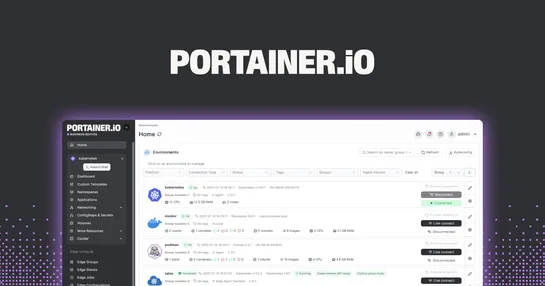
Estimate Your K8s Deployment Costs (Portainer Calculator)

A new TCO calculator breaks down what it really costs to run Kubernetes—DIY CNCF stacks, COSS platforms, and Portainer Business Edition. It crunches infra, labor, and software spend, then maps out staffing needs. It shows exactly where Portainer cuts Kubernetes bloat: itmaybe biased but it's worth t.. read more  

Estimate Your K8s Deployment Costs (Portainer Calculator)
Link
@faun shared a link, 9 months, 1 week ago
FAUN.dev()

Kubernetes 1.34 Debuts KYAML to Resolve YAML Challenges

Kubernetes 1.34 drops on August 27, 2025, and it’s bringingKYAML—a smarter, stricter take on YAML. No more surprise type coercion or “why is this indented wrong?” bugs. Think of it as YAML that behaves. kubectlgets a new trick too:-o kyaml. Use it to spit out manifests in KYAML format—easier to deb.. read more  

Kubernetes 1.34 Debuts KYAML to Resolve YAML Challenges
Link
@faun shared a link, 9 months, 1 week ago
FAUN.dev()

How I Cut AWS Compute Costs by 70% with a Multi-Arch EKS Cluster and Karpenter

Swapping out Kubernetes Cluster Autoscaler forKarpentercut node launch times to under 20 seconds and dropped compute bills by 70%. The secret sauce? Smarter, faster spot instance scaling. Bonus perks: architecture-aware scheduling formulti-CPU (ARM64/x86)workloads—more performance, better utilizati.. read more  

How I Cut AWS Compute Costs by 70% with a Multi-Arch EKS Cluster and Karpenter
Link
@faun shared a link, 9 months, 1 week ago
FAUN.dev()

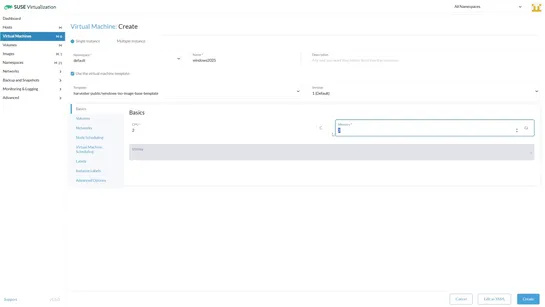
SUSE Adds Arm Support to HCI Platform for Running Monolithic Apps on Kubernetes

SUSE Virtualization 1.5 lands with64-bit Arm and Intelsupport,CSIstorage compatibility, and a tighter4-month release loopsynced with Kubernetes. Built on Harvester and KubeVirt, the update pushes harder on a clear trend: legacy VMs and cloud-native apps sharing the same Kubernetes real estate. Sys.. read more  

SUSE Adds Arm Support to HCI Platform for Running Monolithic Apps on Kubernetes
Link
@faun shared a link, 9 months, 1 week ago
FAUN.dev()

Scale AI/ML Workloads with Amazon EKS: Up to 100K Nodes

Amazon EKS just leveled up—clusters can now run withup to 100,000 nodeswith support ofKubernetes 1.30and up. That's not just big—it’s AI-and-ML-scale big. Cluster setup got a lot less manual, too. The AWS Console’s"auto mode"auto-builds your VPC and IAM configs.eksctlplugs right into the flow... read more  

Scale AI/ML Workloads with Amazon EKS: Up to 100K Nodes
Link
@faun shared a link, 9 months, 1 week ago
FAUN.dev()

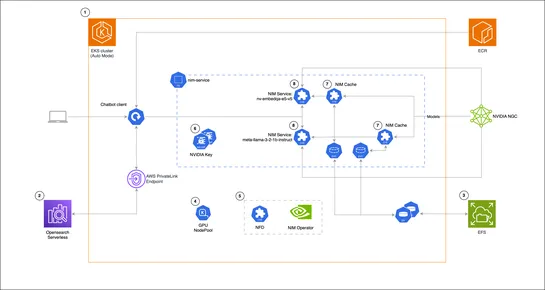
Building a RAG chat-based assistant on Amazon EKS Auto Mode and NVIDIA NIMs

AWS and NVIDIA just dropped a full-stack recipe for running Retrieval-Augmented Generation (RAG) onAmazon EKS Auto Mode—built on top ofNVIDIA NIM microservices. It's LLMs on Kubernetes, but without the hair-pulling. Inference? GPU-accelerated. Embeddings? Covered. Vector search? Handled byAmazon Op.. read more  

Building a RAG chat-based assistant on Amazon EKS Auto Mode and NVIDIA NIMs
Link
@faun shared a link, 9 months, 1 week ago
FAUN.dev()

AI is changing Kubernetes faster than most teams can keep up

AI workloads are taking over Kubernetes. Fastest-growing use case on the block. 90% of orgs expect that growth to keep climbing. 92% are betting on AI-driven ops tools to keep up. Edge Kubernetes? Up from 38% to 50% in a year. Real-time inference is pushing workloads closer to the source.System shif.. read more  

AI is changing Kubernetes faster than most teams can keep up
Link
@faun shared a link, 9 months, 1 week ago
FAUN.dev()

Kubernetes: Web UI Headlamp gets an AI assistant

Headlamp 0.34 drops an alphaAI Assistantplugin—natural language for your cluster, powered by OpenAI, Anthropic, or Mistral. Ask it to explain logs, troubleshoot issues, manage resources. It speaks Kubernetes, with tooling and model config baked in.System shift:Cluster UIs are getting chatty. Less cl.. read more  

Kubernetes: Web UI Headlamp gets an AI assistant
Link
@mmk4mmk_simplifies shared a link, 9 months, 1 week ago

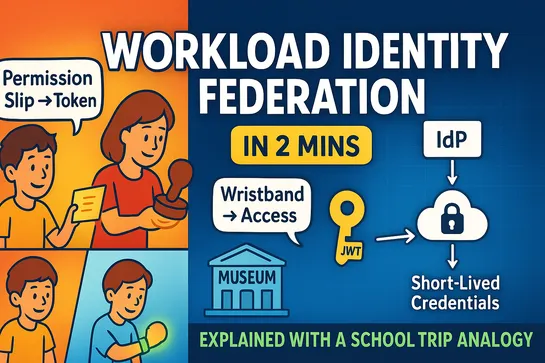
Workload Identity Federation: The School Trip Analogy You’ll Remember

Secrets in repos, API keys in scripts, and forgotten credentials create massive security gaps. Workload Identity Federation (WIF) solves this with short-lived tokens and trust-based authentication across clouds.

To explain it clearly, I’ve put together a 2-minute video that uses a school trip analogy (students, teachers, and wristbands) to break it down step by step.

Video: https://youtu.be/UZa5LWndb8k

Reade more at : https://medium.com/@mmk4mmk.mrani/how-my-kids-school-trip-helped-me-understand-workload-identity-federation-f680a2f4672b

ChatGPT Image Aug 16, 2025, 05_51_02 PM_compressed
Sigstore is an open source initiative designed to make software artifact signing and verification simple, automatic, and widely accessible. Its primary goal is to improve software supply chain security by enabling developers and organizations to cryptographically prove the origin and integrity of the software they build and distribute.

At its core, sigstore removes many of the traditional barriers associated with code signing. Instead of managing long-lived private keys manually, sigstore supports keyless signing, where identities are issued dynamically using OpenID Connect (OIDC) providers such as GitHub Actions, Google, or Microsoft. This dramatically lowers operational complexity and reduces the risk of key compromise.

The sigstore ecosystem is composed of several key components:

- Cosign: A tool for signing, verifying, and storing signatures for container images and other artifacts. Signatures are stored alongside artifacts in OCI registries, rather than embedded in them.

- Fulcio: A certificate authority that issues short-lived X.509 certificates based on OIDC identities, enabling keyless signing.

- Rekor: A transparency log that records signing events in an append-only, tamper-evident ledger. This provides public auditability and detection of suspicious or malicious signing activity.

Together, these components allow anyone to verify who built an artifact, when it was built, and whether it has been tampered with, using publicly verifiable cryptographic proofs. This aligns closely with modern supply chain security practices such as SLSA (Supply-chain Levels for Software Artifacts).

sigstore is widely adopted in the cloud-native ecosystem and integrates with tools like Kubernetes, container registries, CI/CD pipelines, and package managers. It is commonly used to sign container images, Helm charts, binaries, and SBOMs, and is increasingly becoming a baseline security requirement for production software delivery.

The project is governed by the OpenSSF (Open Source Security Foundation) and supported by major industry players.