Join us

ContentUpdates and recent posts about Grafana Tempo..
Link
@faun shared a link, 10 months, 4 weeks ago
FAUN.dev()

Creating a GitHub App based Azure DevOps Pipelines Service Connection

Azure DevOps made it easier to link up with GitHub—no more re-installing the Azure Pipelines GitHub App to kick things off. Teams can spin up aGitHub App–based service connectiondirectly from a dummy pipeline setup. The service connection comes GitHub App–authenticated out of the gate. Super handy .. read more  
Creating a GitHub App based Azure DevOps Pipelines Service Connection
Link
@faun shared a link, 10 months, 4 weeks ago
FAUN.dev()

Cloudflare and the infinite sadness of migrations

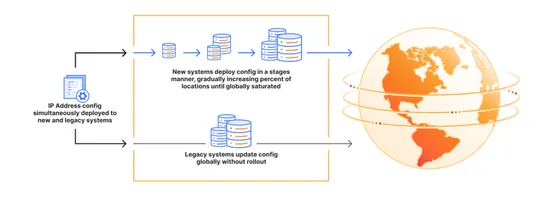
A recent Cloudflare DNS outage traced back to legacy gear tangled with global config changes. Turns out, incomplete migrations can still pack a punch. Their newer topology system does support progressive rollouts—but running it side-by-side with the old one just made the blast radius bigger. System.. read more  

Cloudflare and the infinite sadness of migrations
Link
@faun shared a link, 10 months, 4 weeks ago
FAUN.dev()

Amazon DocumentDB Serverless is now available

Amazon DocumentDB Serverless is out of preview and ready to roll. It auto-scales compute and memory usingDCUsfor MongoDB-compatible clusters. No migration needed—just upgrade your existing instance and go. Available starting in version5.0, with per-second billing based on DCU burn. What’s new:Fixed.. read more  

Link
@faun shared a link, 10 months, 4 weeks ago
FAUN.dev()

From Borg to Broken: why Kubernetes 2.0 is an apology letter

Kubernetes 2.0 is kicking YAML to the curb.After years of living and breathing.yamlfiles, the project is eyeing a hard break. Maintainers haven’t said it outright, but the message is clear: YAML isn’t cutting it anymore. System shift:This could signal a real usability reboot—maybe even a less painf.. read more  

From Borg to Broken: why Kubernetes 2.0 is an apology letter
Link
@faun shared a link, 10 months, 4 weeks ago
FAUN.dev()

vCluster: The Performance Paradox – How Virtual Clusters Save Millions Without Sacrificing Speed

vClustercuts Kubernetes infra costs by running virtual clusters as pods inside a shared host. No more spinning up full control planes for every tenant. Itslean Syncerfilters API traffic to keep clusters from melting down.Shared controllersand a built-insleep modekeep idle workloads quiet—and cheap... read more  

Link
@faun shared a link, 10 months, 4 weeks ago
FAUN.dev()

I've been using Talos Linux for Kubernetes, and I'll never look back

Talos Linux—an OS stripped down to the essentials and locked tighter than a production firewall—now boots cleanly as a VM onProxmox, playing nice with fullKVM/QEMUsupport. No shell, read-only filesystem, all wired forKubernetesviatalosctl. System shift:Devs are tossing old-school VM stacks for bare.. read more  

I've been using Talos Linux for Kubernetes, and I'll never look back
Link
@faun shared a link, 10 months, 4 weeks ago
FAUN.dev()

Docker Scout for Vulnerability management of Containers and remediation

Docker Scout now scans Azure Linux 3.0 containers for CVEs in real time—right in your pipeline. It spots vulns by layer, shows you how to fix them, and plays nice withDocker,Azure DevOps, andGitHub Actions. Security scanning isn't extra credit anymore. It's shipping with the build... read more  

Link
@faun shared a link, 10 months, 4 weeks ago
FAUN.dev()

How to use cache mounts to speed up Docker builds

Depot just droppedNVMe-backed cache mounts—persistent, high-speed, and wired for true incremental Docker builds. Yes, even inephemeral CI. It hooks intonative BuildKit cache mounts, supporting bothsharedandexclusiveaccess. No more fragile registry caches. No more arcane CI cache duct tape... read more  

Link
@faun shared a link, 10 months, 4 weeks ago
FAUN.dev()

Choosing the Best Kubernetes API Gateway: comparing Kong, Envoy, and kgateway

TheKubernetes Gateway APIhit v1.0 and is officially stable. It's a clean break from the old Ingress model, bringing modular, role-aware, multi-protocol control. Core players:Gateway,GatewayClass, andHTTPRoute. On the flip side,Kong Gatewayis losing ground. The newer kids—Envoy Gatewayandkgateway—ar.. read more  

Link
@faun shared a link, 10 months, 4 weeks ago
FAUN.dev()

Retiring Docker Content Trust

Docker’s sunsettingDocker Content Trust (DCT)in 2025, starting withDocker Official Images. Not many used it, andNotary v1is toast. So they’re moving to modern signing tools likeSigstoreandNotation. Migration guides are on the way. What’s really happening:The container world’s ditching old trustboxe.. read more  

Grafana Tempo is a distributed tracing backend built for massive scale and low operational overhead. Unlike traditional tracing systems that depend on complex databases, Tempo uses object storage—such as S3, GCS, or Azure Blob Storage—to store trace data, making it highly cost-effective and resilient. Tempo is part of the Grafana observability stack and integrates natively with Grafana, Prometheus, and Loki, enabling unified visualization and correlation across metrics, logs, and traces.

Technically, Tempo supports ingestion from major tracing protocols including Jaeger, Zipkin, OpenCensus, and OpenTelemetry, ensuring easy interoperability. It features TraceQL, a domain-specific query language for traces inspired by PromQL and LogQL, allowing developers to perform targeted searches and complex trace-based analytics. The newer TraceQL Metrics capability even lets users derive metrics directly from trace data, bridging the gap between tracing and performance analysis.

Tempo’s Traces Drilldown UI further enhances usability by providing intuitive, queryless analysis of latency, errors, and performance bottlenecks. Combined with the tempo-cli and tempo-vulture tools, it delivers a full suite for trace collection, verification, and debugging.

Built in Go and following OpenTelemetry standards, Grafana Tempo is ideal for organizations seeking scalable, vendor-neutral distributed tracing to power observability at cloud scale.