Join us

ContentUpdates and recent posts about GPT-5.4..
Link
@faun shared a link, 1 year ago
FAUN.dev()

Scaling Azure Microservices for Holiday Peak Traffic

Automation hacks away scaling migrainesfor microservices drowning in peak traffic. WithAzure DevOps CI/CDpipelines andIaC, scaling morphs into a cost-effective breeze. JustCosmos DB autoscalingcan shave off up to$7,200a year. Automation’s the unsung hero of cloud efficiency—no capes needed... read more  

Scaling Azure Microservices for Holiday Peak Traffic
Link
@faun shared a link, 1 year ago
FAUN.dev()

The 18-point secrets management checklist

By 2027, user blunders will cause a staggering 99% of cloud breaches, according to the experts who swear they know these things. Lock down secrets management by centralizing and automating with tools likeOktaorMicrosoft Entra ID. Don't skimp on IBAC and least-privileged access. Guard your cloud fort.. read more  

The 18-point secrets management checklist
Link
@faun shared a link, 1 year ago
FAUN.dev()

The 4 R’s of Pipeline Reliability: Data Systems That Last

RAG applicationslean on pipelines that can crumble if the4 R's frameworkisn't in place: reliable architecture, resumability, recoverability, redundancy. Ingenious stuff!.. read more  

The 4 R’s of Pipeline Reliability: Data Systems That Last
Link
@faun shared a link, 1 year ago
FAUN.dev()

Building Azure Right: A Practical Checklist for Infrastructure Landing Zones

Azure fans are pros at dodging groundwork, which, surprise, leads to chaos; lay down a rock-solid Landing Zone to hack your costs and cut the pandemonium.GrabInfrastructure as Code tools like Terraformto smooth out deployments. Make sureRBACdoesn’t dive into the horror of unmonitored access... read more  

Building Azure Right: A Practical Checklist for Infrastructure Landing Zones
Link
@faun shared a link, 1 year ago
FAUN.dev()

Bringing Kubernetes Back to Debian

KubernetesonDebianjust got its act together. The team axed the messy vendoring, shrunk the tarball bulk by over half, and tidied up dependency chaos. Now every dependency snuggles into Debian nicely, kicking out those pesky proprietary blobs. This means a secure, policy-friendly package and—drumroll.. read more  

Bringing Kubernetes Back to Debian
Link
@faun shared a link, 1 year ago
FAUN.dev()

Another Lightweight Kubernetes Distro Choice as k0s Joins CNCF Sandbox

k0s, the streamlined Kubernetes flavor pioneered by theCNCF Sandbox, strips it down to one slick binary. It's tailor-made for edge AI, shedding the bulky baggage. UnlikeK3s, k0s thrives on meager resources, sipping energy while skipping the tangled installation dance. Just 1-2 GB of RAM, and you're .. read more  

Link
@faun shared a link, 1 year ago
FAUN.dev()

Monolith-First - are you sure?

Modular monolithsrisk turning into messy "big balls of mud" when developers overdo shortcuts or tangle the code. Gomodular-firstand be ready to spot stealthy dependencies lurking in the corners. Skip the quick fixes—they're overrated... read more  

Monolith-First - are you sure?
Link
@faun shared a link, 1 year ago
FAUN.dev()

Woodpecker: Open-source red teaming for AI, Kubernetes, APIs

Woodpeckertakes on the dirty work of red teaming for AI, Kubernetes, and APIs. It tackles over half of the OWASP Top 10 threats without breaking a sweat. Find it free on GitHub, spreading top-notch security testing like free candy... read more  

Woodpecker: Open-source red teaming for AI, Kubernetes, APIs
Link
@faun shared a link, 1 year ago
FAUN.dev()

Argo CD Vulnerability Let Attackers Create, Modify, & Deleting Kubernetes Resources

CVE-2025-47933inArgo CDshreds security and hands injected JavaScript the keys to your Kubernetes kingdom. With a terrifyingCVSS score of 9.1, this one's no joke. Patch it, yesterday!.. read more  

Argo CD Vulnerability Let Attackers Create, Modify, & Deleting Kubernetes Resources
Link
@faun shared a link, 1 year ago
FAUN.dev()

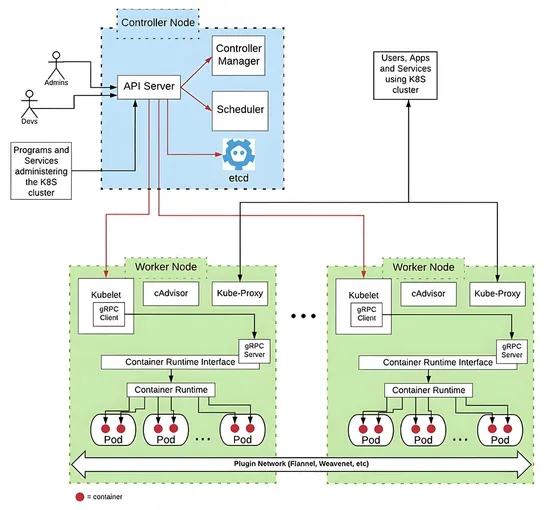
Kubernetes may seem complex, but once broken down, it operates like a well-orchestrated system…

Kubernetes' Master Nodeis the cluster's brain. TheAPI Server? Think of it as the front door, shrewdly dispatching developer requests like a bouncer with a clipboard... read more  

Kubernetes may seem complex, but once broken down, it operates like a well-orchestrated system…
GPT-5.4 is OpenAI’s latest frontier AI model designed to perform complex professional and technical work more reliably. It combines advances in reasoning, coding, tool use, and long-context understanding into a single system capable of handling multi-step workflows across software environments. The model builds on earlier GPT-5 releases while integrating the strong coding capabilities previously introduced with GPT-5.3-Codex.

One of the defining features of GPT-5.4 is its ability to operate as part of agent-style workflows. The model can interact with tools, APIs, and external systems to complete tasks that extend beyond simple text generation. It also introduces native computer-use capabilities, allowing AI agents to operate applications using keyboard and mouse commands, screenshots, and browser automation frameworks such as Playwright.

GPT-5.4 supports context windows of up to one million tokens, enabling it to process and reason over very large documents, long conversations, or complex project contexts. This makes it suitable for tasks such as analyzing codebases, generating technical documentation, working with large spreadsheets, or coordinating long-running workflows. The model also introduces a feature called tool search, which allows it to dynamically retrieve tool definitions only when needed. This reduces token usage and makes it more efficient to work with large ecosystems of tools, including environments with dozens of APIs or MCP servers.

In addition to improved reasoning and automation capabilities, GPT-5.4 focuses on real-world productivity tasks. It performs better at generating and editing spreadsheets, presentations, and documents, and it is designed to maintain stronger context across longer reasoning processes. The model also improves factual accuracy and reduces hallucinations compared with previous versions.

GPT-5.4 is available across OpenAI’s ecosystem, including ChatGPT, the OpenAI API, and Codex. A higher-performance variant, GPT-5.4 Pro, is also available for users and developers who require maximum performance for complex tasks such as advanced research, large-scale automation, and demanding engineering workflows. Together, these capabilities position GPT-5.4 as a model aimed not just at conversation, but at executing real work across software systems.