Join us

ContentUpdates and recent posts about GPT-5.4..
Link
@faun shared a link, 8 months, 2 weeks ago
FAUN.dev()

How to use Terraform to generate secrets

Terraform just leveled up secret handling inAzure Key Vault. It now supports automated secret generation withrandom_password, plus full lifecycle control—rotation, expiration, and storage—baked right into your IaC. Secrets stay marked as sensitive. They're managed in one place. And thanks to Terraf.. read more  

How to use Terraform to generate secrets
Link
@faun shared a link, 8 months, 2 weeks ago
FAUN.dev()

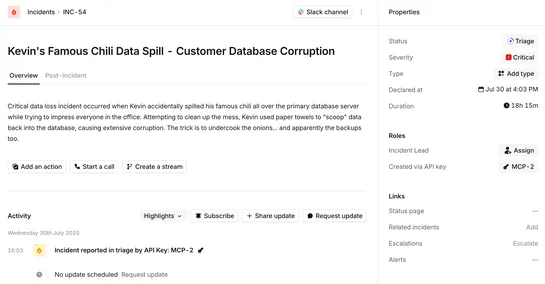
We built an MCP server so Claude can access your incidents

Incident.io dropped an open sourceMCP server in Gothat plugs Claude into their API using theModel Context Protocol. That means Claude can now ask questions, spin up incidents, and dig into timelines—just by talking. The server translates Claude’s prompts into REST calls, turning AI babble into real.. read more  

We built an MCP server so Claude can access your incidents
Link
@faun shared a link, 8 months, 2 weeks ago
FAUN.dev()

Does platform engineering make sense for startups?

Platform engineering isn't just for the big dogs anymore. Startups are picking it up as astrategic edge, building tight, high-leverage tooling from day one. Think:templated CI/CD pipelines, plug-and-play infra modules, zero-handoff onboarding. Done right, these early bets smooth the path and keep d.. read more  

Does platform engineering make sense for startups?
Link
@faun shared a link, 8 months, 2 weeks ago
FAUN.dev()

Proton launches free standalone cross-platform Authenticator app

Proton just droppedProton Authenticator, a free 2FA app that actually respects your privacy. It’s cross-platform, offline-friendly, and skips the usual junk—no ads, no trackers, no bait-and-lock-in. It’s gotend-to-end encryption, a biometric lock, and lets youexport TOTP seedslike it’s your data (b.. read more  

Link
@faun shared a link, 8 months, 2 weeks ago
FAUN.dev()

A practical guide on how to use the GitHub MCP server

GitHub offers a managed MCP endpoint to simplify infrastructure management and streamline AI workflows, enhancing collaboration and code review processes... read more  

Link
@faun shared a link, 8 months, 2 weeks ago
FAUN.dev()

AWS Lambda now supports GitHub Actions to simplify function deployment

AWS Lambda just got a smoother ride to prod. There’s now a nativeGitHub Actions integration—no more DIY scripts to ship your serverless. On commit, the new action packages your code, wires up IAM viaOIDC, and deploys using either.zip bundles or containers. All from a tidy, declarative GitHub workfl.. read more  

Link
@faun shared a link, 8 months, 2 weeks ago
FAUN.dev()

Pinterest Uncovers Rare Search Failure During Migration to Kubernetes

Pinterest hit a weird one-in-a-million query mismatch during its search infra move to Kubernetes. The culprit? A slippery timing bug. To catch it, engineers pulled out every trick—live traffic replays, their own diff tools, hybrid rollouts layered on both the legacy and K8s stacks. Painful, but it .. read more  

Pinterest Uncovers Rare Search Failure During Migration to Kubernetes
Link
@faun shared a link, 8 months, 2 weeks ago
FAUN.dev()

Terraform Validate Disagrees with Terraform Docs

Terraform’s CLI will throw errors on configs that match the docs—because your local provider schema might be stale or out of sync. Docs follow the latest release. Your machine might not. So even supported fields can break validation. Love that for us... read more  

Link
@faun shared a link, 8 months, 2 weeks ago
FAUN.dev()

Who does the unsexy but essential work for open source?

Oracle led the line-count race in the Linux 6.1 kernel release—beating out flashier open source names. Most of its work isn’t headline material. It’s deep-core stuff: memory management tweaks, block device updates, the quiet machinery real systems run on... read more  

Who does the unsexy but essential work for open source?
Link
@faun shared a link, 8 months, 2 weeks ago
FAUN.dev()

Kubernetes 1.34 Debuts KYAML to Resolve YAML Challenges

Kubernetes 1.34 drops on August 27, 2025, and it’s bringingKYAML—a smarter, stricter take on YAML. No more surprise type coercion or “why is this indented wrong?” bugs. Think of it as YAML that behaves. kubectlgets a new trick too:-o kyaml. Use it to spit out manifests in KYAML format—easier to deb.. read more  

Kubernetes 1.34 Debuts KYAML to Resolve YAML Challenges
GPT-5.4 is OpenAI’s latest frontier AI model designed to perform complex professional and technical work more reliably. It combines advances in reasoning, coding, tool use, and long-context understanding into a single system capable of handling multi-step workflows across software environments. The model builds on earlier GPT-5 releases while integrating the strong coding capabilities previously introduced with GPT-5.3-Codex.

One of the defining features of GPT-5.4 is its ability to operate as part of agent-style workflows. The model can interact with tools, APIs, and external systems to complete tasks that extend beyond simple text generation. It also introduces native computer-use capabilities, allowing AI agents to operate applications using keyboard and mouse commands, screenshots, and browser automation frameworks such as Playwright.

GPT-5.4 supports context windows of up to one million tokens, enabling it to process and reason over very large documents, long conversations, or complex project contexts. This makes it suitable for tasks such as analyzing codebases, generating technical documentation, working with large spreadsheets, or coordinating long-running workflows. The model also introduces a feature called tool search, which allows it to dynamically retrieve tool definitions only when needed. This reduces token usage and makes it more efficient to work with large ecosystems of tools, including environments with dozens of APIs or MCP servers.

In addition to improved reasoning and automation capabilities, GPT-5.4 focuses on real-world productivity tasks. It performs better at generating and editing spreadsheets, presentations, and documents, and it is designed to maintain stronger context across longer reasoning processes. The model also improves factual accuracy and reduces hallucinations compared with previous versions.

GPT-5.4 is available across OpenAI’s ecosystem, including ChatGPT, the OpenAI API, and Codex. A higher-performance variant, GPT-5.4 Pro, is also available for users and developers who require maximum performance for complex tasks such as advanced research, large-scale automation, and demanding engineering workflows. Together, these capabilities position GPT-5.4 as a model aimed not just at conversation, but at executing real work across software systems.