Join us

ContentUpdates and recent posts about GPT-5.4..
Link
@faun shared a link, 7 months, 3 weeks ago
FAUN.dev()

v1.34: Service Account Token Integration for Image Pulls Graduates to Beta

Kubernetes v1.34 bumpsServiceAccount token integration for Kubelet Credential Providersto beta. That means image pulls can now ditch long-lived secrets for workload-scoped tokens. Cleaner, safer, and more locked down per ServiceAccount... read more  

Link
@faun shared a link, 7 months, 3 weeks ago
FAUN.dev()

Container Logs in Kubernetes: How to View and Collect Them

This guide shows how to wrangle container logs in Kubernetes—usingkubectl, shell tools, structured logging, and the Kubernetes Dashboard. It covers the basics and dives into how to scale up log collection and make observability less painful across clusters... read more  

Container Logs in Kubernetes: How to View and Collect Them
Link
@faun shared a link, 7 months, 3 weeks ago
FAUN.dev()

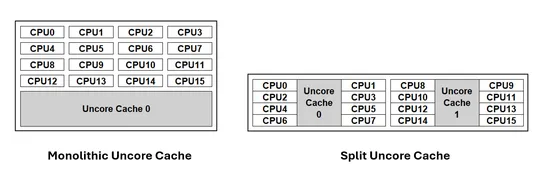
v1.34: Introducing CPU Manager Static Policy Option for Uncore Cache Alignment

Kubernetes 1.34 bumps theCPU Manager uncore-cache alignment policyto beta. It’s aimed at nodes withsplit uncore cache architectures. The policy groups all a container’s CPUs under the same uncore cache—cutting latency and easing contention for workloads that hate waiting. System shift:Kubernetes kee.. read more  

v1.34: Introducing CPU Manager Static Policy Option for Uncore Cache Alignment
Link
@faun shared a link, 7 months, 3 weeks ago
FAUN.dev()

CNCF Elevates Metal3.io to Incubating Status for Bare-Metal Kubernetes

The CNCF just bumpedMetal3.ioup to incubating status. That’s a clear nod to rising demand forKubernetes-native bare-metal management. Metal3.io wires up physical servers as Kubernetes resources—no VMs in sight. It leans onIronicand theBare Metal Operatorto handle provisioning and lifecycle tasks lik.. read more  

Link
@faun shared a link, 7 months, 3 weeks ago
FAUN.dev()

Scaling Kubernetes the Right Way: In-Depth Comparison of HPA, VPA, CA, Karpenter, and KEDA

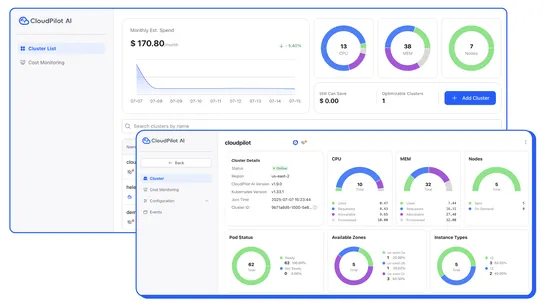
A hands-on breakdown of Kubernetes autoscalers—HPA,VPA,Cluster Autoscaler,Karpenter, andKEDA—maps how each scales pods, nodes, and events. The hot pairing lately?Karpenterfor fast node spin-up, teamed withCloudPilot AIto wrangle Spot instances across 800+ compute types without melting costs... read more  

Scaling Kubernetes the Right Way: In-Depth Comparison of HPA, VPA, CA, Karpenter, and KEDA
Link
@faun shared a link, 7 months, 3 weeks ago
FAUN.dev()

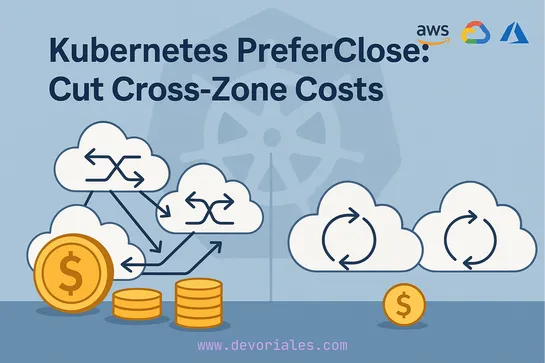
Reduce Cloud Cross-Zone Data Transfer Costs with Kubernetes 1.33 trafficDistribution

Kubernetes 1.33 drops a new traffic policy that addszone-local routing. With it, kube-proxy now prefers endpoints in the same availability zone. Translation: less cross-AZ chatter, fewer surprise charges. On AWS, that can chop the usual $0.02/GB cross-AZ fee by up to 85%—especially in EKS clusters j.. read more  

Reduce Cloud Cross-Zone Data Transfer Costs with Kubernetes 1.33 trafficDistribution
Link
@faun shared a link, 7 months, 3 weeks ago
FAUN.dev()

v1.34: Pod Replacement Policy for Jobs Goes GA

ThePod replacement policyin Kubernetes v1.34 just hit GA. Jobs can now hold off on spinning up new Pods until the old ones arefullygone. No more duplicates per index. No more blowing through quotas or stalling schedulers—big win for workloads like ML training. System shift:This rewires how Jobs hand.. read more  

Link
@faun shared a link, 7 months, 3 weeks ago
FAUN.dev()

v1.34: PSI Metrics for Graduates to Beta

Kubernetes v1.34 bumpsPressure Stall Information (PSI) metricsto Beta. Now kubelets expose kernel-level resource pressure—CPU, memory, and I/O—through the Summary API and Prometheus. Instead of just tracking how much a resource gets used, PSI shows how often workloads get throttled or blocked. That .. read more  

Link
@anjali shared a link, 7 months, 3 weeks ago
Customer Marketing Manager, Last9

Kubernetes Monitoring Metrics That Improve Cluster Reliability

Understand Kubernetes monitoring metrics that help detect issues early, improve reliability, and keep your cluster performing at its best.

kubernetes_metrics
Story
@laura_garcia shared a post, 7 months, 3 weeks ago
Software Developer, RELIANOID

🚀 Strengthening Europe’s Cybersecurity in Space

Just in case you missed it last month: The European Space Agency (ESA) has launched its brand-new Cybersecurity Operations Center (C-SOC) to safeguard satellites, mission control systems, and digital assets against growing cyber threats. 🌍 In today’s space-driven world, initiatives like this — suppo..

ESA_Cybersecurity Operations Center
GPT-5.4 is OpenAI’s latest frontier AI model designed to perform complex professional and technical work more reliably. It combines advances in reasoning, coding, tool use, and long-context understanding into a single system capable of handling multi-step workflows across software environments. The model builds on earlier GPT-5 releases while integrating the strong coding capabilities previously introduced with GPT-5.3-Codex.

One of the defining features of GPT-5.4 is its ability to operate as part of agent-style workflows. The model can interact with tools, APIs, and external systems to complete tasks that extend beyond simple text generation. It also introduces native computer-use capabilities, allowing AI agents to operate applications using keyboard and mouse commands, screenshots, and browser automation frameworks such as Playwright.

GPT-5.4 supports context windows of up to one million tokens, enabling it to process and reason over very large documents, long conversations, or complex project contexts. This makes it suitable for tasks such as analyzing codebases, generating technical documentation, working with large spreadsheets, or coordinating long-running workflows. The model also introduces a feature called tool search, which allows it to dynamically retrieve tool definitions only when needed. This reduces token usage and makes it more efficient to work with large ecosystems of tools, including environments with dozens of APIs or MCP servers.

In addition to improved reasoning and automation capabilities, GPT-5.4 focuses on real-world productivity tasks. It performs better at generating and editing spreadsheets, presentations, and documents, and it is designed to maintain stronger context across longer reasoning processes. The model also improves factual accuracy and reduces hallucinations compared with previous versions.

GPT-5.4 is available across OpenAI’s ecosystem, including ChatGPT, the OpenAI API, and Codex. A higher-performance variant, GPT-5.4 Pro, is also available for users and developers who require maximum performance for complex tasks such as advanced research, large-scale automation, and demanding engineering workflows. Together, these capabilities position GPT-5.4 as a model aimed not just at conversation, but at executing real work across software systems.