Join us

ContentUpdates and recent posts about GPT-5.3-Codex..
Link
@faun shared a link, 10 months, 2 weeks ago
FAUN.dev()

When Process Becomes Latency: Optimizing Incident Response Cadence

In incident response, adaptability is key. Instead of endless playbooks, focus on flexible frameworks for faster, more effective responses. Brandon Chalk,16-year Google SRE, shares insights onbalancing structure and speedwhen every second counts... read more  
Link
@faun shared a link, 10 months, 2 weeks ago
FAUN.dev()

GitHub Copilot DevOps Excellence: Prompt Files vs Instructions vs Chat Modes

GitHub Copilot just leveled up:prompt files,custom instructions, andcustom chat modesare live. Now it's not just tagging along—it’s shaping how you work. Automate code reviews, security scans, or implementation plans. Reuse setups across teams. Control it all from VS Code... read more  

Link
@faun shared a link, 10 months, 2 weeks ago
FAUN.dev()

GitOps Done Right: 10 Best Practices That Make It Work

GitOps ditches hand-rolled deployment scripts for a cleaner, declarative model. Git becomes the truth. Agents likeArgo CDorFlux CDwatch for changes and sync your clusters on their own. It’s not just about pushing YAML. Good GitOps setups lean onKustomizefor modular config, wire inautomated image up.. read more  

GitOps Done Right: 10 Best Practices That Make It Work
Link
@faun shared a link, 10 months, 2 weeks ago
FAUN.dev()

Indexed Views in SQL Server: A Production DBA's Complete Guide

Indexed viewsare apowerfulyet underutilized feature in SQL Server for optimizing complex query performance, with potential for significant performance gains in read-heavy applications. Automatic query substitution is a game-changer when it comes to leveragingindexed viewsfor performance optimization.. read more  

Link
@faun shared a link, 10 months, 2 weeks ago
FAUN.dev()

How I Scanned all of GitHub’s “Oops Commits” for Leaked Secrets

Truffle Security dropped a sharp new open-source tool that digs through GitHub’s public commit history looking forzero-commit force pushes—a tactic devs use to erase mistakes, usually secrets. Problem is, they don’t go quietly. By tapping into historical GitHub PushEvents via GH Archive, the tool h.. read more  

Link
@faun shared a link, 10 months, 2 weeks ago
FAUN.dev()

You might not need tmux

A dev swapped outtmuxfor a slick combo:Zellij,SSH multiplexing, andsystemdsocket daemons. No more virtual splits. Just clean session persistence and tight remote control. This setup brings scrollback back where it belongs—your terminal’s native buffer. It plays nice with extras like theKitty graphi.. read more  

Link
@faun shared a link, 10 months, 2 weeks ago
FAUN.dev()

Writing a basic service for GNU Guix

A developer walks through building acustom GNU Guix system serviceforkmonad—yes, the keyboard remapper—by wiring up a newservice-typethat plugs intoShepherdandaccount-service-type. To get there, they lift patterns from services likewesnothd, usemake-forkexec-constructorto spin up the daemon, and de.. read more  

Link
@faun shared a link, 10 months, 2 weeks ago
FAUN.dev()

Automating infrastructure deployments in the Cloud with Terraform and Azure Pipelines

This Azure lab wires upTerraformwithAzure Pipelines CI/CDto spin up infrastructure and deploy a .NET Core app using IaC. It handles remote state with Azure Storage, automatesplanandapplyin pipelines, and swaps in config values via token replacement during deploy... read more  

Link
@faun shared a link, 10 months, 2 weeks ago
FAUN.dev()

Cloudflare and the infinite sadness of migrations

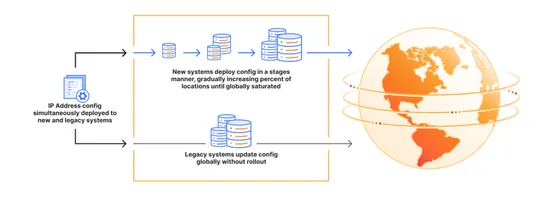
A recent Cloudflare DNS outage traced back to legacy gear tangled with global config changes. Turns out, incomplete migrations can still pack a punch. Their newer topology system does support progressive rollouts—but running it side-by-side with the old one just made the blast radius bigger. System.. read more  

Cloudflare and the infinite sadness of migrations
Link
@faun shared a link, 10 months, 2 weeks ago
FAUN.dev()

Amazon DocumentDB Serverless is now available

Amazon DocumentDB Serverless is out of preview and ready to roll. It auto-scales compute and memory usingDCUsfor MongoDB-compatible clusters. No migration needed—just upgrade your existing instance and go. Available starting in version5.0, with per-second billing based on DCU burn. What’s new:Fixed.. read more  

GPT-5.3-Codex is OpenAI’s advanced agentic coding model, designed to go beyond writing code and operate as a general-purpose collaborator on a computer. It builds on GPT-5.2-Codex by combining stronger coding performance with improved reasoning and professional knowledge, while running about 25% faster. The model is optimized for long-running tasks that involve research, tool use, and complex execution, and it performs at the top of industry benchmarks such as SWE-Bench Pro and Terminal-Bench.

Unlike earlier Codex models that focused primarily on code generation and review, GPT-5.3-Codex can reason, plan, and act across the full software lifecycle. It supports activities such as debugging, deploying, monitoring, writing product requirement documents, creating tests, and analyzing metrics. It can also autonomously build and iterate on complex applications and better interpret underspecified prompts, producing more complete and production-ready results by default.

A defining feature of GPT-5.3-Codex is its interactive, agentic workflow. Users can steer the model while it is working, receive progress updates, and adjust direction without losing context, making it feel more like a teammate than a batch automation tool. The model was even used internally to help debug its own training and deployment processes. GPT-5.3-Codex is available through paid ChatGPT plans in the Codex app, CLI, IDE extension, and web, with API access planned for the future.