Join us

ContentUpdates and recent posts about Flask..
Link
@kaptain shared a link, 4 months, 1 week ago
FAUN.dev()

Troubleshooting Cilium network policies: Four common pitfalls

Cilium’s Day 2 playbook covers the real work: dialing inL7 policy controls, tuningHubble observability, and wringing performance fromBPF. It's how you keep big Kubernetes clusters sane. The focus?Multi-tenant isolation,node-to-node encryption, and scaling cleanly withexternal etcdso the network does.. read more  

Link
@kaptain shared a link, 4 months, 1 week ago
FAUN.dev()

93% Faster Next.js in (your) Kubernetes

Next.js brings advanced capabilities to developers out-of-the-box, but scaling it in your own environment can be challenging due to uneven load distribution and high latency. Watt addresses these issues by leveragingSO_REUSEPORTin the Linux kernel, resulting in significantly improved performance met.. read more  

Link
@kaptain shared a link, 4 months, 1 week ago
FAUN.dev()

1.35: In-Place Pod Resize Graduates to Stable

In-Place Pod Resizehits GA in Kubernetes 1.35. You can now tweak CPU and memory on live pods without restarts. This is finally production-ready! What’s new since beta? It now handlesmemory limit decreases, doesprioritized resizes, and gives you betterobservabilitywith fresh Kubelet metrics and Pod e.. read more  

Link
@kaptain shared a link, 4 months, 1 week ago
FAUN.dev()

Kubernetes OptimizationInPlace Pod Resizing,ZoneAware Routin

Halodoc cut EC2 costs and shaved latency by leaning into two Kubernetes tricks: In-place pod resizing(v1.33) lets them dial pod resources up or down on the fly, especially handy during off-peak hours. Zone-aware routingviatopology-aware hintskeeps inter-service traffic close to home (same AZ), skipp.. read more  

Kubernetes OptimizationInPlace Pod Resizing,ZoneAware Routin
Link
@kaptain shared a link, 4 months, 1 week ago
FAUN.dev()

Avoiding Zombie Cluster Members When Upgrading to etcd v3.6

etcd v3.5.26 patches a nasty upgrade bug. It now syncsv3storefromv2storeto stop zombie nodes from corrupting clusters during the jump to v3.6. The core issue: Older versions let stale store states bring removed members back from the dead... read more  

Link
@kala shared a link, 4 months, 1 week ago
FAUN.dev()

Chinese AI in 2025, Wrapped

Chinese AI milestones in 2025: Big models from DeepSeek and others, AGI discussions at Alibaba, US-China chip war swings, Beijing's AI Action plan, and more. DeepSeek led the way with an open-source model, setting off a wave of Chinese companies going open-source. China's push for AGI and involvemen.. read more  

Link
@kala shared a link, 4 months, 1 week ago
FAUN.dev()

Review of Deep Seek OCR

DeepSeek-OCRflips the OCR script. Instead of feeding full image tokens to the decoder, it leans on an encoder to compress them up front, trimming down input size and GPU strain in one move. That context diet? It opens the door for way bigger windows in LLMs. Why it matters:Shoving compression earlie.. read more  

Link
@kala shared a link, 4 months, 1 week ago
FAUN.dev()

Evaluating AI Agents in Security Operations

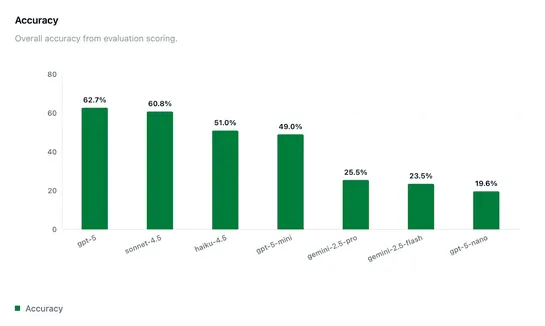
Cotool threw frontier LLMs at real-world SecOps tasks using Splunk’s BOTSv3 dataset.GPT-5topped the chart in accuracy (62.7%) and gave the best results per dollar.Claude Haiku-4.5blazed through tasks fastest, just 240 seconds on average, maxing out tool integrations.Gemini-2.5-proflopped on both acc.. read more  

Evaluating AI Agents in Security Operations
Link
@kala shared a link, 4 months, 1 week ago
FAUN.dev()

AI agents are starting to eat SaaS

AI coding agents are eating the lunch of low-complexity SaaS. Teams with a bit of dev muscle are skipping subscription logins and spinning up dashboards, pipelines, even decks, using Claude, Gemini, whoever’s fastest that day. Build vs. buy? Tilting back toward build. The kicker: build now takes min.. read more  

AI agents are starting to eat SaaS
Link
@kala shared a link, 4 months, 1 week ago
FAUN.dev()

Everything to know about Google Gemini’s most recent AI updates

Google jammed a full no-code AI workshop into Gemini. The browser now bakes inOpal, a drag-and-drop app builder with a shiny newvisual editor. You can chain prompts, preview apps, and feed it text, voice, or images, without touching code. They also dropped theGemini 3 Flash model, built for dual rea.. read more  

Flask is an open-source web framework written in Python and created by Armin Ronacher in 2010. It is known as a microframework, not because it is weak or incomplete, but because it provides only the essential building blocks for developing web applications. Its core focuses on handling HTTP requests, defining routes, and rendering templates, while leaving decisions about databases, authentication, form handling, and other components to the developer. This minimalistic design makes Flask lightweight, flexible, and easy to learn, but also powerful enough to support complex systems when extended with the right tools.

At the heart of Flask are two libraries: Werkzeug, which is a WSGI utility library that handles the low-level details of communication between web servers and applications, and Jinja2, a templating engine that allows developers to write dynamic HTML pages with embedded Python logic. By combining these two, Flask provides a clean and pythonic way to create web applications without imposing strict architectural patterns.

One of the defining characteristics of Flask is its explicitness. Unlike larger frameworks such as Django, Flask does not try to hide complexity behind layers of abstraction or dictate how a project should be structured. Instead, it gives developers complete control over how they organize their code and which tools they integrate. This explicit nature makes applications easier to reason about and gives teams the freedom to design solutions that match their exact needs. At the same time, Flask benefits from a vast ecosystem of extensions contributed by the community. These extensions cover areas such as database integration through SQLAlchemy, user session and authentication management, form validation with CSRF protection, and database migration handling. This modular approach means a developer can start with a very simple application and gradually add only the pieces they require, avoiding the overhead of unused components.

Flask is also widely appreciated for its simplicity and approachability. Many developers write their first web application in Flask because the learning curve is gentle, the documentation is clear, and the framework itself avoids unnecessary complexity. It is particularly well suited for building prototypes, REST APIs, microservices, or small to medium-sized web applications. At the same time, production-grade deployments are supported by running Flask applications on WSGI servers such as Gunicorn or uWSGI, since the development server included with Flask is intended only for testing and debugging.

The strengths of Flask lie in its minimalism, flexibility, and extensibility. It gives developers the freedom to assemble their application architecture, choose their own libraries, and maintain tight control over how things work under the hood. This is attractive to experienced engineers who dislike being boxed in by heavy frameworks. However, the same freedom can become a limitation. Flask does not include features like an ORM, admin interface, or built-in authentication system, which means teams working on very large applications must take on more responsibility for enforcing patterns and maintaining consistency. In situations where a project requires an opinionated, all-in-one solution, Django or another full-stack framework may be a better fit.

In practice, Flask has grown far beyond its initial positioning as a lightweight tool. It has been used by startups for rapid prototypes and by large companies for production systems. Its design philosophy—keep the core simple, make extensions easy, and let developers decide—continues to attract both beginners and professionals. This balance between simplicity and power has made Flask one of the most enduring and widely used Python web frameworks.