Join us

ContentUpdates and recent posts about Claude..
Link
@faun shared a link, 7 months, 1 week ago
FAUN.dev()

Inside NVIDIA GPUs: Anatomy of high performance matmul kernels

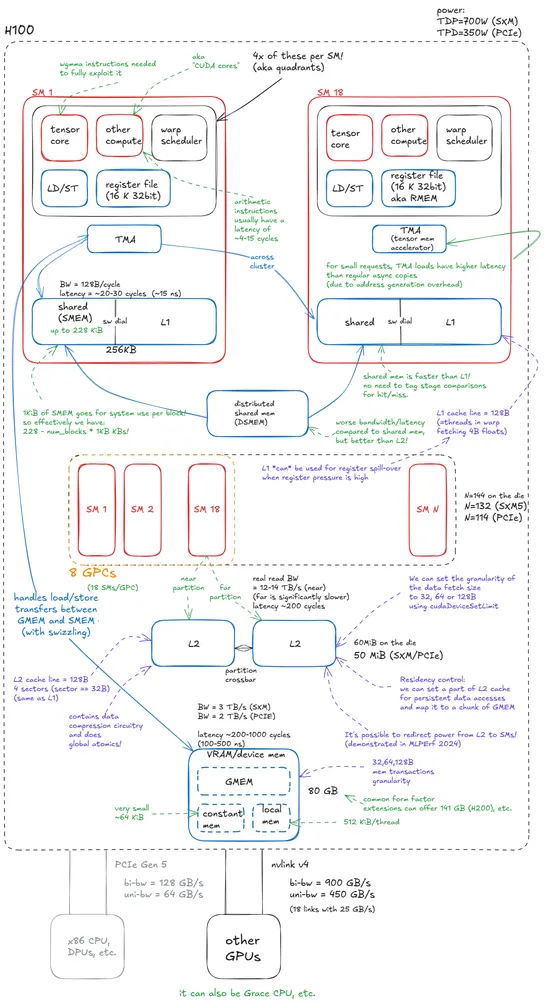
NVIDIA Hopper packs serious architectural tricks. At the core: **Tensor Memory Accelerator (TMA)**, **tensor cores**, and **swizzling**—the trio behind async, cache-friendly matmul kernels that flirt with peak throughput. But folks aren't stopping at cuBLAS. They're stacking new tactics: **warp-gro.. read more  
Inside NVIDIA GPUs: Anatomy of high performance matmul kernels
Link
@faun shared a link, 7 months, 1 week ago
FAUN.dev()

Becoming a Research Engineer at a Big LLM Lab - 18 Months of Strategic Career Development

To land a big career role like Mistral, mix efficient **tactical** moves (like LeetCode practice) with **strategic** ups, like building a powerful portfolio and a solid network. Balance is key; aim to impress and prepare well without overlooking the power of strategy in shaping a successful career... read more  

Link
@faun shared a link, 7 months, 1 week ago
FAUN.dev()

Building a Natural Language Interface for Apache Pinot with LLM Agents

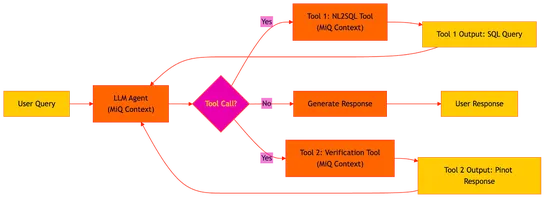
MiQ plugged **Google’s Agent Development Kit** into their stack to spin up **LLM agents** that turn plain English into clean, validated SQL. These agents speak directly to **Apache Pinot**, firing off real-time queries without the usual parsing pain. Behind the scenes, it’s a slick handoff: NL2SQL .. read more  

Building a Natural Language Interface for Apache Pinot with LLM Agents
Link
@faun shared a link, 7 months, 1 week ago
FAUN.dev()

Jupyter Agents: training LLMs to reason with notebooks

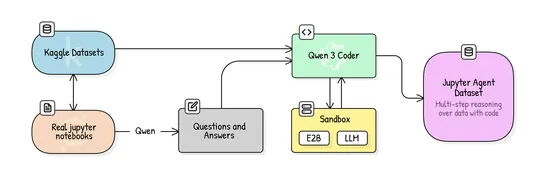
Hugging Face dropped an open pipeline and dataset for training small models—think **Qwen3-4B**—into sharp **Jupyter-native data science agents**. They pulled curated Kaggle notebooks, whipped up synthetic QA pairs, added lightweight **scaffolding**, and went full fine-tune. Net result? A **36% jump .. read more  

Jupyter Agents: training LLMs to reason with notebooks
Link
@faun shared a link, 7 months, 1 week ago
FAUN.dev()

Shai-Hulud npm Supply Chain Attack

Malicious npm packages just leveled up: this one dropped a self-spreading worm that hijacks repos and leaks secrets the moment it lands. It abuses `postinstall` scripts to run TruffleHog and swipe tokens straight from your codebase. Then it uses GitHub Actions to exfiltrate the loot and auto-publis.. read more  

Shai-Hulud npm Supply Chain Attack
Link
@faun shared a link, 7 months, 1 week ago
FAUN.dev()

How FinOps Drives Value for Every Engineering Dollar

Duolingo’s FinOps crew didn’t just track cloud costs—they wired up sharp, automated observability across 100+ microservices. Real-time alerts now catch AI and infra spend spikes before they torch the budget. They sliced TTS costs by 40% with in-memory caching. Dumped pricey CloudWatch metrics for P.. read more  

How FinOps Drives Value for Every Engineering Dollar
Link
@faun shared a link, 7 months, 1 week ago
FAUN.dev()

Introducing DigitalOcean Organizations, a new and comprehensive account layer

DigitalOcean just dropped **Organizations**—a real upgrade for anyone juggling multiple Teams. Think one top-level account to rule them all: centralized user control, one invoice to track, and org-wide settings for taxes, credits, and permissions... read more  

Introducing DigitalOcean Organizations, a new and comprehensive account layer
Link
@faun shared a link, 7 months, 1 week ago
FAUN.dev()

Top 30 Argo CD Anti-Patterns to Avoid When Adopting Gitops

A teardown of Argo CD anti-patterns calls out 28 common misfires—stuff like skipping Git for Application CRDs or stuffing Helm/Kustomize config right into Argo CD manifests. Yikes. It pushes for a cleaner setup: use **ApplicationSets** instead of rolling your own YAML, turn on **auto-sync/self-heal.. read more  

Link
@faun shared a link, 7 months, 1 week ago
FAUN.dev()

Observability for the Invisible: Tracing Message Drops in Kafka Pipelines

When an event drops silently in a distributed system, it is not a bug, it is an architectural blind spot. Detect, debug, and prevent message loss in Kafka-based streaming pipelines using tools like OpenTelemetry, Fluent Bit, Jaeger, and dead-letter queues. Make sure observability gaps in event strea.. read more  

Link
@faun shared a link, 7 months, 1 week ago
FAUN.dev()

Demystifying Log Retention in Azure

Azure logs come in three flavors: **Activity Logs**, **Diagnostic Logs**, and **Log Analytics**. Each with its own rules for retention and billing. The catch? Those differences aren’t quirks—they’re baked in... read more  

Claude is an AI assistant built by Anthropic, a safety-focused AI research company. It's designed around three core principles - being helpful, harmless, and honest - which shapes how it approaches everything from simple questions to complex, multi-step tasks. In practice, Claude handles a broad range of work: writing and editing, coding and debugging, research and summarization, data analysis, brainstorming, and extended back-and-forth conversation. It's built to engage thoughtfully rather than just generate output - it can push back when something seems off, ask clarifying questions, and reason through problems step by step. What sets Claude apart from many AI assistants is its emphasis on nuance and judgment. It tries to give calibrated answers - acknowledging uncertainty when it exists, avoiding overconfidence, and flagging when a question might not have a clean answer. It also has a large context window, making it well suited for long documents, complex codebases, or extended workflows. Claude is available through Claude.ai for individual users, through an API for developers building products and tools, and through Claude Code for agentic coding tasks directly in the terminal. The current model family includes Claude Opus 4.6, Claude Sonnet 4.6, and Claude Haiku 4.5 - ranging from lightweight and fast to highly capable for complex reasoning tasks.