Join us

ContentUpdates and recent posts about Claude..
Link
@faun shared a link, 7 months ago
FAUN.dev()

Inside Husky’s query engine: Real-time access to 100 trillion events

SteamPipe just gutted its real-time storage engine and rebuilt it inRust. Expect faster performance and better scaling. Now runs oncolumnar storage, ships withvectorized queries, and rolls anobject store-backed WAL. Serious firepower for time series data. System shift:Another sign that high-throughp.. read more  

Link
@faun shared a link, 7 months ago
FAUN.dev()

Development gets better with Age

A longtime AWS insider, Werner Vogels, breaks down the shift from slow-and-steady software growth to the generative AI rocket ride. Capabilities soared. Guardrails? Not so much. No docs, no handrails - just launch and learn. AWS didn’t chase the hype. It pulled a classic AWS move: doubled down on B2.. read more  

Development gets better with Age
Link
@faun shared a link, 7 months ago
FAUN.dev()

Advanced PostgreSQL Indexing: Multi-Key Queries and Performance Optimization

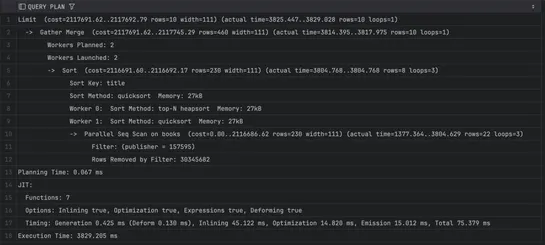
Advanced PostgreSQL tuning gets real results: composite indexes and CTEs can cut query latency hard when slicing huge datasets. AddLATERALjoins and indexed subqueries into the mix, and you’ve got a top-N query pattern that holds up—even when hammering long ID lists... read more  

Advanced PostgreSQL Indexing: Multi-Key Queries and Performance Optimization
Link
@faun shared a link, 7 months ago
FAUN.dev()

I'm Building a Browser for Reverse Engineers

A researcher rolled their ownChromium forkwith a customDevTools Protocol (CDP) domain- not for fun, but to surgically probe browser internals. It reaches into Canvas, WebGL, and other trickier APIs, dodging the usual sandbox and spoofing all the bot blockers they'd rather you leave alone. It injects.. read more  

I'm Building a Browser for Reverse Engineers
Link
@faun shared a link, 7 months ago
FAUN.dev()

Going down the rabbit hole of Postgres 18 features by Tudor Golubenco

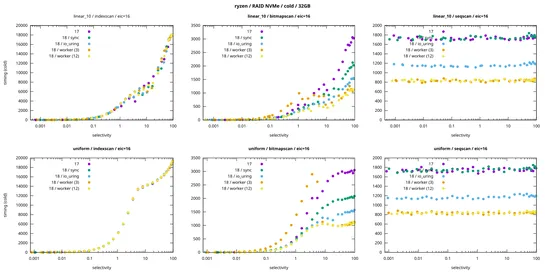
PostgreSQL 18 just hit stable. Big swing! Async IO infrastructureis in. That means lower overhead, tighter storage control, and less CPU getting chewed up by I/O. Adddirect IO, and the database starts flexing beyond traditional bottlenecks. OAuth 2.0? Native now. No hacks needed. UUIDv7? Built-in su.. read more  

Going down the rabbit hole of Postgres 18 features by Tudor Golubenco
Link
@faun shared a link, 7 months ago
FAUN.dev()

Technical Tuesday: 10 best practices for building reliable AI agents in 2025

UiPath just droppedAgent Builder in Studio- a legit development environment for AI agents that can actually handle enterprise chaos. Think production-grade: modular builds, traceable steps, and failure handling that doesn’t flake under pressure. It’s wired forschema-driven prompts,tool versioning, a.. read more  

Link
@faun shared a link, 7 months ago
FAUN.dev()

Write Deep Learning Code Locally and Run on GPUs Instantly

Modal cuts the drama out of deep learning ops. Devs write Python like usual, then fire off training, eval, and serving scripts to serverless GPUs - zero cluster wrangling. It handles data blobs, image builds, and orchestration. You focus on tuning with libraries like Unsloth, or serving via vLLM... read more  

Write Deep Learning Code Locally and Run on GPUs Instantly
Link
@faun shared a link, 7 months ago
FAUN.dev()

The RAG Obituary: Killed by Agents, Buried by Context Windows

Agent-based setups are starting to edge out old-school RAG. As LLMs snag multi-million-token context windows and better task chops, the need for chunking, embeddings, and reranking starts to fade. Claude Code, for example, skips all that - with direct file access and smart navigation instead. Retrie.. read more  

The RAG Obituary: Killed by Agents, Buried by Context Windows
Link
@faun shared a link, 7 months ago
FAUN.dev()

Serverless RL: Faster, Cheaper and More Flexible RL Training

New product, Serverless RL, available through collaboration between CoreWeave, Weights & Biases, and OpenPipe. Offers fast training, lower costs, and simple model deployment. Saves time with no infra setup, faster feedback loops, and easier entry into RL training... read more  

Link
@faun shared a link, 7 months ago
FAUN.dev()

How LogSeam Searches 500 Million Logs per second

LogSeam rips through500M log searches/secand pushes1.5+ TB/s throughputusing Tigris’ geo-distributed object storage. It slashes log volume by 100× with Parquet + Zstandard compression. Then it spins up compute on the fly, right where the data lives—no long-running infrastructure, no laggy reads... read more  

How LogSeam Searches 500 Million Logs per second
Claude is an AI assistant built by Anthropic, a safety-focused AI research company. It's designed around three core principles - being helpful, harmless, and honest - which shapes how it approaches everything from simple questions to complex, multi-step tasks. In practice, Claude handles a broad range of work: writing and editing, coding and debugging, research and summarization, data analysis, brainstorming, and extended back-and-forth conversation. It's built to engage thoughtfully rather than just generate output - it can push back when something seems off, ask clarifying questions, and reason through problems step by step. What sets Claude apart from many AI assistants is its emphasis on nuance and judgment. It tries to give calibrated answers - acknowledging uncertainty when it exists, avoiding overconfidence, and flagging when a question might not have a clean answer. It also has a large context window, making it well suited for long documents, complex codebases, or extended workflows. Claude is available through Claude.ai for individual users, through an API for developers building products and tools, and through Claude Code for agentic coding tasks directly in the terminal. The current model family includes Claude Opus 4.6, Claude Sonnet 4.6, and Claude Haiku 4.5 - ranging from lightweight and fast to highly capable for complex reasoning tasks.