Join us

ContentUpdates and recent posts about AIStor..
Story
@laura_garcia shared a post, 9 months, 3 weeks ago
Software Developer, RELIANOID

🚀 DevOpsDays arrives in Lima for the first time!

On August 21, 2025, DevOps practitioners and tech leaders will gather to share insights on CI/CD, SRE, DevSecOps, AI/MLOps, and CloudOps. 🔹 RELIANOID will be there—showcasing how our platform empowers secure, scalable, observability-driven DevOps operations. #DevOpsDays#DevOps#SRE#DevSecOps#CloudOps..

Link
@faun shared a link, 9 months, 3 weeks ago
FAUN.dev()

You can’t UPDATE what you can’t find: vs PostgreSQL

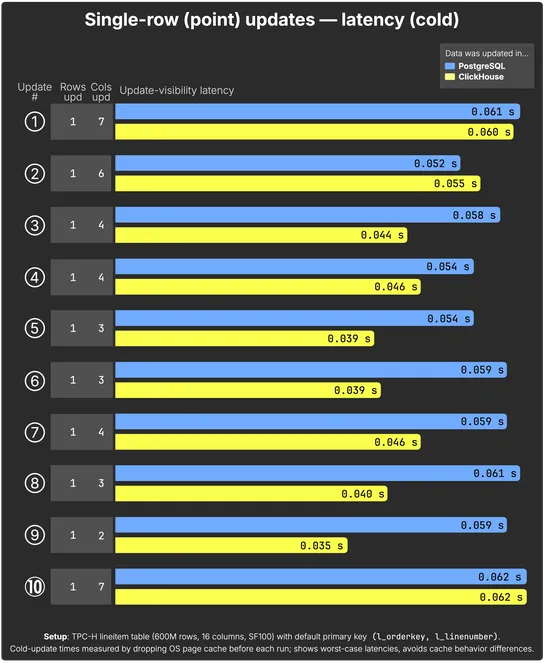
ClickHouse just leveled up. Its new SQL-standardUPDATEis fast—PostgreSQL-fast on single-row changes, and up to4,000×faster on bulk updates. That’s pure columnar speed plus parallelism in the driver’s seat. Yes, both use MVCC. But unlike Postgres, ClickHouse dodges transaction bloat by default. That.. read more  

You can’t UPDATE what you can’t find: vs PostgreSQL
Link
@faun shared a link, 9 months, 3 weeks ago
FAUN.dev()

GitHub folds into Microsoft following CEO resignation — once independent programming site now part of 'CoreAI' team

GitHub just lost its autonomy. Microsoft is folding it into theCoreAIdivision, where it’ll now march in step with Redmond’s broader AI play. CEO Thomas Dohmke is out. No replacement named. Bigger picture:Why now? Copilot hit general availability, and GitHub’s becoming less a platform, more a provin.. read more  

GitHub folds into Microsoft following CEO resignation — once independent programming site now part of 'CoreAI' team
Link
@faun shared a link, 9 months, 3 weeks ago
FAUN.dev()

Node.js v22.18.0 (LTS) is out

Node.js just got spicier. You can now runTypeScript files out of the box—no transpile step, no weird configs. It’s experimental, and only supports a trimmed-down syntax, but still: big move. Elsewhere, it’s tacklingburst fs eventswith AsyncIterator support, tightening upCJS/ESM cycle resolution, an.. read more  

Node.js v22.18.0 (LTS) is out
Link
@faun shared a link, 9 months, 3 weeks ago
FAUN.dev()

Using AWS ECR as a universal OCI repository

AWS ECR is an OCI repository supporting different types of artifacts, from Docker images to machine learning models, allowing for simplified management and unified access. Users can interact with ECR using CLI tools like ORAS, Helm, and Terraform, providing integration with CI/CD pipelines for effic.. read more  

Link
@faun shared a link, 9 months, 3 weeks ago
FAUN.dev()

Faster Index I/O with NVMe SSDs

A search service (Marginalia Search) gutted its old index internals and dropped memory-mapped B-trees. In their place: adeterministic, block-aligned skip listtuned fordirect reads on NVMe SSDs. It runs on128KB block sizes, usescustom buffer pools, and leans hard onio_uringfor async position lookups.. read more  

Link
@faun shared a link, 9 months, 3 weeks ago
FAUN.dev()

Building a web search engine from scratch in two months with 3 billion neural embeddings

An indie dev just went full mad scientist and built a full-stack, transformer-powered search engine—solo. They indexed 280 million pages from scratch with hundreds of crawlers, a fully sharded backend, and serious metal:64 RocksDB nodes,200 CPU cores, and82 TB of SSD. Under the hood: custom HTML pa.. read more  

Link
@faun shared a link, 9 months, 3 weeks ago
FAUN.dev()

The decline of high-tech manufacturing in the United States

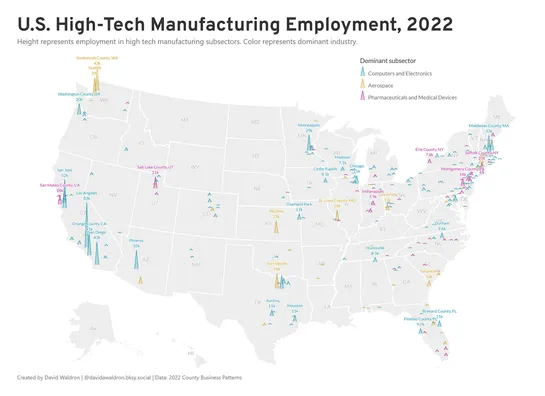
High-tech manufacturing used to employ 2.8% of U.S. workers back in 1990. Now it’s down to 1.3%. The sharpest losses hitcomputers, electronics, and aerospace—industries that once defined the future. Onlypharma and med devicesmanaged to buck the trend, adding 189,000 jobs while the rest bled over a .. read more  

The decline of high-tech manufacturing in the United States
Link
@faun shared a link, 9 months, 3 weeks ago
FAUN.dev()

LLM Evaluation: Practical Tips at Booking.com

A new LLM evaluation framework taps into an"LLM-as-judge"setup—think strong model playing human annotator. It gets prompted (or fine-tuned) to mimic human scores and rate outputs from other LLMs. It runs on a tightly labeledgolden dataset, handles both pointwise and head-to-head comparisons, and sh.. read more  

LLM Evaluation: Practical Tips at Booking.com
Link
@faun shared a link, 9 months, 3 weeks ago
FAUN.dev()

No, AI is not Making Engineers 10x as Productive

Claims of 10–100x dev speed from AI tools skip the hard parts—code reviews, bug queues, flaky tests. In practice, AI helps with the small stuff: one-off scripts, throwaway glue code, basic scaffolds. But scaling that help across big, messy codebases? Still a pipe dream. Too much context lost. Too ma.. read more  

AIStor is an enterprise-grade, high-performance object storage platform built for modern data workloads such as AI, machine learning, analytics, and large-scale data lakes. It is designed to handle massive datasets with predictable performance, operational simplicity, and hyperscale efficiency, while remaining fully compatible with the Amazon S3 API. AIStor is offered under a commercial license as a subscription-based product.

At its core, AIStor is a software-defined, distributed object store that runs on commodity hardware or in containerized environments like Kubernetes. Rather than being limited to traditional file or block interfaces, it exposes object storage semantics that scale from petabytes to exabytes within a single namespace, enabling consistent, flat addressing of vast datasets. It is engineered to sustain very high throughput and concurrency, with examples of multi-TiB/s read performance on optimized clusters.

AIStor is optimized specifically for AI and data-intensive workloads, where throughput, low latency, and horizontal scalability are critical. It integrates broadly with modern AI and analytics tools, including frameworks such as TensorFlow, PyTorch, Spark, and Iceberg-style table engines, making it suitable as the foundational storage layer for pipelines that demand both performance and consistency.

Security and enterprise readiness are central to AIStor’s design. It includes capabilities like encryption, replication, erasure coding, identity and access controls, immutability, lifecycle management, and operational observability, which are important for mission-critical deployments that must meet compliance and data protection requirements.

AIStor is positioned as a platform that unifies diverse data workloads — from unstructured storage for application data to structured table storage for analytics, as well as AI training and inference datasets — within a consistent object-native architecture. It supports multi-tenant environments and can be deployed across on-premises, cloud, and hybrid infrastructure.