Join us

ContentUpdates and recent posts about AIStor..
Link
@faun shared a link, 8 months ago
FAUN.dev()

Redis to acquire Decodable

Redis is buyingDecodable, the real-time streaming startup, to crank up itsRedis Data Integration (RDI)and beef up real-time data ingestion. Decodable’s stack lands in Redis Cloud first, syncing outside data into Redis fast enough to feed hungry AI agents real context. What's really happening:Redis i.. read more  

Redis to acquire Decodable
Link
@faun shared a link, 8 months ago
FAUN.dev()

My Own DNS Server At Home

RunningBIND on Fedora with Podmanputs you in the driver’s seat—local DNS, full zone control, and no third-party middlemen. It handles staticforward/reverse zonesacross multiple IPv4 subnets, skips the mess of dynamic updates, and plugs into your router as a recursiveforwarding resolver. Call it a se.. read more  

My Own DNS Server At Home
Link
@faun shared a link, 8 months ago
FAUN.dev()

Vibe Coding Will Break Your Enterprise

Tools likeReplitandLovableare fine for quick hacks. Not for enterprise. They can’t handle service integration, durable state, or transactions that don’t fall apart. What enterprises need: realagentic systems. These aren’t glorified code editors—they’re stateful, resilient operators. They juggle work.. read more  

Vibe Coding Will Break Your Enterprise
Link
@faun shared a link, 8 months ago
FAUN.dev()

Le Chat now integrates with 20+ enterprise platforms—powered by MCP—and remembers what matters with Memories.

Le Chat now includes20+ secure, MCP-based connectorsfor tools like GitHub, Snowflake, Stripe, and Jira. That means in-chat search, summaries, and actions—straight from enterprise systems. Developers can plug in their owncustom MCP connectors, and run Le Chat wherever it fits: on-prem, private cloud.. read more  

Le Chat now integrates with 20+ enterprise platforms—powered by MCP—and remembers what matters with Memories.
Link
@faun shared a link, 8 months ago
FAUN.dev()

OpenAI to launch its first AI chip in 2026 with Broadcom, FT reports

OpenAI’s firstin-house AI chipis nearly out of the oven. It’s headed for fabrication atTSMCand built to handle OpenAI’s own workloads—no outside sales, according to theFinancial Times. Why it matters:Big AI shops are going vertical. Custom silicon means tighter control over runtime, reliability, an.. read more  

OpenAI to launch its first AI chip in 2026 with Broadcom, FT reports
Link
@faun shared a link, 8 months ago
FAUN.dev()

GPT-5 Thinking in ChatGPT (aka Research Goblin) is shockingly good at search

GPT-5's“thinking” modeljust leveled up. It's not just answering queries—it’s doing full-on research. Picture deep, multi-step Bing searches mixed with tool use and reasoning chains. It reads PDFs. Analyzes them. Suggests what to do next. Then actually does it. All from your phone. What’s changing:L.. read more  

GPT-5 Thinking in ChatGPT (aka Research Goblin) is shockingly good at search
Link
@faun shared a link, 8 months ago
FAUN.dev()

The Big LLM Architecture Comparison

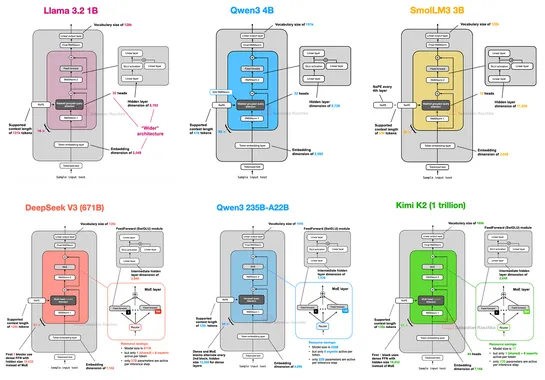
Architectures since GPT-2 still ride transformers. They crank memory and performance withRoPE, swapGQAforMLA, sprinkle in sparseMoE, and roll sliding-window attention. Teams shiftRMSNorm. They tweak layer norms withQK-Norm, locking in training stability across modern models. Trend to watch:In 2025,.. read more  

The Big LLM Architecture Comparison
Link
@faun shared a link, 8 months ago
FAUN.dev()

Best Practices for High Availability of LLM Based on AI Gateway

Alibaba Cloud’s AI Gateway just got sharper. It now handlesreal-time overload protectionandLLM fallback routingusing passive health checks, first packet timeouts, and traffic shaping. It proxies both BYO and cloud LLMs—think PAI-EAS, Tongyi Qianwen—and redirects load spikes or failures on the fly. F.. read more  

Best Practices for High Availability of LLM Based on AI Gateway
Link
@faun shared a link, 8 months ago
FAUN.dev()

Why language models hallucinate

OpenAI sheds light on the persistence ofhallucinationsin language models due to evaluation methods favoring guessing over honesty, requiring a shift towards rewarding uncertainty acknowledgment. High model accuracy does not equate to the eradication of hallucinations, as some questions are inherentl.. read more  

Why language models hallucinate
Link
@faun shared a link, 8 months ago
FAUN.dev()

From Zero to GPU: A Guide to Building and Scaling Production-Ready CUDA Kernels

Hugging Face just dropped Kernel Builder—a full-stack toolchain for building, versioning, and shippingcustom CUDA kernels as native PyTorch ops. Kernels arearchitecture-aware,semantically versioned, andpullable straight from the Hub. It tracks changes with lockfiles and bakes inDocker deploysout of.. read more  

AIStor is an enterprise-grade, high-performance object storage platform built for modern data workloads such as AI, machine learning, analytics, and large-scale data lakes. It is designed to handle massive datasets with predictable performance, operational simplicity, and hyperscale efficiency, while remaining fully compatible with the Amazon S3 API. AIStor is offered under a commercial license as a subscription-based product.

At its core, AIStor is a software-defined, distributed object store that runs on commodity hardware or in containerized environments like Kubernetes. Rather than being limited to traditional file or block interfaces, it exposes object storage semantics that scale from petabytes to exabytes within a single namespace, enabling consistent, flat addressing of vast datasets. It is engineered to sustain very high throughput and concurrency, with examples of multi-TiB/s read performance on optimized clusters.

AIStor is optimized specifically for AI and data-intensive workloads, where throughput, low latency, and horizontal scalability are critical. It integrates broadly with modern AI and analytics tools, including frameworks such as TensorFlow, PyTorch, Spark, and Iceberg-style table engines, making it suitable as the foundational storage layer for pipelines that demand both performance and consistency.

Security and enterprise readiness are central to AIStor’s design. It includes capabilities like encryption, replication, erasure coding, identity and access controls, immutability, lifecycle management, and operational observability, which are important for mission-critical deployments that must meet compliance and data protection requirements.

AIStor is positioned as a platform that unifies diverse data workloads — from unstructured storage for application data to structured table storage for analytics, as well as AI training and inference datasets — within a consistent object-native architecture. It supports multi-tenant environments and can be deployed across on-premises, cloud, and hybrid infrastructure.