Join us

ContentUpdates and recent posts about AIStor..
Link
@faun shared a link, 7 months, 2 weeks ago
FAUN.dev()

TIOBE Programming Index News September 2025: Perl Regains the Spotlight

Perl 5 has risen to **10th place in the TIOBE Index**, increasing in popularity even though the exact reason is unknown. Perl 6, or Raku, lags behind Perl 5 in rankings and has not seen the same rise in attention. Other top languages like C and Java have experienced slight falls in rankings... read more  

Link
@faun shared a link, 7 months, 2 weeks ago
FAUN.dev()

Using Claude Code to modernize a 25-year-old kernel driver

A long-dead Linux kernel driver for QIC-80 tape drives just got dragged into the present—with help from **Claude Code** and a lot of tinkering. It now builds cleanly and runs as a **standalone module** on **Linux 6.8**, playing nice with modern setups like **Xubuntu 24.04**. **The bigger picture:**.. read more  

Using Claude Code to modernize a 25-year-old kernel driver
Link
@faun shared a link, 7 months, 2 weeks ago
FAUN.dev()

Building an AI Server on a Budget ($1.3K)

A developer rolled their own AI server for $1.3K—Ubuntu 24.04.2 LTS, an Nvidia RTX GPU, and a sharp eye on Tensor cores, VRAM, and resale value. The rig handles small models locally and punts big jobs to the cloud when needed. Local-first, cloud-when-it-counts... read more  

Building an AI Server on a Budget ($1.3K)
Link
@faun shared a link, 7 months, 2 weeks ago
FAUN.dev()

You Vibe It, You Run It?

Vibe Coding lets developers create software by chatting with AI, skipping traditional coding. But the non-determinism of AI prompts poses significant risks for reliability and maintainability, potentially leading to addiction-like dependence on this new tool. Think twice before fully embracing this .. read more  

Link
@faun shared a link, 7 months, 2 weeks ago
FAUN.dev()

Understanding LLMs: Insights from Mechanistic Interpretability

LLMs generate text by predicting the next word using attention to capture context and MLP layers to store learned patterns. Mechanistic interpretability shows these models build circuits of attention and features, and tools like sparse autoencoders and attribution graphs help unpack superposition, r.. read more  

Link
@faun shared a link, 7 months, 2 weeks ago
FAUN.dev()

The LinkedIn Generative AI Application Tech Stack: Extending to Build AI Agents

LinkedIn tore down its GenAI stack and rebuilt it for scale—with agents, not monoliths. The new setup leans on distributed, gRPC-powered systems. Central skill registry? Check. Message-driven orchestration? Yep. It’s all about pluggable parts that play nice together. They added sync and async modes.. read more  

The LinkedIn Generative AI Application Tech Stack: Extending to Build AI Agents
Link
@faun shared a link, 7 months, 2 weeks ago
FAUN.dev()

GitHub Copilot on autopilot as community complaints persist

GitHub's biggest debates right now? Whether to shut down AI-generated "noise" fromCopilot—stuff like auto-written issues and code reviews. No clear answers from GitHub yet. Frustration is piling up. Some devs are ditching the platform altogether, shifting their projects toCodebergor spinning upself-.. read more  

GitHub Copilot on autopilot as community complaints persist
Link
@faun shared a link, 7 months, 2 weeks ago
FAUN.dev()

Building Agents for Small Language Models: A Deep Dive into Lightweight AI

Agent engineering with **small language models (SLMs)**—anywhere from 270M to 32B parameters—calls for a different playbook. Think tight prompts, offloaded logic, clean I/O, and systems that don’t fall apart when things go sideways. The newer stack—**GGUF** + **llama.cpp**—lets these agents run loc.. read more  

Link
@faun shared a link, 7 months, 2 weeks ago
FAUN.dev()

AgentHopper: An AI Virus

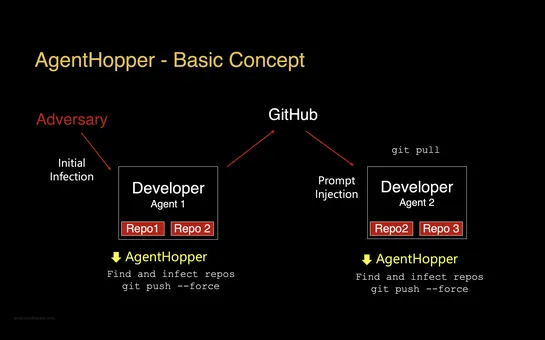
In the “Month of AI Bugs,” researchers poked deep and found prompt injection holes bad enough to run **arbitrary code** on major AI coding tools—**GitHub Copilot**, **Amazon Q**, and **AWS Kiro** all flinched. They didn’t stop at theory. They built **AgentHopper**, a proof-of-concept AI virus that .. read more  

AgentHopper: An AI Virus
Link
@faun shared a link, 7 months, 2 weeks ago
FAUN.dev()

Guardians of the Agents 

A new static verification framework wants to make runtime safeguards look lazy. It slaps **mathematical safety proofs** onto LLM-generated workflows *before* they run—no more crossing fingers at execution time. The setup decouples **code from data**, then runs checks with tools like **CodeQL** and .. read more  

AIStor is an enterprise-grade, high-performance object storage platform built for modern data workloads such as AI, machine learning, analytics, and large-scale data lakes. It is designed to handle massive datasets with predictable performance, operational simplicity, and hyperscale efficiency, while remaining fully compatible with the Amazon S3 API. AIStor is offered under a commercial license as a subscription-based product.

At its core, AIStor is a software-defined, distributed object store that runs on commodity hardware or in containerized environments like Kubernetes. Rather than being limited to traditional file or block interfaces, it exposes object storage semantics that scale from petabytes to exabytes within a single namespace, enabling consistent, flat addressing of vast datasets. It is engineered to sustain very high throughput and concurrency, with examples of multi-TiB/s read performance on optimized clusters.

AIStor is optimized specifically for AI and data-intensive workloads, where throughput, low latency, and horizontal scalability are critical. It integrates broadly with modern AI and analytics tools, including frameworks such as TensorFlow, PyTorch, Spark, and Iceberg-style table engines, making it suitable as the foundational storage layer for pipelines that demand both performance and consistency.

Security and enterprise readiness are central to AIStor’s design. It includes capabilities like encryption, replication, erasure coding, identity and access controls, immutability, lifecycle management, and operational observability, which are important for mission-critical deployments that must meet compliance and data protection requirements.

AIStor is positioned as a platform that unifies diverse data workloads — from unstructured storage for application data to structured table storage for analytics, as well as AI training and inference datasets — within a consistent object-native architecture. It supports multi-tenant environments and can be deployed across on-premises, cloud, and hybrid infrastructure.