Join us

ContentUpdates from The Open Source Security Foundation (OpenSSF) is a...
News FAUN.dev() Team
@devopslinks shared an update, 2 months ago
FAUN.dev()

2025 Internet Trends: Explosive AI Crawling Growth and the Rise of 30+ Tbps DDoS Attacks

In 2025, Internet growth was driven less by humans and more by AI, with AI crawling and user-triggered access surging while post-quantum encryption secured over half of human web traffic. Security risks intensified as record-breaking DDoS attacks topped 30 Tbps and government-imposed shutdowns accounted for nearly half of major global outages.
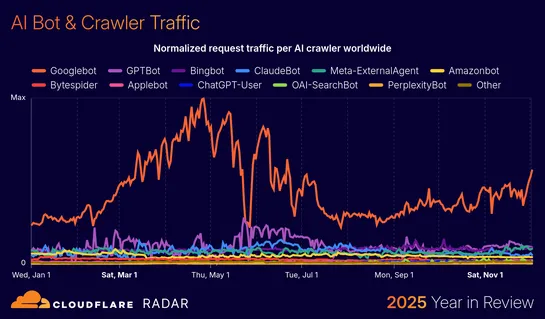
2025 Internet Trends: Explosive AI Crawling Growth and the Rise of 30+ Tbps DDoS Attacks
News FAUN.dev() Team
@kala shared an update, 2 months ago
FAUN.dev()

Meta Acquires Autonomous AI Startup Manus for $3B

Manus AI

Meta has acquired Manus AI for $3 billion, integrating its autonomous AI agents into Meta's products. Manus will continue operations and expand services under Meta, excluding China due to the removal of Chinese ownership.

Manus AI
 Activity
@kala added a new tool Manus AI , 2 months ago.
Story
@laura_garcia shared a post, 2 months ago
Software Developer, RELIANOID

What is Load Balancing in DigitalOcean? ⚖️

A quick 3-minute read on how traffic is distributed across Droplets to improve performance, scalability, and availability—and how RELIANOID enhances it with advanced monitoring, security, and flexibility. 👉 Smart traffic distribution. High availability. Seamless scaling. #LoadBalancing#DigitalOcean#..

Knowledge base Load Balancing in DigitalOcean  RELIANOID
Story
@viktoriiagolovtseva shared a post, 2 months, 1 week ago

Jira Action Items Functionality

Jira Action Items are a new feature introduced in Jira to help teams track small tasks inside a work item (issue) without needing to create subtasks. Instead of breaking out additional tickets for quick to-dos or follow-ups, you can now add lightweight checklists directly into rich text fields like ..

Zrzut ekranu 2026-01-02 152946
Story
@laura_garcia shared a post, 2 months, 1 week ago
Software Developer, RELIANOID

What is AWS (Amazon Web Services)?

AWS is a global public cloud platform that lets you run compute, storage, networking, databases, and more on demand, pay-as-you-go, and at scale across multiple Regions and Availability Zones. 👉 Build resilient architectures 👉 Automate everything with APIs & IaC 👉 Scale securely and globally in minu..

Knowledge base Why Deploy RELIANOID Load Balancer on AWS
Story
@viktoriiagolovtseva shared a post, 2 months, 1 week ago

Vendor Payment Template for Jira

Vendor Payments Take Too Much Time And There Is a Way Out of the Vicious Cycle

Zrzut ekranu 2026-01-02 142203
Story
@laura_garcia shared a post, 2 months, 1 week ago
Software Developer, RELIANOID

✨ Thank You, 2025 — What a Year for RELIANOID! ✨

As the year comes to a close, we want to take a moment to look back and saythank youto everyone who has been part of RELIANOID’s journey in 2025. This year has been all aboutgrowth, innovation, and community: 🚀Product & Technology - Continued evolution ofRELIANOID Enterprise Edition, delivering high..

carrusel1
Story
@laura_garcia shared a post, 2 months, 1 week ago
Software Developer, RELIANOID

AI-driven cyberthreats are reshaping industrial security faster than many manufacturers expect.

As we approach 2026, attackers are already leveraging AI to automate reconnaissance, social engineering and intrusion workflows—often at machine speed. For manufacturing environments, where IT and OT increasingly converge, this creates a new risk landscape. In our latest article, we explore: - Why A..

Blog Manufacturing industry cyberthreats previsions 2026 RELIANOID
Story
@viktoriiagolovtseva shared a post, 2 months, 1 week ago

Your Guide to Cloning in JIRA: How to Clone Issues in Different Ways

While cloning in Jira can be done in just a few clicks, it becomes less straightforward when you have special requirements. What if you need to clone an issue to a different project, clone tasks in bulk, or do this automatically on a schedule? In this article, we explore all these scenarios and provide you with examples and step-by-step instructions.

Zrzut ekranu 2025-12-30 142435
The Open Source Security Foundation (OpenSSF) is an industry-backed foundation focused on strengthening the security of the global open source software ecosystem. It brings together major technology companies, cloud providers, open source communities, and security experts to address systemic security challenges that affect how software is built, distributed, and consumed.

OpenSSF was launched in 2021 and operates under the Linux Foundation, combining efforts from earlier initiatives such as the Core Infrastructure Initiative (CII) and industry-led supply chain security programs. Its mission is to make open source software more trustworthy, resilient, and secure by default, without placing unrealistic burdens on maintainers.

The foundation works across several key areas:

- Supply chain security: Developing frameworks, best practices, and tools to secure the software lifecycle from source to deployment. This includes stewardship of projects like sigstore and leadership on SLSA (Supply-chain Levels for Software Artifacts).

- Security tooling: Supporting and incubating open source tools that help developers detect, prevent, and remediate vulnerabilities at scale.

- Vulnerability management: Improving how vulnerabilities are discovered, disclosed, scored, and fixed across open source projects.

- Education and best practices: Publishing guidance, training, and maturity models such as the OpenSSF Best Practices Badge Program, which helps projects assess and improve their security posture.

- Metrics and research: Advancing data-driven approaches to understanding open source security risks and ecosystem health.

OpenSSF operates through working groups and special interest groups (SIGs) that focus on specific problem areas like securing builds, improving dependency management, or automating provenance generation. This structure allows practitioners to collaborate on concrete, actionable solutions rather than high-level policy alone.

By aligning maintainers, enterprises, and security teams, OpenSSF plays a central role in reducing large-scale risks such as dependency confusion, compromised build systems, and malicious package injection. Its work underpins many modern DevSecOps and cloud-native security practices and is increasingly referenced by governments and enterprises as a baseline for secure software development.