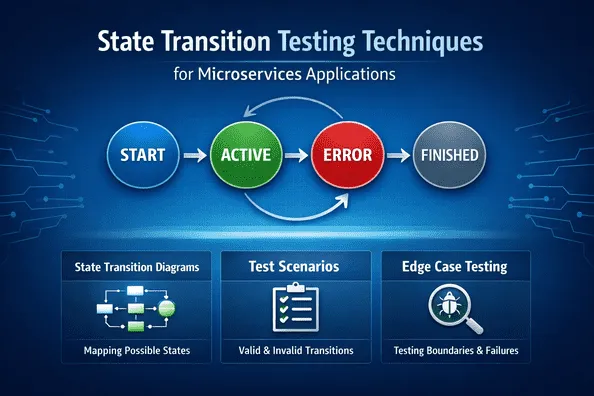
Microservices architectures have transformed modern software development by enabling modular, scalable, and independently deployable components. While this approach offers significant benefits, it also introduces new testing challenges. Each service can have multiple states, and interactions between services can create complex workflows that need careful validation. State transition testing is an effective technique to ensure microservices behave correctly across different states and scenarios.
State transition testing focuses on verifying how a system moves from one state to another based on specific inputs or events. In microservices, this means validating both individual service states and the interactions between services to maintain overall system reliability.
Why State Transition Testing Matters for Microservices
Microservices are loosely coupled and often communicate asynchronously through APIs, messaging queues, or event-driven mechanisms. This distributed nature creates multiple points where state-dependent errors can occur. By using state transition testing, teams can:
- Identify unhandled or unexpected state changes in individual services
- Detect integration issues between services triggered by state transitions
- Validate that workflows maintain consistency across multiple microservices
- Reduce the risk of defects impacting end users in production
Because microservices frequently undergo rapid updates and deployments, incorporating state transition testing helps maintain confidence in system behavior.
Core Techniques for State Transition Testing in Microservices
To implement effective state transition testing, teams typically use a combination of the following techniques:
1. State Diagram Modeling
Create visual representations of all possible states for each microservice and the valid transitions between them. This helps testers and developers understand:
- All possible states a service can occupy
- Events or inputs that trigger transitions
- Expected outputs for each transition
State diagrams act as the foundation for designing test cases and ensure no scenarios are overlooked.
2. Transition Table Testing
Transition tables are tabular representations of states, inputs/events, and expected outcomes. Each row represents a specific transition scenario. This technique is particularly useful for microservices because it allows testers to:
- Clearly define expected behavior for each state change
- Systematically cover all possible transitions
- Identify gaps or ambiguities in service behavior
Transition tables can be automated to improve test efficiency and consistency.
3. Event-Driven Testing
Microservices often communicate through events or messages. Event-driven testing ensures that services respond correctly to incoming events and transition to the appropriate states. Key considerations include:
- Handling valid and invalid event sequences
- Ensuring events trigger correct transitions across services
- Validating that output events or responses are correctly generated
This technique helps uncover defects that occur only during complex service interactions.
4. Boundary and Edge Case Testing
Microservices can have states that are sensitive to boundary conditions, such as thresholds, timeouts, or maximum capacity. Testing edge cases ensures that:
- Services handle unusual or extreme input conditions correctly
- State transitions do not cause unexpected failures
- The overall system remains stable under stress or unusual scenarios
Incorporating edge cases strengthens the reliability of both individual services and the entire microservices ecosystem.
5. Automated Regression Testing
As microservices evolve, new releases may inadvertently affect existing state-dependent functionality. Automated regression tests validate that previously tested states and transitions continue to behave correctly after updates. Benefits include:
- Faster feedback for developers during CI/CD cycles
- Consistent validation of critical workflows
- Reduced risk of introducing defects when deploying new features
Automation tools like Keploy can help teams manage and execute large suites of state-based regression tests efficiently.
Best Practices for Microservices State Transition Testing
To maximize effectiveness, follow these best practices:
- Start small: Begin with critical services or high-risk workflows before scaling to all services.
- Combine with other testing strategies: Integrate state transition testing with unit tests, integration tests, and regression testing for comprehensive validation.
- Automate wherever possible: Leverage testing tools to run state-based tests in CI/CD pipelines consistently.
- Keep diagrams and tables up to date: Regularly review and revise state models as services evolve.
- Prioritize real user scenarios: Focus testing on transitions that are most likely to occur in production.
These practices help ensure that state transition testing remains efficient, manageable, and aligned with microservices best practices.
Conclusion
Microservices architectures offer flexibility and scalability but also introduce complexity in system behavior. State transition testing techniques provide a structured approach to validate how individual services and their interactions respond to various states and events.
By applying state diagram modeling, transition tables, event-driven testing, edge case validation, and automated regression testing, teams can improve test coverage, reduce deployment risks, and maintain system reliability. When implemented effectively, state transition testing becomes an essential part of microservices quality assurance, ensuring that rapid releases remain stable and predictable.