TL;DR
OpenAI introduces ChatGPT for Healthcare, offering HIPAA-compliant AI tools to enhance healthcare delivery. The suite includes ChatGPT Health, designed to integrate health information with AI for improved user navigation.
Key Points
Highlight key points with color coding based on sentiment (positive, neutral, negative).The OpenAI API for Healthcare allows developers to integrate AI models into healthcare systems, supporting applications like patient chart summarization and care team coordination.
The products are powered by GPT-5.2 models, optimized for healthcare tasks and evaluated through real-world clinical scenarios.
Developers can embed AI directly into healthcare workflows and systems, with integrations available for enterprise tools like Microsoft SharePoint.
The platform emphasizes data control with features like customer-managed encryption keys and audit logs to ensure compliance with privacy standards.
The system includes role-based access controls and organization-wide user management for secure deployment across clinical, administrative, and research teams.
OpenAI has introduced a suite of products under the name OpenAI for Healthcare. This includes ChatGPT for Healthcare and the OpenAI API, both of which are being used by major healthcare institutions. The initiative addresses the increasing demand and administrative challenges in healthcare by providing AI tools designed to support care delivery.
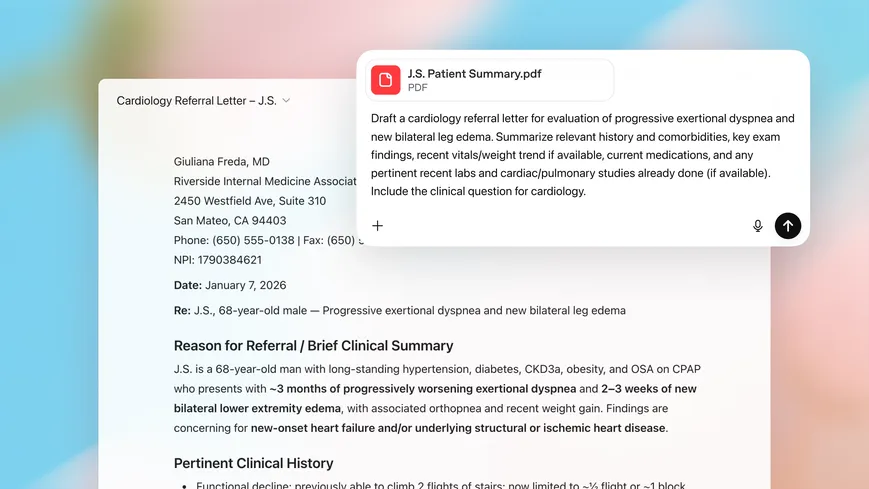
ChatGPT for Healthcare is customized to assist with clinical workflows, evidence retrieval, policy alignment, workflow automation, and access management. It delivers high-quality responses for clinical, research, and operational tasks, using GPT-5 models specifically developed for healthcare. These models have been rigorously tested by physicians and are designed to support evidence-based reasoning in patient care. The tool provides transparent citations from medical sources, aiding clinicians in making informed decisions.
The platform integrates with enterprise tools to align with institutional policies and care pathways, ensuring consistent execution across teams. It includes reusable templates for automating common tasks, reducing the time clinicians spend on administrative work and improving patient transitions of care. Access management is centralized, featuring role-based controls and organization-wide user management, which provides governance for deploying AI across various teams.
The OpenAI API allows developers to embed AI directly into healthcare systems. It supports applications such as patient chart summarization and care team coordination, maintaining HIPAA compliance. An option for a Business Associate Agreement (BAA) is available to ensure data security and privacy.
OpenAI for Healthcare focuses on data control, with patient data remaining under the organization's control. It offers features like data residency options, audit logs, and customer-managed encryption keys. Content shared with ChatGPT for Healthcare is not used to train models, ensuring privacy and compliance.
The initiative is supported by collaborations with healthcare institutions and professional services firms to accelerate AI adoption in healthcare. OpenAI's products are powered by GPT-5.2 models, which have been fine-tuned for healthcare through extensive evaluation and feedback from a global network of physicians. These models have demonstrated improved performance in real-world clinical workflows, surpassing previous models and human baselines in various tasks. OpenAI for Healthcare provides a secure, enterprise-grade foundation for AI in healthcare, supporting compliance with regulatory requirements.
Key Numbers
Present key numerics and statistics in a minimalist format.Licensed physicians partnered with OpenAI for healthcare model evaluation.
Countries represented by participating licensed physicians.
Model outputs reviewed by physicians during healthcare evaluations.
Distinct healthcare areas of focus covered in evaluations.
Healthcare institutions named as early adopters of ChatGPT for Healthcare.
Weekly global users asking health and wellness questions on ChatGPT.
Years of physician-led collaboration informing healthcare model development.
Stakeholder Relationships
An interactive diagram mapping entities directly or indirectly involved in this news. Drag nodes to rearrange them and see relationship details.Organizations
Key entities and stakeholders, categorized for clarity: people, organizations, tools, events, regulatory bodies, and industries.Developed OpenAI for Healthcare, including ChatGPT for Healthcare and the OpenAI API.
Various hospitals and academic medical centers are early adopters of ChatGPT for Healthcare.
Utilizes the OpenAI API to develop capabilities like ambient listening and automated clinical documentation.
Leverages the OpenAI API for developing healthcare-related applications.
Uses the OpenAI API to create solutions such as appointment scheduling.
Tools
Key entities and stakeholders, categorized for clarity: people, organizations, tools, events, regulatory bodies, and industries.A specialized version of ChatGPT designed for healthcare settings to support clinical workflows and reduce administrative burdens.
Allows developers to integrate AI models into healthcare systems, supporting HIPAA compliance.
Regulatory
Key entities and stakeholders, categorized for clarity: people, organizations, tools, events, regulatory bodies, and industries.Ensures compliance in the handling of health information by OpenAI for Healthcare tools.
Industries
Key entities and stakeholders, categorized for clarity: people, organizations, tools, events, regulatory bodies, and industries.The primary industry where OpenAI for Healthcare tools are being implemented to enhance care delivery.
Timeline of Events
Timeline of key events and milestones.Over two years, more than 260 physicians across 60 countries have provided feedback on model outputs, shaping the development of ChatGPT Health.
These models power all OpenAI for Healthcare products and outperform earlier models, developed through ongoing research and real-world evaluation.
ChatGPT for Healthcare is now available and being adopted by major institutions such as AdventHealth, Baylor Scott & White Health, Boston Children’s Hospital, Cedars-Sinai Medical Center, HCA Healthcare, Memorial Sloan Kettering Cancer Center, Stanford Medicine Children’s Health, and University of California, San Francisco (UCSF).
Starting with a small group of early users, with plans to expand access to all users on web and iOS in the coming weeks.
Additional Resources
Enjoyed it?
Get weekly updates delivered straight to your inbox, it only takes 3 seconds!Subscribe to our weekly newsletter Kala to receive similar updates for free!
Give a Pawfive to this post!
Share with your friends and followers
Start writing about what excites you in tech — connect with developers, grow your voice, and get rewarded.
Join other developers and claim your FAUN.dev() account now!

FAUN.dev()
FAUN.dev() is a developer-first platform built with a simple goal: help engineers stay sharp withou…



Kala #GenAI
FAUN.dev()
@kalaDeveloper Influence
16
Influence
1
Total Hits
127
Posts