Join us

ContentUpdates and recent posts about Unsloth..
Link
@kala shared a link, 22 hours ago
FAUN.dev()

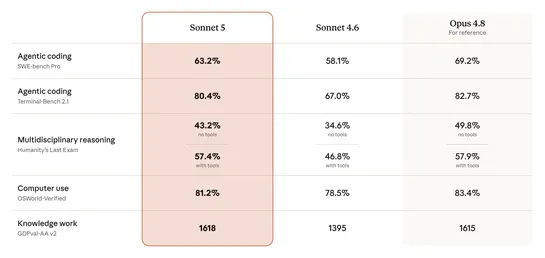
Introducing Claude Sonnet 5

Anthropic launched Claude Sonnet 5, its most agentic Sonnet model, and set it as the default for Free and Pro users... read more  
Introducing Claude Sonnet 5
Link
@varbear shared a link, 1 day, 8 hours ago
FAUN.dev()

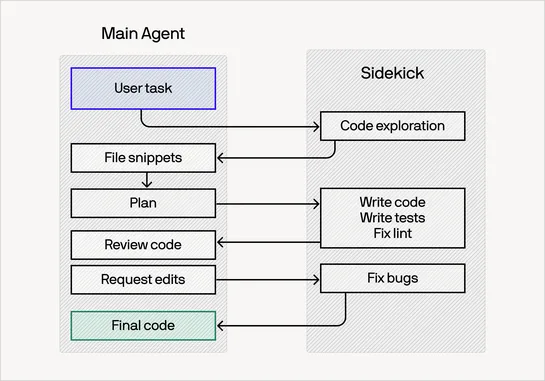
Devin Fusion

Devin Fusion maintains frontier performance at a 35% lower cost on the new FrontierCode benchmark, thanks to its innovative multi-model routing approach. By using both a frontier model and a cost-effective "sidekick" model, Devin Fusion optimizes performance and cost efficiency. The sidekick pattern.. read more  
Devin Fusion
Link
@varbear shared a link, 1 day, 8 hours ago
FAUN.dev()

Introducing Session Switcher. Swap Burp Sessions with One Click!

Doyensec released Session Switcher, a Burp Suite extension. You can save HTTP sessions under names, then swap cookies and headers inside the request editor... read more  

Introducing Session Switcher. Swap Burp Sessions with One Click!
Link
@varbear shared a link, 1 day, 8 hours ago
FAUN.dev()

Jobs and Software is Fu*ked

The writer, a software engineer with 10 years of experience, expresses frustration with the current job market, citing difficulties in navigating filters like Coderpad, hackerrank, and AI proctored exams. They feel disadvantaged by these filters and feel like companies are making it more difficult t.. read more  

Jobs and Software is Fu*ked
Link
@varbear shared a link, 1 day, 8 hours ago
FAUN.dev()

Qwen 3.6 27B is the sweet spot for local development

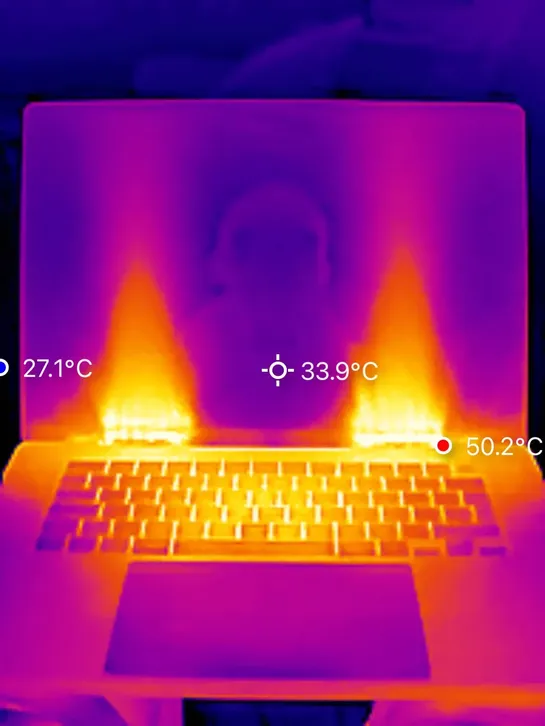
Qwen 3.6 is a local model that stands out as a general intelligence, offered in two variants: Qwen 3.6 35B A3B and Qwen 3.6 27B. Qwen 3.6 27B has been praised for punching above its weight, making it worth the heat it generates. Running Qwen 3.6 locally with llama.cpp is easier than ever, allowing f.. read more  
Qwen 3.6 27B is the sweet spot for local development
Link
@varbear shared a link, 1 day, 8 hours ago
FAUN.dev()

Samsung, SK hynix, Micron Sued in US Over Memory Price Fixing

Samsung Electronics, SK hynix, and Micron face a lawsuit in the US over alleged memory price fixing. Plaintiffs claim the companies colluded on supply and pricing for DRAM, leading to price increases of about 700% in the past four years. The lawsuit, filed by individual consumers and small businesse.. read more  

Link
@varbear shared a link, 1 day, 8 hours ago
FAUN.dev()

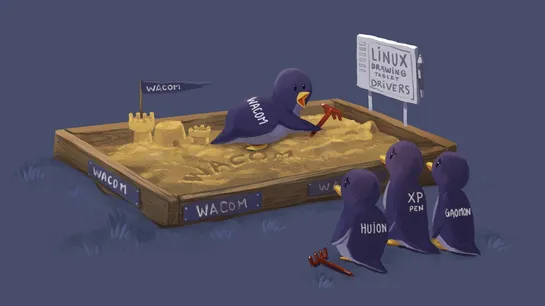
Why Drawing Tablet Brands Won't Collaborate on Linux FLOSS Drivers

The process of creating Linux drivers for drawing tablets can be challenging due to branding issues in the open-source infrastructure. Collaboration from tablet brands is essential for improving support, as demonstrated in recent interactions with Gaomon... read more  
Why Drawing Tablet Brands Won't Collaborate on Linux FLOSS Drivers
Link
@kaptain shared a link, 1 day, 8 hours ago
FAUN.dev()

Building an Event-Driven Network Policy Engine with eBPF and Cilium

Running iptables -L on a node in a 500-node cluster can cause the terminal to freeze due to kube-proxy writing 40,000–60,000 rules across various chains. Conntrack tracks each flow with a global spinlock, becoming a bottleneck past 80,000 connections per second. Cilium replaces this path entirely by.. read more  
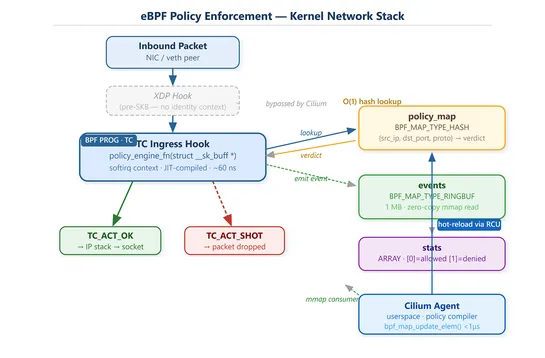
Building an Event-Driven Network Policy Engine with eBPF and Cilium
Link
@kaptain shared a link, 1 day, 8 hours ago
FAUN.dev()

Why cloud native belongs at the heart of agentic AI: Lessons from building a multi-agent security platform on Kubernetes

In March, Willem Berroubache gave a talk at KubeCon + CloudNativeCon Europe 2026 in Amsterdam, addressing questions about building agentic AI on cloud native foundations. The internal security-operations platform at Orange Innovation utilizes A2A protocol for inter-agent coordination, MCP for enviro.. read more  
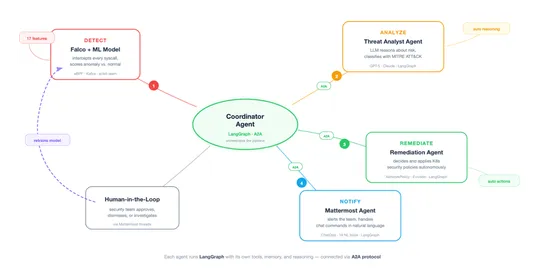
Why cloud native belongs at the heart of agentic AI: Lessons from building a multi-agent security platform on Kubernetes
Link
@kaptain shared a link, 1 day, 8 hours ago
FAUN.dev()

Kepler, re-architected: Improved power accuracy and a community call to action!

Kepler maintainers rewrote Kepler to remove eBPF. They replaced privileged kernel tracing with read-only Linux process data to attribute energy use to Kubernetes workloads... read more  
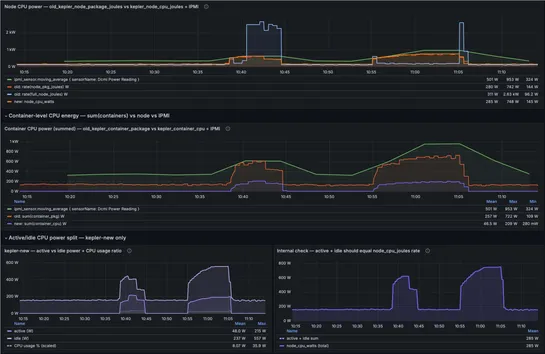
Kepler, re-architected: Improved power accuracy and a community call to action!
Unsloth is an open-source toolkit for training and fine-tuning large language models faster and with less memory than a standard Hugging Face stack. Its core library replaces PyTorch's default autograd with custom backpropagation kernels written in OpenAI's Triton language, which is where most of its speed and memory savings come from. It supports LoRA, QLoRA, full fine-tuning, reinforcement learning, pretraining, and 4-bit, 16-bit, and FP8 training, across more than 500 text, vision, audio, and embedding models.

The practical draw is hardware reach. QLoRA workflows in Unsloth let you fine-tune an 8B model on a single 12 GB consumer GPU, and the project headlines roughly 2x faster training with about 70 percent less VRAM versus baseline implementations, though the exact figures vary by model, GPU, and config. A 2026 update added faster mixture-of-experts training, with models like Qwen3-30B-A3B fine-tunable on about 17.5 GB of VRAM. It runs on NVIDIA (including Blackwell and DGX Spark), AMD, and Intel GPUs, with free Colab and Kaggle notebooks for trying it without local hardware.

It fits cleanly into the local-AI workflow. Unsloth integrates with Hugging Face transformers and TRL, and uses llama.cpp to save and run models, exporting to GGUF for Ollama or LM Studio as well as safetensors. As of 2026 it also ships Unsloth Studio, a local no-code GUI that covers the full lifecycle from dataset creation to training to running and comparing GGUF and safetensors models, with tool-calling, web search, and an OpenAI-compatible API, all running offline on Mac and Windows, with the core library under the Apache 2.0 license.