Join us

ContentUpdates and recent posts about k3d..
 Activity
@goutham-annem started using tool Google Kubernetes Engine (GKE) , 1 week ago.
 Activity
@goutham-annem started using tool Claude Code , 1 week ago.
 Activity
@goutham-annem started using tool Azure Kubernetes Service (AKS) , 1 week ago.
 Activity
@goutham-annem started using tool AWS EKS , 1 week ago.
 Activity
@goutham-annem started using tool Amazon Web Services , 1 week ago.
 Activity
@goutham-annem started using tool Amazon ECS , 1 week ago.
 Activity
Link
@varbear shared a link, 1 week ago
FAUN.dev()

Build and Deploy a Remote MCP Server to GKE in 30 Minutes

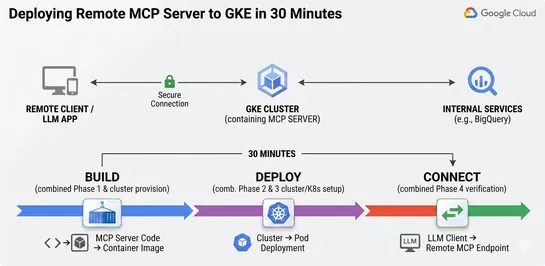
Google walks you through shipping a remoteMCP serveronGKE AutopilotusingFastMCPandstreamable-http, swapping localstdiofor shared HTTP endpoints. The clever bit: theGateway APIhandles managed SSL plusCLIENT_IP session affinity, so one centralized server beats everyone running redundant local copies... read more  
Build and Deploy a Remote MCP Server to GKE in 30 Minutes
Link
@varbear shared a link, 1 week ago
FAUN.dev()

How building an HTML-first site doubled our users overnight

Building HTML-first forms using Astro instead of React dramatically increased completion rates and sustainability, highlighting the effectiveness of lightweight, accessible web components for all users, regardless of browser or connectivity... read more  

How building an HTML-first site doubled our users overnight
Link
@varbear shared a link, 1 week ago
FAUN.dev()

The unwritten laws of software engineering

- Always related - first rollback, then debug. - Backups aren’t real until restored. - You’ll hate yourself for bad logs. - ALWAYS have a rollback plan. - Every external dependency will fail. - If there's risk, use the “4 eyes” rule. - Nothing lasts like a temporary fix... read more  

The unwritten laws of software engineering
k3d is an open-source utility designed to simplify running Kubernetes locally by wrapping K3s (Rancher’s lightweight Kubernetes distribution) inside Docker containers. Instead of creating virtual machines, k3d uses Docker as the execution layer, allowing developers to spin up multi-node Kubernetes clusters in seconds using minimal system resources.

k3d is especially popular for local development, CI pipelines, demos, and testing Kubernetes-native applications. It supports advanced setups such as multi-node clusters, load balancers, custom container registries, port mappings, and volume mounts, while remaining easy to tear down and recreate.

Because it uses K3s, k3d inherits a simplified control plane, bundled components, and reduced memory footprint compared to full Kubernetes distributions. This makes it ideal for developers who want a realistic Kubernetes environment without the overhead of tools like Minikube or full VM-based clusters.

k3d integrates cleanly with common Kubernetes workflows and tools such as kubectl, Helm, Skaffold, and Argo CD. It is frequently used to validate manifests, test Helm charts, and simulate production-like environments locally before deploying to cloud or on-prem clusters.