Join us

ContentUpdates and recent posts about Argo CD..
Link
@kaptain shared a link, 1 day, 11 hours ago
FAUN.dev()

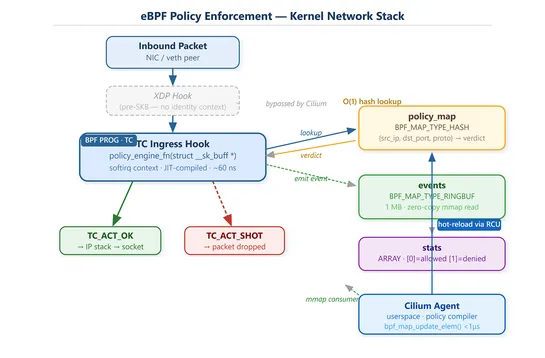
Building an Event-Driven Network Policy Engine with eBPF and Cilium

Running iptables -L on a node in a 500-node cluster can cause the terminal to freeze due to kube-proxy writing 40,000–60,000 rules across various chains. Conntrack tracks each flow with a global spinlock, becoming a bottleneck past 80,000 connections per second. Cilium replaces this path entirely by.. read more  
Building an Event-Driven Network Policy Engine with eBPF and Cilium
Link
@kaptain shared a link, 1 day, 11 hours ago
FAUN.dev()

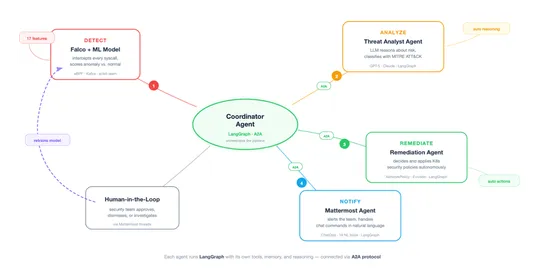
Why cloud native belongs at the heart of agentic AI: Lessons from building a multi-agent security platform on Kubernetes

In March, Willem Berroubache gave a talk at KubeCon + CloudNativeCon Europe 2026 in Amsterdam, addressing questions about building agentic AI on cloud native foundations. The internal security-operations platform at Orange Innovation utilizes A2A protocol for inter-agent coordination, MCP for enviro.. read more  

Why cloud native belongs at the heart of agentic AI: Lessons from building a multi-agent security platform on Kubernetes
Link
@kaptain shared a link, 1 day, 11 hours ago
FAUN.dev()

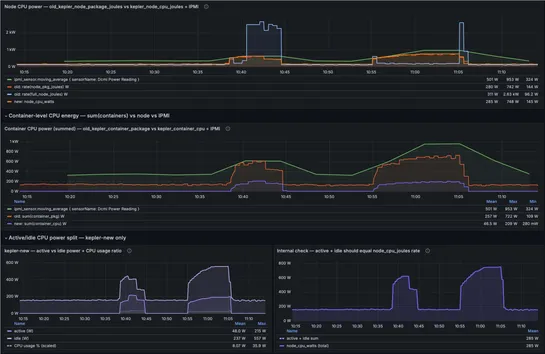
Kepler, re-architected: Improved power accuracy and a community call to action!

Kepler maintainers rewrote Kepler to remove eBPF. They replaced privileged kernel tracing with read-only Linux process data to attribute energy use to Kubernetes workloads... read more  

Kepler, re-architected: Improved power accuracy and a community call to action!
Link
@kaptain shared a link, 1 day, 11 hours ago
FAUN.dev()

Open source maintainership in the age of AI

Kubernetes maintainers accept AI-assisted contributions when contributors disclose AI use, understand the code, and own the change. Maintainers test AI review tools to help them sort issues and pull requests... read more  

Link
@kaptain shared a link, 1 day, 11 hours ago
FAUN.dev()

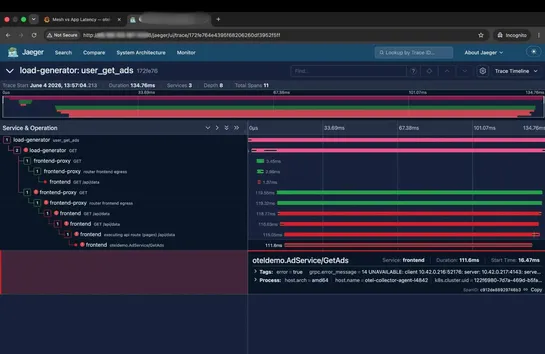
OTel and mesh-derived metrics: A 2026 reference

A blog post by Mesut Oezdil, a DevOps Engineer from Buoyant, discusses how Linkerd's proxy provides network layer metrics with zero changes to application code. The post showcases the overlap and differences between mesh-derived metrics and OpenTelemetry metrics, along with the integration pattern t.. read more  

OTel and mesh-derived metrics: A 2026 reference
Link
@kaptain shared a link, 1 day, 11 hours ago
FAUN.dev()

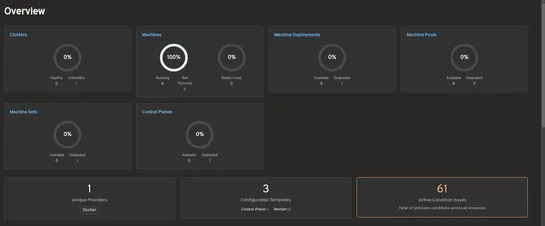
Introducing the Cluster API plugin for Headlamp

Headlamp is an open-source, extensible Kubernetes SIG UI project designed to let you explore, manage, and debug cluster resources directly from a browser. Cluster API (CAPI) is a Kubernetes sub-project that brings declarative, Kubernetes-style APIs to cluster lifecycle management. It lets platform t.. read more  

Introducing the Cluster API plugin for Headlamp
Link
@kala shared a link, 1 day, 12 hours ago
FAUN.dev()

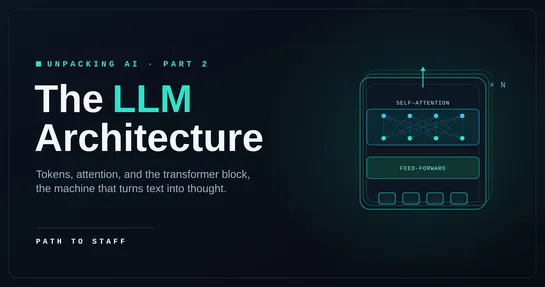
Everything a Senior Engineer Needs to Know About What's Inside an LLM

The shift from RNNs totransformerssolved sequential bottlenecks and long-range decay issues withself-attention. Transformers use encoding, decoding, and tokenization to process sequences efficiently and accurately. This evolution led to models like GPT, which excel at tasks with minimal fine-tuning .. read more  

Everything a Senior Engineer Needs to Know About What's Inside an LLM
Link
@kala shared a link, 1 day, 12 hours ago
FAUN.dev()

GLM-5.2 vs Claude Opus

After a head-to-head coding test, you can use GLM-5.2 as a low-cost open-weights coding model and choose Opus when you need stronger correctness, faster responses, or visual self-checking... read more  

GLM-5.2 vs Claude Opus
Link
@kala shared a link, 1 day, 12 hours ago
FAUN.dev()

The Problem is Prompt Debt

Teams create prompt debt when they hand-tune prompts. They turn natural-language instructions into fragile specs, spend more time adjusting wording, and tie the application to one model... read more  

The Problem is Prompt Debt
Link
@kala shared a link, 1 day, 12 hours ago
FAUN.dev()

Cisco Bets On WideField Security Acquisition To Tackle Agentic AI Security Gap

Cisco executives plan to acquire WideField Security so Cisco teams can add identity and session telemetry to agentic AI security operations... read more  

Cisco Bets On WideField Security Acquisition To Tackle Agentic AI Security Gap
At its core, Argo CD treats Git as the single source of truth for application definitions. You declare the desired state of your Kubernetes applications in Git (manifests, Helm charts, Kustomize overlays), and Argo CD continuously compares that desired state with what is actually running in the cluster. When drift is detected, it can alert you or automatically reconcile the cluster back to the Git-defined state.

Argo CD runs inside Kubernetes and provides:

- Declarative application management
- Automated or manual sync from Git to cluster
- Continuous drift detection and health assessment
- Rollbacks by reverting Git commits
- Fine-grained RBAC and multi-cluster support

It integrates natively with common Kubernetes configuration formats:

- Plain YAML
- Helm
- Kustomize
- Jsonnet

Operationally, Argo CD exposes both a web UI and CLI, making it easy to visualize application state, deployment history, diffs, and sync status. It is commonly used in platform engineering and SRE teams to standardize deployments, reduce configuration drift, and enforce auditability.

Argo CD is part of the Argo Project, which is hosted by the Cloud Native Computing Foundation (CNCF), and is widely adopted in production Kubernetes environments ranging from startups to large enterprises.