Join us

ContentUpdates and recent posts about Vertex AI..
Link
@varbear shared a link, 4 months ago
FAUN.dev()

Stop Forwarding Errors, Start Designing Them

A fresh take on Rust error handling just dropped - and it's calling out the usual suspects. Forget blindly forwarding errors withanyhowor smearing context around withProvider. This approach pushes forstructured, intent-driven error types- errors that say what to do next (like "retry this") instead o.. read more  

Link
@varbear shared a link, 4 months ago
FAUN.dev()

Distinguishing yourself early in your career as a developer

A seasoned dev maps the job market into three tiers:local/public companies,VC-backed/startups, andBig Tech/finance. Each step up brings more money, more competition, and a steeper climb. Category 3(Big Tech/finance): Highest salaries. Broadest interview access. Brutal prep required. Category 2(start.. read more  

Link
@varbear shared a link, 4 months ago
FAUN.dev()

The Code Review That Cost $2 Million, CodeGood

New data shows only15% of code review comments catch real bugs. The rest? Nitpicks on style, naming, or formatting - stuff linters and AI were made to handle. Human reviews burn through$3.6M a yearin larger orgs and still miss the tough stuff: threading issues, system integration bugs, rare edge cas.. read more  

Link
@kaptain shared a link, 4 months ago
FAUN.dev()

BadPods Series: Everything Allowed on AWS EKS

A security researcher ran a full-blown container escape on EKS usingBadPods- a tool that spins up dangerously overprivileged pods. The pod broke out of its container, poked around the host node, moved laterally, and swiped AWS IAM creds. All of it slipped past EKS’s defaultPod Security Admission (PS.. read more  

BadPods Series: Everything Allowed on AWS EKS
Link
@kaptain shared a link, 4 months ago
FAUN.dev()

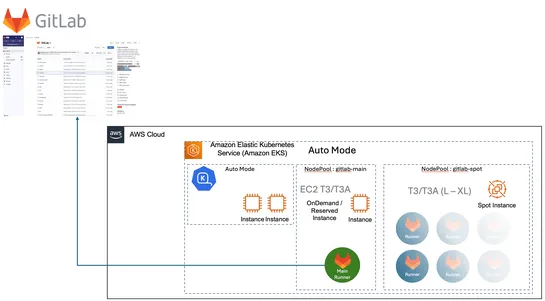
Streamline your containerized CI/CD with GitLab Runners and Amazon EKS Auto Mode

GitLab Runners now work withAmazon EKS Auto Mode. That means hands-off infra, smarter scaling, and built-in AWS security. Runners spin up onEC2 Spot Instances, so teams can cut CI/CD compute costs by as much as90%- without hacking together flaky pipelines... read more  

Streamline your containerized CI/CD with GitLab Runners and Amazon EKS Auto Mode
Link
@kaptain shared a link, 4 months ago
FAUN.dev()

Kubernetes GPU Management Just Got a Major Upgrade

Kubernetes 1.34 droppedDynamic Resource Allocation (DRA)- think persistent volumes, but for GPUs and custom hardware. Vendors can now plug in drivers and schedulers for their devices, and workloads can pick exactly what they need. Coming in 1.35: a newworkload abstractionthat speaks the language of .. read more  

Link
@kaptain shared a link, 4 months ago
FAUN.dev()

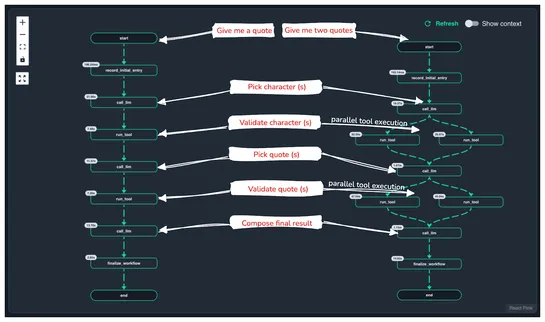
From Deterministic to Agentic: Creating Durable AI Workflows with Dapr

Dapr droppedDurable Agents- a mashup of classic workflows and LLM-driven agents that can actually get things done and survive rough edges. They track reasoning steps, tool calls, and chat states like a champ. If things crash, no problem: Dapr Workflows and Diagrid Catalyst bring it all back... read more  

From Deterministic to Agentic: Creating Durable AI Workflows with Dapr
Link
@kaptain shared a link, 4 months ago
FAUN.dev()

Implementing assurance pipeline for Amazon EKS Platform

AWS released a full-stack CI/CD validation pipeline forAmazon EKS. It pulls in six layers of testing,Terraform,Helm,Locustload testing, and evenAWS Fault Injectionfor pushing resilience to the edge. The goal: bake policy checks, functional tests, and brutal load tests right into pre-deployment. Fewe.. read more  

Link
@kaptain shared a link, 4 months ago
FAUN.dev()

v1.35: New level of efficiency with in-place Pod restart

Kubernetes 1.35, as you may know, introducedin-place Pod restarts(alpha). It's a real reset: all containers, init and sidecars included - without killing the Pod or kicking off a reschedule. Think restart without the cloud drama. Big win for workloads with heavy inter-container dependencies or massi.. read more  

Link
@kaptain shared a link, 4 months ago
FAUN.dev()

v1.35: Watch Based Route Reconciliation in the Cloud Controller Manager

Kubernetes v1.35 sneaks in an alphafeature gatethat flips the CCM route controller from "check every X minutes" to "watch and react." It now usesinformersto trigger syncs when nodes change - plus a light periodic check every 12–24 hours... read more  

Vertex AI is Google Cloud’s end-to-end machine learning and generative AI platform, designed to help teams build, deploy, and operate AI systems reliably at scale. It unifies data preparation, model training, evaluation, deployment, and monitoring into a single managed environment, reducing operational complexity while supporting advanced AI workloads.

Vertex AI supports both custom models and foundation models, including Google’s Gemini model family. It enables organizations to fine-tune models, run large-scale inference, orchestrate agentic workflows, and integrate AI into production systems with strong security, governance, and observability controls.

The platform includes tools for AutoML, custom training with TensorFlow and PyTorch, managed pipelines, feature stores, vector search, and online and batch prediction. For generative AI use cases, Vertex AI provides APIs for text, image, code, multimodal generation, embeddings, and agent-based systems, including support for Model Context Protocol (MCP) integrations.

Built for enterprise environments, Vertex AI integrates deeply with Google Cloud services such as BigQuery, Cloud Storage, IAM, and VPC, enabling secure data access and compliance. It is widely used across industries like finance, healthcare, retail, and science for applications ranging from recommendation systems and forecasting to autonomous research agents and AI-powered products.