Join us

ContentUpdates and recent posts about Vertex AI..
Link
@varbear shared a link, 3 months, 3 weeks ago
FAUN.dev()

How Browsers Work

An interactive open-source guide breaks down browser internals with slick, step-through models coveringDNS resolution,TCP handshakes, andHTML parsing. It walks through the browser'ssequential pipeline- from URL to DOM - blending protocol deep-dives with hands-on visuals you can poke at... read more  

Link
@kaptain shared a link, 3 months, 3 weeks ago
FAUN.dev()

v1.35: Introducing Workload Aware Scheduling

Kubernetes v1.35 is shifting gears. The newWorkload APIand earlygang schedulingsupport bring group-first thinking, schedule Pods as a unit, or not at all. They’ve thrown inopportunistic batchingtoo. It’s in Beta. It speeds up clusters juggling loads of identical Pods by skipping repeat feasibility c.. read more  

Link
@kaptain shared a link, 3 months, 3 weeks ago
FAUN.dev()

Bryan Cantrill: How Kubernetes Broke the AWS Cloud Monopoly

Bryan Cantrill says Kubernetes didn’t just organize containers, it cracked open the cloud market. By letting teams provision infrastructure without locking into provider APIs, it broke AWS’s first-mover grip. That shift putcloud neutralityon the table, and suddenly multi-cloud wasn’t just a buzzword.. read more  

Bryan Cantrill: How Kubernetes Broke the AWS Cloud Monopoly
Link
@kaptain shared a link, 3 months, 3 weeks ago
FAUN.dev()

Kubernetes Was Overkill. We Moved to Docker Compose and Saved 60 Hours.

A small team rolled back their Kubernetes move after six months in the weeds. The setup tanked productivity, bloated infra costs, and turned simple deploys into a slog. They ditched it, brought back Docker Compose, and chopped deploy time from 45 minutes to 4. That one change freed up 60+ engineerin.. read more  

Link
@kaptain shared a link, 3 months, 3 weeks ago
FAUN.dev()

From Cluster UI to Operational Plane: Lessons from the Kubernetes Dashboard Deprecation

The official Kubernetes Dashboard has been deprecated. This reflects the shift in Kubernetes operations towards multi-cluster environments, GitOps workflows, and strict access controls. Modern Kubernetes environments require application-aware, RBAC-first operational tools that work across clusters a.. read more  

Link
@kaptain shared a link, 3 months, 3 weeks ago
FAUN.dev()

Kubernetes by Example

K8s by Exampleis likeGo by Example, but for YAML and Kubernetes. It’s packed with annotated manifests that show real deployment, scaling, and self-healing patterns, stuff you'd actually use in prod... read more  

Link
@kala shared a link, 3 months, 3 weeks ago
FAUN.dev()

8 plots that explain the state of open models

Starting 2026, Chinese companies are dominating the open AI model scene, with Qwen leading in adoption metrics. Despite the rise of new entrants like Z.ai, MiniMax, Kimi Moonshot, and others, Qwen's position seems secure. DeepSeek's large models are showing potential to compete with Qwen, but the Ch.. read more  

Link
@kala shared a link, 3 months, 3 weeks ago
FAUN.dev()

Build an AI-powered website assistant with Amazon Bedrock

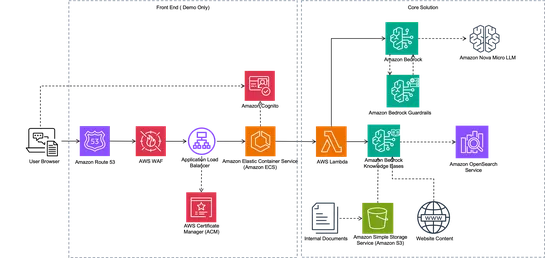
AWS spun up a serverless RAG-based support assistant usingAmazon BedrockandBedrock Knowledge Bases. It pulls in docs via a web crawler and S3, then stuffs embeddings intoAmazon OpenSearch Serverless. Access is role-aware, locked down withCognito. Everything spins up clean withAWS CDK... read more  

Build an AI-powered website assistant with Amazon Bedrock
Link
@kala shared a link, 3 months, 3 weeks ago
FAUN.dev()

Where good ideas come from (for coding agents)

A new way to build agents treats prompting ascontext navigation, steering the LLM through ideas like a pilot, not tossing it prompts and hoping for magic. It maps neatly onto Steven Johnson’s seven patterns of innovation. For coding agents to actually pull their weight, users need to bring more than.. read more  

Link
@kala shared a link, 3 months, 3 weeks ago
FAUN.dev()

Towards Generalizable and Efficient Large-Scale Generative Recommenders

Authors discuss their approach to scaling generative recommendation models from O(1M) to O(1B) parameters for Netflix tasks, improving training stability, computational efficiency, and evaluation methodology. They address challenges in alignment, cold-start adaptation, and deployment, proposing syst.. read more  

Vertex AI is Google Cloud’s end-to-end machine learning and generative AI platform, designed to help teams build, deploy, and operate AI systems reliably at scale. It unifies data preparation, model training, evaluation, deployment, and monitoring into a single managed environment, reducing operational complexity while supporting advanced AI workloads.

Vertex AI supports both custom models and foundation models, including Google’s Gemini model family. It enables organizations to fine-tune models, run large-scale inference, orchestrate agentic workflows, and integrate AI into production systems with strong security, governance, and observability controls.

The platform includes tools for AutoML, custom training with TensorFlow and PyTorch, managed pipelines, feature stores, vector search, and online and batch prediction. For generative AI use cases, Vertex AI provides APIs for text, image, code, multimodal generation, embeddings, and agent-based systems, including support for Model Context Protocol (MCP) integrations.

Built for enterprise environments, Vertex AI integrates deeply with Google Cloud services such as BigQuery, Cloud Storage, IAM, and VPC, enabling secure data access and compliance. It is widely used across industries like finance, healthcare, retail, and science for applications ranging from recommendation systems and forecasting to autonomous research agents and AI-powered products.