Join us

ContentUpdates and recent posts about Slurm..
Story
@laura_garcia shared a post, 6 months, 2 weeks ago
Software Developer, RELIANOID

NEW RELEASE: RELIANOID 8.4 Enterprise Edition is here!

- We’re excited to announce the launch of RELIANOID 8.4, bringing greater performance, security, and automation to your Application Delivery Infrastructure. - What’s new in 8.4: - High-Performance Proxy – Now with HTTP/2 support and Hot Restart for seamless, zero-downtime updates. - Multi-Factor Aut..
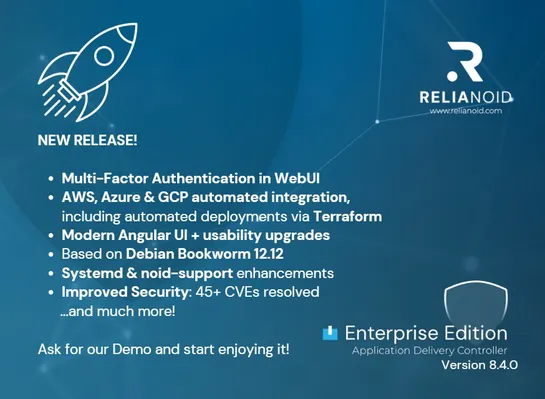
RELIANOID Enterprise Edition 8.4.0
Link
@anjali shared a link, 6 months, 2 weeks ago
Customer Marketing Manager, Last9

OpenTelemetry Spans Explained: Deconstructing Distributed Tracing

Understand how OpenTelemetry Spans capture, connect, and explain every operation in your distributed system for deeper visibility.

otel
Story
@laura_garcia shared a post, 6 months, 2 weeks ago
Software Developer, RELIANOID

🔁 In case you missed it:Incident Response in 2025: Lessons Learned

🔁 In case you missed it: Our August blog post — “Incident Response in 2025: Lessons Learned” — looks back at a summer marked by major cyber incidents, from supply chain disruptions to large-scale data breaches. Discover how AI-driven detection, faster response strategies, and new resilience tools ar..

Link
@anjali shared a link, 6 months, 2 weeks ago
Customer Marketing Manager, Last9

Top 9 APM Tools for Node.js Performance Monitoring

Compare top APM tools for Node.js — from open-source options to enterprise-grade platforms — and choose the best fit for your stack.

php_apm
Link
@anjali shared a link, 6 months, 2 weeks ago
Customer Marketing Manager, Last9

Top 11 Ruby APM Tools for 2025: A Performance-Driven Selection

Explore the top Ruby APM tools for 2025 — from open-source to enterprise — to monitor, trace, and optimize your app’s performance.

nodejs_apm
Story
@laura_garcia shared a post, 6 months, 3 weeks ago
Software Developer, RELIANOID

🔐 Defense-in-depth is no longer a theory—it's a necessity in industrial networks.

In our latest article, we explore how industrial sectors are implementing network segmentation and microsegmentation to protect critical systems. From vertical and horizontal segmentation models to modern OT firewalls and IoT gateways, we break down the architectures and tools driving zero-trust in ..

Story
@laura_garcia shared a post, 6 months, 3 weeks ago
Software Developer, RELIANOID

🌍 RELIANOID at DevOpsDays Almaty 2025 | 24 October | Almaty, Kazakhstan

DevOpsDays — a global series of technical conferences uniting software development and IT operations professionals — is coming to Almaty on 24 October 2025! 🎉 This event will gather local and international experts, engineers, and businesses to share insights, drive collaboration, and grow the DevOp..

devopsdays almaty event
Story
@laura_garcia shared a post, 6 months, 3 weeks ago
Software Developer, RELIANOID

🚨 Cyberattack on Qantas exposed growing threats to aviation

A few months ago, up to 6 million customers were affected through a third-party data breach — reportedly linked to Scattered Spider, a group notorious for social engineering and supply chain attacks. 🔍 The takeaway? The weakest link often lies outside the organization. ✈️ At RELIANOID, we helped air..

News FAUN.dev() Team Trending
@devopslinks shared an update, 6 months, 3 weeks ago
FAUN.dev()

AWS Outage: A Single Cloud Region Shouldn’t Take Down the World. But It Did.

Amazon Web Services

A major AWS outage disrupted high-profile services like Amazon, Snapchat, and Disney+, affecting over 70 AWS services and causing widespread operational issues.

Downdetector
Slurm Workload Manager is an open-source, fault-tolerant, and highly scalable cluster management and scheduling system widely used in high-performance computing (HPC). Designed to operate without kernel modifications, Slurm coordinates thousands of compute nodes by allocating resources, launching and monitoring jobs, and managing contention through its flexible scheduling queue.

At its core, Slurm uses a centralized controller (slurmctld) to track cluster state and assign work, while lightweight daemons (slurmd) on each node execute tasks and communicate hierarchically for fault tolerance. Optional components like slurmdbd and slurmrestd extend Slurm with accounting and REST APIs. A rich set of commands—such as srun, squeue, scancel, and sinfo—gives users and administrators full visibility and control.

Slurm’s modular plugin architecture supports nearly every aspect of cluster operation, including authentication, MPI integration, container runtimes, resource limits, energy accounting, topology-aware scheduling, preemption, and GPU management via Generic Resources (GRES). Nodes are organized into partitions, enabling sophisticated policies for job size, priority, fairness, oversubscription, reservation, and resource exclusivity.

Widely adopted across academia, research labs, and enterprise HPC environments, Slurm serves as the backbone for many of the world’s top supercomputers, offering a battle-tested, flexible, and highly configurable framework for large-scale distributed computing.