Join us

ContentUpdates and recent posts about Lustre..
Link
@varbear shared a link, 3 months, 1 week ago
FAUN.dev()

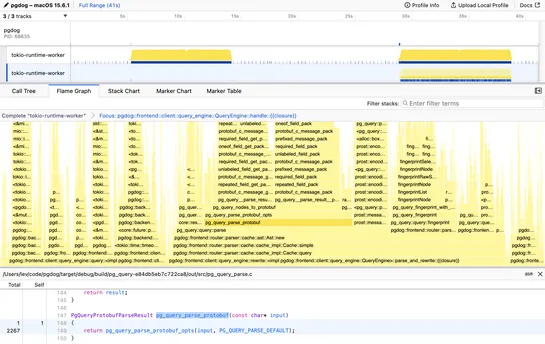
Replacing Protobuf with Rust to go 5 times faster

PgDog ditched Protobuf for raw C-to-Rust integration inpg_query.rs. The new setup usesbindgenand recursive FFI wrappers - no serialization, no handoffs. The payoff? Query parsing is 5× faster. Deparsing hit 10×. Evenpgbenchsaw a 25% bump across major ops... read more  
Replacing Protobuf with Rust to go 5 times faster
Link
@varbear shared a link, 3 months, 1 week ago
FAUN.dev()

A Social Filesystem

The AT Protocol flips social apps inside out. Instead of locking posts and profiles inside platform silos, it treats them as files -JSON-based records, stored in your own decentralized, app-neutral repo. Everything you do - posts, follows, likes - gets logged as a signed, timestampedrecordin your pe.. read more  

A Social Filesystem
Link
@varbear shared a link, 3 months, 1 week ago
FAUN.dev()

ASCII characters are not pixels: a deep dive into ASCII rendering

A fresh take on programmatic ASCII rendering brings inhigh-dimensional shape vectors,supersampling, andcontrast tricksto keep edges crisp and animations clean. Under the hood:k-d tree nearest-neighbor lookups,vector quantization, andGPU-powered samplinghelp push sharp ASCII frames without tanking pe.. read more  

ASCII characters are not pixels: a deep dive into ASCII rendering
Link
@varbear shared a link, 3 months, 1 week ago
FAUN.dev()

If you're a Zoomer, this one's for you: Everything Gen Z needs to know about the 2025 tech landscape

AI investment hit $1.5T in 2025. Think dot-com energy: bloated valuations, feverish M&A. Startup acquisitions shot up 13%. Deal volume? Up 115%. Hype’s worn thin. Enterprises are done lighting money on fire with flashy tools. Focus is shifting to agents - LLMs thatdothings, not justsaythings. System.. read more  

If you're a Zoomer, this one's for you: Everything Gen Z needs to know about the 2025 tech landscape
Link
@kaptain shared a link, 3 months, 1 week ago
FAUN.dev()

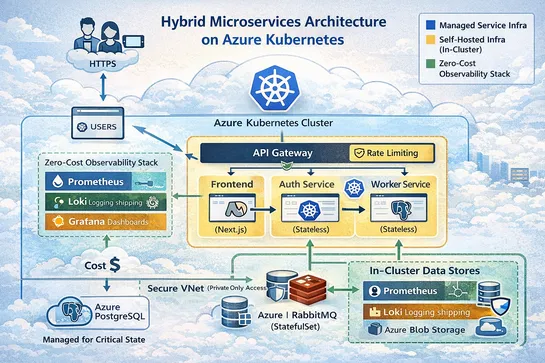
Building Production-Grade Micro services on Azure Kubernetes

A team running microservices onAzure Kubernetes Servicegave their setup a smart overhaul: critical state stayed managed inPostgreSQL, but compute and observability went DIY. The payoff? Major cost cuts. Interrupt-friendly jobs landed onspot instances, and they ditched pricey per-GB logging for a hom.. read more  

Building Production-Grade Micro services on Azure Kubernetes
Link
@kaptain shared a link, 3 months, 1 week ago
FAUN.dev()

v1.35: Mutable PersistentVolume Node Affinity (alpha)

Kubernetes 1.35 (alpha) cracks openPersistentVolume node affinity. You can now update it on the fly. Before, it was locked down - once set, it stayed set. That got in the way of shifting workloads when disks were upgraded or moved across zones. Now? More flexibility. Less pain... read more  

Link
@kaptain shared a link, 3 months, 1 week ago
FAUN.dev()

What has Docker become?

Docker’s not just about containers anymore. It’s pivoting hard into AI infrastructure - with some teeth. The newModel Runner,GPU offloading, and fresh AI-native integrations with Google Cloud and Vercel show where it’s headed: less dev environment, more AI runtime engine. Under the hood, Docker drop.. read more  

Link
@kaptain shared a link, 3 months, 1 week ago
FAUN.dev()

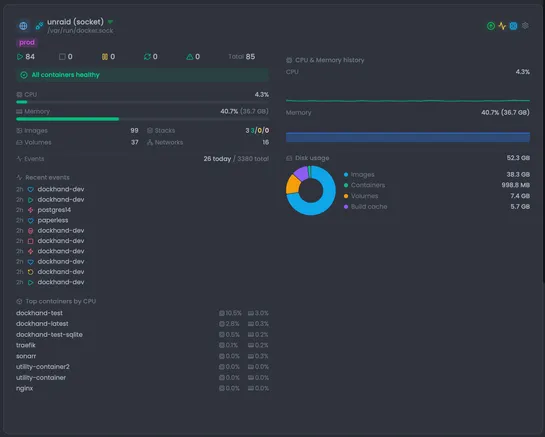
Dockhand - The Ultimate Self-Hosted Docker Management Tool

Dockhand just dropped, and it's aiming straight at the bloated SaaS stack. It’s a fully self-hosted Docker management tool with zero license walls. Local or remote? Doesn’t matter. It even plays nice behind NAT using outbound WebSocket agents. You get container lifecycle controls, a visual Compose e.. read more  

Dockhand - The Ultimate Self-Hosted Docker Management Tool
Link
@kala shared a link, 3 months, 1 week ago
FAUN.dev()

How to build a Frontend for LangChain Deep Agents with CopilotKit!

LangChain recently introduced Deep Agents: a new way to build structured, multi-agent systems that can plan, delegate, and reason across multiple steps. It comes with built-in planning, a filesystem for context, and subagent spawning. But connecting that agent to a real frontend is still surprisingl.. read more  

Link
@kala shared a link, 3 months, 1 week ago
FAUN.dev()

The Rise of GPUOps: Where Infrastructure Meets Thermodynamics

GPU demand for AI has shot up 600% since 2020. It’s outpaced the cloud abstractions devs rely on - highlighting a growing gap between slick DevOps dashboards and the gritty realities of heat, cost, and silicon. EnterGPUOps. It's not just a trend - it’s a new layer in the stack. Think observability w.. read more  

The Rise of GPUOps: Where Infrastructure Meets Thermodynamics
Lustre is an open-source, parallel distributed file system built for high-performance computing environments that require extremely fast, large-scale data access. Designed to serve thousands of compute nodes concurrently, Lustre enables HPC clusters to read and write data at multi-terabyte-per-second speeds while maintaining low latency and fault tolerance.

A Lustre deployment separates metadata and file data into distinct services—Metadata Servers (MDS) handling namespace operations and Object Storage Servers (OSS) serving file contents stored across multiple Object Storage Targets (OSTs). This architecture allows clients to access data in parallel, achieving performance far beyond traditional network file systems.

Widely adopted in scientific computing, supercomputing centers, weather modeling, genomics, and large-scale AI training, Lustre remains a foundational component of modern HPC stacks. It integrates with resource managers like Slurm, supports POSIX semantics, and is designed to scale from small clusters to some of the world’s fastest supercomputers.

With strong community and enterprise support, Lustre provides a mature, battle-tested solution for workloads that demand extreme I/O performance, massive concurrency, and petabyte-scale distributed storage.