Join us

ContentUpdates and recent posts about Grafana Tempo..
 Activity
@koukibadr started using tool Azure Pipelines , 1 week, 1 day ago.
 Activity
@koukibadr started using tool Amazon S3 , 1 week, 1 day ago.
 Activity
@ravikyada started using tool Kubernetes , 1 week, 1 day ago.
 Activity
@ravikyada started using tool Jenkins , 1 week, 1 day ago.
 Activity
@ravikyada started using tool Grafana , 1 week, 1 day ago.
 Activity
@ravikyada started using tool Docker , 1 week, 1 day ago.
 Activity
@ravikyada started using tool Amazon Web Services , 1 week, 1 day ago.
Link
@varbear shared a link, 1 week, 2 days ago
FAUN.dev()

Why are top university websites serving p0rn? It comes down to shoddy housekeeping.

Researcher Alex Shakhov found scammers commandeering staleCNAMErecords. They hijack university subdomains (eg.berkeley.edu,columbia.edu,washu.edu) and serve p0rn and scam pages. Shakhov found hundreds of abused subdomains across at least34universities. He counted thousands of hijacked pages indexed .. read more  

Why are top university websites serving p0rn? It comes down to shoddy housekeeping.
Link
@varbear shared a link, 1 week, 2 days ago
FAUN.dev()

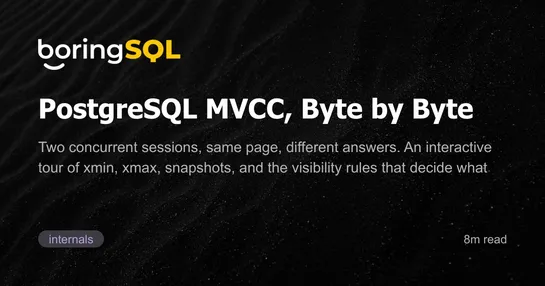
PostgreSQL MVCC, Byte by Byte

PostgreSQL's MVCC stores two 32-bit XIDs per tuple -xminandxmax. The transaction snapshot decides visibility per tuple. Updates append new tuples and mark the old withxmax.VACUUMreclaims versions only when no active snapshot can see them. Long-runningREPEATABLE READsnapshots pin versions and cause b.. read more  

PostgreSQL MVCC, Byte by Byte
Link
@varbear shared a link, 1 week, 2 days ago
FAUN.dev()

The AWS Lambda 'Kiss of Death'

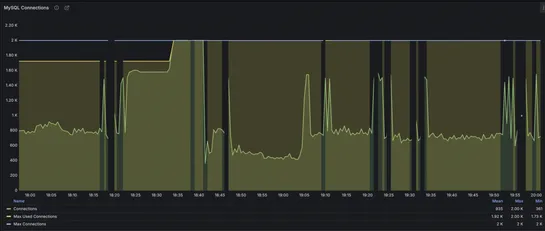
A Galera writer node froze afterInnoDBundo history ballooned. PooledAWS Lambdaconnections left transactions open and pinned MVCC read views. The team killed stalled sessions, enabledinnodb_undo_log_truncate, and cappedinnodb_max_undo_log_size. They also set sessiontransaction_isolation=READ-COMMITTE.. read more  

The AWS Lambda 'Kiss of Death'
Grafana Tempo is a distributed tracing backend built for massive scale and low operational overhead. Unlike traditional tracing systems that depend on complex databases, Tempo uses object storage—such as S3, GCS, or Azure Blob Storage—to store trace data, making it highly cost-effective and resilient. Tempo is part of the Grafana observability stack and integrates natively with Grafana, Prometheus, and Loki, enabling unified visualization and correlation across metrics, logs, and traces.

Technically, Tempo supports ingestion from major tracing protocols including Jaeger, Zipkin, OpenCensus, and OpenTelemetry, ensuring easy interoperability. It features TraceQL, a domain-specific query language for traces inspired by PromQL and LogQL, allowing developers to perform targeted searches and complex trace-based analytics. The newer TraceQL Metrics capability even lets users derive metrics directly from trace data, bridging the gap between tracing and performance analysis.

Tempo’s Traces Drilldown UI further enhances usability by providing intuitive, queryless analysis of latency, errors, and performance bottlenecks. Combined with the tempo-cli and tempo-vulture tools, it delivers a full suite for trace collection, verification, and debugging.

Built in Go and following OpenTelemetry standards, Grafana Tempo is ideal for organizations seeking scalable, vendor-neutral distributed tracing to power observability at cloud scale.