Join us

ContentUpdates and recent posts about GPT..
Link
@varbear shared a link, 2 months ago
FAUN.dev()

Email address obfuscation: What works in 2026?

The article catalogs obfuscation methods:HTML entities,SVG in an object,display:none, JavaScript decoders, custom encodings, andAES‑256. It coversmailtoobfuscation, redirects (302/301,.htaccess), interaction-gated reveals, accessibility caveats, and ahoneypot-based spam-statistics system... read more  

Link
@varbear shared a link, 2 months ago
FAUN.dev()

SQLite Features You Didn’t Know It Had: JSON, text search, CTE, STRICT, generated columns, WAL

SQLite packsJSONextraction, expression indexes,FTS5full-text search,CTEs, window functions, andWALinto a single file. It enforcesstrict tables, supportsgenerated columns, and indexes JSON expressions for fast semi-structured queries... read more  

Link
@kaptain shared a link, 2 months ago
FAUN.dev()

How GitHub uses eBPF to improve deployment safety

GitHub hosts its own source code on github.com, creating a circular dependency. To mitigate this, GitHub maintains mirrors of its code and built assets. By using eBPF, GitHub can selectively monitor and block calls that create circular dependencies in their deployment system... read more  

How GitHub uses eBPF to improve deployment safety
Link
@kaptain shared a link, 2 months ago
FAUN.dev()

K3s on On-Prem Infrastructures the GitOps Way: Writing a Custom k0rdent Template from Scratch

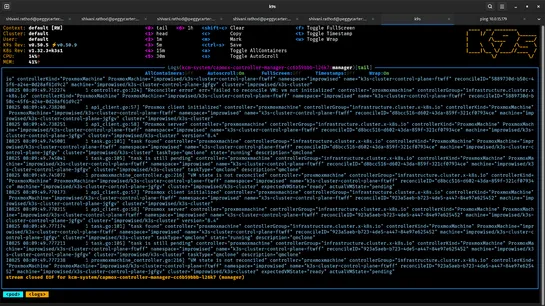
Kubernetes, now 12 years old, has evolved into the universal operating system for modern infrastructure, running on various platforms like Proxmox. Using k0rdent, Proxmox, and K3s, users can provision and manage Kubernetes clusters on-premise in a declarative, repeatable, and clean manner. This appr.. read more  

K3s on On-Prem Infrastructures the GitOps Way: Writing a Custom k0rdent Template from Scratch
Link
@kaptain shared a link, 2 months ago
FAUN.dev()

Kubernetes Monitoring Helm chart v4: Biggest update ever!

The Kubernetes Monitoring Helm chart version 4.0 is designed to solve real pain points that users have hit as their monitoring setups have grown. Destinations are now defined as a map instead of a list, making it easier to manage configurations for multiple clusters. Collectors are defined by the us.. read more  

Kubernetes Monitoring Helm chart v4: Biggest update ever!
Link
@kaptain shared a link, 2 months ago
FAUN.dev()

When Kubernetes restarts your pod - And when it doesn’t

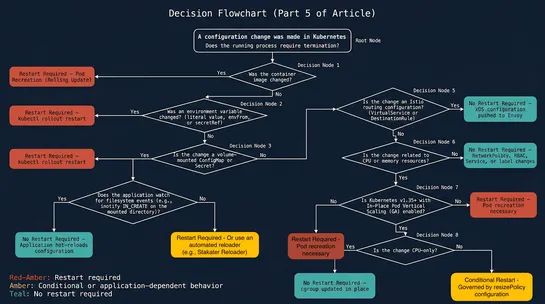
Production internals guide verified against Kubernetes 1.35 GA. Engineers need to understand terminology differences to avoid flawed runbooks and bad on-call decisions. Kubelet watches the pod spec, not other resources like ConfigMaps or Secrets, to explain the majority of config update investigatio.. read more  

When Kubernetes restarts your pod - And when it doesn’t
Link
@kaptain shared a link, 2 months ago
FAUN.dev()

Duolingo's Kubernetes Leap

Duolingo made a bold leap migrating 500+ services to Kubernetes, embracing Argo CD for blue-green deployments and leveraging GitOps for flexibility and control. This shift to a cellular architecture enabled them to isolate environments and manage developer trust while navigating AWS rate limits. Exc.. read more  

Link
@kala shared a link, 2 months ago
FAUN.dev()

Scaling MCP adoption: Our reference architecture for simpler, safer and cheaper enterprise deployments of MCP

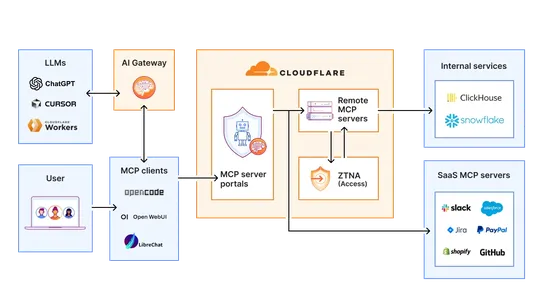
Cloudflare centralized MCP servers in a monorepo. It added governed templates, Cloudflare Access auth, audit logs, and DLP behind an MCP server portal. It launched Code Mode to collapse many tool schemas into two portal tools. Token use fell ~94%. Cloudflare Gateway now finds shadow MCP servers... read more  

Scaling MCP adoption: Our reference architecture for simpler, safer and cheaper enterprise deployments of MCP
Link
@kala shared a link, 2 months ago
FAUN.dev()

I Measured Claude 4.7's New Tokenizer. Here's What It Costs You.

Anthropic's Claude Opus 4.7 migration guide states the new tokenizer utilizes "roughly 1.0 to 1.35x as many tokens" compared to 4.6. Actual measurements show a higher ratio on technical docs and real CLAUDE.md files. The cost of the new tokenizer was measured using real content and synthetic samples.. read more  

I Measured Claude 4.7's New Tokenizer. Here's What It Costs You.
Link
@kala shared a link, 2 months ago
FAUN.dev()

Anthropic releases Claude Opus 4.7, narrowly retaking lead for most powerful generally available LLM

Anthropic has unveiled Claude Opus 4.7, a powerful large language model that outperforms key rivals like GPT-5.4 and Google's Gemini 3.1 Pro in benchmarks such as agentic coding and financial analysis. Opus 4.7 leads the market on the GDPVal-AA knowledge work evaluation with an Elo score of 1753 and.. read more  

GPT (Generative Pre-trained Transformer) is a deep learning model developed by OpenAI that has been pre-trained on massive amounts of text data using unsupervised learning techniques. GPT is designed to generate human-like text in response to prompts, and it is capable of performing a variety of natural language processing tasks, including language translation, summarization, and question-answering. The model is based on the transformer architecture, which allows it to handle long-range dependencies and generate coherent, fluent text. GPT has been used in a wide range of applications, including chatbots, language translation, and content generation.

GPT is a family of language models that have been trained on large amounts of text data using a technique called unsupervised learning. The model is pre-trained on a diverse range of text sources, including books, articles, and web pages, which allows it to capture a broad range of language patterns and styles. Once trained, GPT can be fine-tuned on specific tasks, such as language translation or question-answering, by providing it with task-specific data.

One of the key features of GPT is its ability to generate coherent and fluent text that is indistinguishable from human-generated text. This is achieved by training the model to predict the next word in a sentence given the previous words. GPT also uses a technique called attention, which allows it to focus on relevant parts of the input text when generating a response.

GPT has become increasingly popular in recent years, particularly in the field of natural language processing. The model has been used in a wide range of applications, including chatbots, content generation, and language translation. GPT has also been used to create AI-generated stories, poetry, and even music.