Join us

ContentUpdates and recent posts about Flask..
Link
@varbear shared a link, 1 month ago
FAUN.dev()

Build agents that run automatically

Agents trigger from schedules, Slack, Linear, GitHub, PagerDuty events, or customwebhooks. They spin upcloud sandboxes. They run configuredMCPsand models. They verify outputs. They use amemorytool. Cursor automates security audits on pushes. Scores PR risk and auto-approves low-risk changes. Runs Pa.. read more  
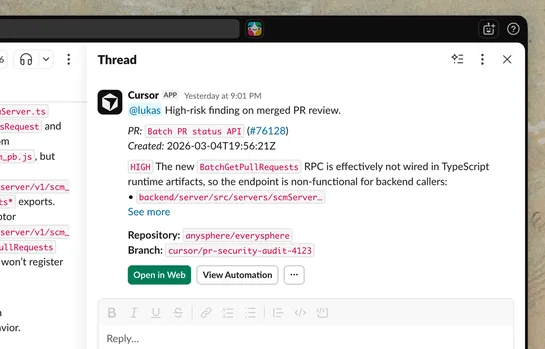
Build agents that run automatically
Link
@varbear shared a link, 1 month ago
FAUN.dev()

The Great Developer Divide: How AI Is Reshaping the Software Job Market Into Three Tiers

AI hiring has split dev work into three camps:Apex Tier,Hybrid Middle, and a shrinkingAutomatable Tail. Demand now favorsAI orchestration,prompt engineering, fastcode reading, and platform roles likeplatform engineer,fleet supervisor, andAI QA. System shift:Organizations must rework career ladders, .. read more  

The Great Developer Divide: How AI Is Reshaping the Software Job Market Into Three Tiers
Link
@varbear shared a link, 1 month ago
FAUN.dev()

I deleted my laptop from my dev workflow. My iPhone does the job now

A developer ditches the laptop and SSHs from an iPhone into an always-onMac Mini. The phone becomes a terminal and browser. The remote runs the dev server, theClaude Code/CodexCLI, hot reload, file watching, and pushes viaTailscale. Persistent sessions (tmux) keep AI agents and services alive across.. read more  

I deleted my laptop from my dev workflow. My iPhone does the job now
Link
@varbear shared a link, 1 month ago
FAUN.dev()

We Might All Be AI Engineers Now

The author supervises AI agents that orchestrate concurrent graph traversal, multi-layer hashing, AST parsing, and file system watchers. The agents run traversal, hashing, and watcher loops. The engineer architects system behavior, verifies outputs, and probes agents in parallel to debug... read more  

We Might All Be AI Engineers Now
Link
@varbear shared a link, 1 month ago
FAUN.dev()

Zen: A Minimalist HTTP Library for Go

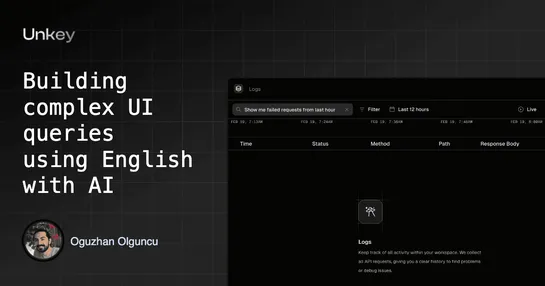
Unkey builtZen- a thin HTTP framework on Go'snet/http. It restores precise middleware ordering and lets middleware run after errors to capture the final response. Zen poolsSessionobjects to cut allocations. It emits RFC7807problem+jsonfor tagged domain errors. It runs OpenAPI validation before handl.. read more  

Zen: A Minimalist HTTP Library for Go
Link
@kaptain shared a link, 1 month ago
FAUN.dev()

It's Not Kubernetes. It Never Was

The complexity in managing Kubernetes clusters is a reflection of the organizational decisions and lack of processes within the teams operating them. The move towards multi-cloud environments without sufficient planning or resources has exacerbated these issues. Platform engineering solutions offer .. read more  

It's Not Kubernetes. It Never Was
Link
@kaptain shared a link, 1 month ago
FAUN.dev()

How Does Kubernetes Self-Healing Work? Understand Self-Healing By Breaking a Real Cluster

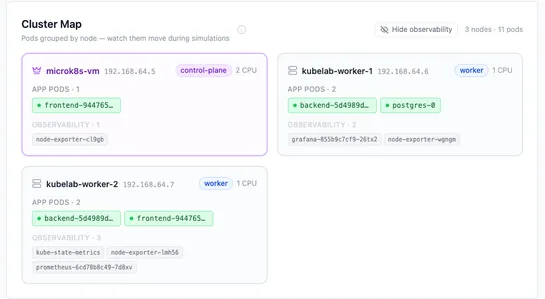
KubeLab boots a three-nodeKubernetescluster and runs seven failure simulations. It deploysNode.js,Postgres,Prometheus, andGrafana. Then it deletes pods, forcesOOMKill, throttles CPU, drains nodes, and scales aStatefulSetto zero. Each scenario surfaces fixes:readiness probes,PodDisruptionBudget, anti.. read more  

How Does Kubernetes Self-Healing Work? Understand Self-Healing By Breaking a Real Cluster
Link
@kaptain shared a link, 1 month ago
FAUN.dev()

How WebAssembly plugins simplify Kubernetes extensibility

Helm 4runsWebAssembly (Wasm)plugins to executeWASImodules insideOCIcontainers and VMs.Helmtemplates standardize module lifecycle. The Wasm plugin adds instruction-level sandboxing and Kubernetes segmentation.Helm 4preserves portability acrossx86/ARM. Compared withHelm 3plugins, it shows up to a 40% .. read more  

Link
@kaptain shared a link, 1 month ago
FAUN.dev()

The great migration: Why every AI platform is converging on Kubernetes

The CNCF survey finds82%of container users runKubernetesin production.66%of GenAI hosts use it for inference. Kubernetes now stitches data processing, distributed training, LLM inference, and autonomous agents viaSpark,Kubeflow,Kueue,KServe, andArmada. GPU sharing and scheduling advanced withMIG, ti.. read more  

The great migration: Why every AI platform is converging on Kubernetes
Link
@kaptain shared a link, 1 month ago
FAUN.dev()

pg_plan_alternatives: Tracing PostgreSQL’s Query Plan Alternatives using eBPF

The tracer hooks PostgreSQL's optimizer via eBPF. It captures every alternative plan path with cost estimates and flags the chosen plan. A kernel-space eBPF program reads planner structs using DWARF-derived offsets. A user-space collector gathers the data and a visualizer renders plan graphs. eBPF p.. read more  

Flask is an open-source web framework written in Python and created by Armin Ronacher in 2010. It is known as a microframework, not because it is weak or incomplete, but because it provides only the essential building blocks for developing web applications. Its core focuses on handling HTTP requests, defining routes, and rendering templates, while leaving decisions about databases, authentication, form handling, and other components to the developer. This minimalistic design makes Flask lightweight, flexible, and easy to learn, but also powerful enough to support complex systems when extended with the right tools.

At the heart of Flask are two libraries: Werkzeug, which is a WSGI utility library that handles the low-level details of communication between web servers and applications, and Jinja2, a templating engine that allows developers to write dynamic HTML pages with embedded Python logic. By combining these two, Flask provides a clean and pythonic way to create web applications without imposing strict architectural patterns.

One of the defining characteristics of Flask is its explicitness. Unlike larger frameworks such as Django, Flask does not try to hide complexity behind layers of abstraction or dictate how a project should be structured. Instead, it gives developers complete control over how they organize their code and which tools they integrate. This explicit nature makes applications easier to reason about and gives teams the freedom to design solutions that match their exact needs. At the same time, Flask benefits from a vast ecosystem of extensions contributed by the community. These extensions cover areas such as database integration through SQLAlchemy, user session and authentication management, form validation with CSRF protection, and database migration handling. This modular approach means a developer can start with a very simple application and gradually add only the pieces they require, avoiding the overhead of unused components.

Flask is also widely appreciated for its simplicity and approachability. Many developers write their first web application in Flask because the learning curve is gentle, the documentation is clear, and the framework itself avoids unnecessary complexity. It is particularly well suited for building prototypes, REST APIs, microservices, or small to medium-sized web applications. At the same time, production-grade deployments are supported by running Flask applications on WSGI servers such as Gunicorn or uWSGI, since the development server included with Flask is intended only for testing and debugging.

The strengths of Flask lie in its minimalism, flexibility, and extensibility. It gives developers the freedom to assemble their application architecture, choose their own libraries, and maintain tight control over how things work under the hood. This is attractive to experienced engineers who dislike being boxed in by heavy frameworks. However, the same freedom can become a limitation. Flask does not include features like an ORM, admin interface, or built-in authentication system, which means teams working on very large applications must take on more responsibility for enforcing patterns and maintaining consistency. In situations where a project requires an opinionated, all-in-one solution, Django or another full-stack framework may be a better fit.

In practice, Flask has grown far beyond its initial positioning as a lightweight tool. It has been used by startups for rapid prototypes and by large companies for production systems. Its design philosophy—keep the core simple, make extensions easy, and let developers decide—continues to attract both beginners and professionals. This balance between simplicity and power has made Flask one of the most enduring and widely used Python web frameworks.