Join us

ContentUpdates and recent posts about Flask..
Link
@varbear shared a link, 2 weeks, 4 days ago
FAUN.dev()

Why value streams and capability maps are your new governance control plane

The piece flips enterprise AI fromgenerativetoagentic. Agents getstructured autonomyto perceive, plan, and execute across systems. It turnsvalue streammaps into a control plane withautonomy zones,halt-on-exceptiongates, cryptographicflight recorders, andpolicy-as-code. Result: less hallucination and.. read more  

Why value streams and capability maps are your new governance control plane
Link
@kaptain shared a link, 2 weeks, 4 days ago
FAUN.dev()

Running Agents on Kubernetes with Agent Sandbox

Agent Sandbox unveils the Sandbox CRD to map long-lived, singleton AI agents onto Kubernetes. It adds stable identity and lifecycle primitives. It supports runtimes like gVisor and Kata Containers. It enables zero-scale resume. It includes SandboxWarmPool with SandboxClaim and SandboxTemplate to kil.. read more  

Link
@kaptain shared a link, 2 weeks, 4 days ago
FAUN.dev()

Securing Production Debugging in Kubernetes

The post prescribes an on-demand SSH gateway pod. It usesshort-lived, identity-bound credentialsandKubernetes RBACto grant scoped, auditable debug sessions. It recommends anaccess brokerthat binds Roles to groups, issues ephemeral certs and OpenSSH user certificates, rotates CAs, enforces command-le.. read more  

Link
@kaptain shared a link, 2 weeks, 4 days ago
FAUN.dev()

The Invisible Rewrite: Modernizing the Image Promoter

SIG Release rewrote theimage promotercore. It cut 20% of the code. It added apipeline engine,cosignsigning, andSLSAattestations. Signing now sits separate fromsignature replication. Registry reads run in parallel - plan time dropped ~20m → ~2m. Per-request timeouts, retries, and HTTP connection reus.. read more  

Link
@kaptain shared a link, 2 weeks, 4 days ago
FAUN.dev()

Kubernetes v1.36 - Sneak Peek

Kubernetes v1.36 (Apr 22, 2026) enablesHPAScaleToZeroby default. That lets theHPAuseminReplicas: 0and read only controller-owned pod metrics. The release swaps long-lived image-pull secrets forephemeral KSA tokens. It deprecatesIPVS, retiresIngress NGINX, and aligns withcontainerd 2.x. The release f.. read more  

Link
@kala shared a link, 2 weeks, 4 days ago
FAUN.dev()

Scaling Karpathy's Autoresearch: What Happens When the Agent Gets a GPU Cluster

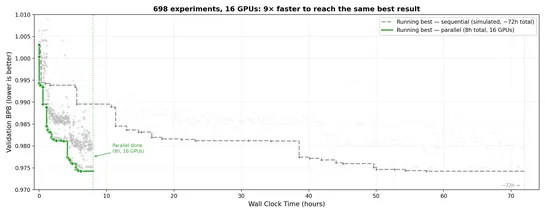
A team pointedClaude Codeatautoresearchand spun up 16 Kubernetes GPUs. The setup ran ~910 experiments in 8 hours.val_bpbdropped from 1.003 to 0.974 (2.87%). Throughput climbed ~9×. Parallel factorial waves revealedAR=96as the best width. The pipeline usedH100for cheap screening andH200for validation.. read more  

Scaling Karpathy's Autoresearch: What Happens When the Agent Gets a GPU Cluster
Link
@kala shared a link, 2 weeks, 4 days ago
FAUN.dev()

Building AI Teams with Sandboxes & Agent

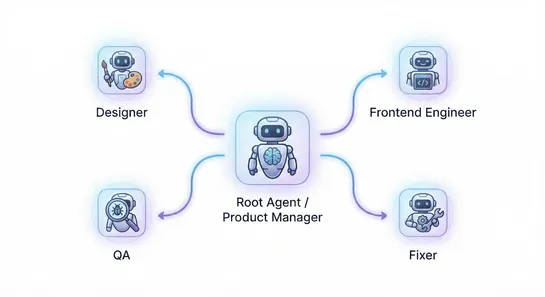
Docker Agentruns teams of specialized AI agents. The agents split work: design, code, test, fix. Models and toolsets are configurable. Docker Sandboxesisolate each agent in a per-workspacemicroVM. The sandbox mounts the host project path, strips host env vars, and limits network access. Tooling move.. read more  

Building AI Teams with Sandboxes & Agent
Link
@kala shared a link, 2 weeks, 4 days ago
FAUN.dev()

OpenClaw Tutorial: AI Stock Agent with Exa and Milvus

An autonomous market agent ships. OpenClaw handles orchestration. Exa returns structured, semantic web results. Milvus (or Zilliz Cloud) stores vectorized trade memory. A 30‑minute Heartbeat keeps it running. Custom Skills load on demand. Recalls query 1536‑dim embeddings. Entire stack runs for abou.. read more  

OpenClaw Tutorial: AI Stock Agent with Exa and Milvus
Link
@kala shared a link, 2 weeks, 4 days ago
FAUN.dev()

OpenClaw is a great movement, but dead product. what's next?

After talking to 50+ individuals experimenting with OpenClaw, it's clear that while many have tried it and even explored it for more than 3 days, only around 10% have attempted automating real actions. However, most struggle to maintain these automations at a production level due to challenges with .. read more  

Link
@kala shared a link, 2 weeks, 4 days ago
FAUN.dev()

OpenAI to acquire Astral

OpenAI will acquire Astral, pending regulatory close. It will fold Astral's open-source Python tools —uv,Ruff, andty— intoCodex. Teams will integrate the tools.Codexwill plan changes, modify codebases, run linters and formatters, and verify results acrossPythonworkflows. System shift:This injects pr.. read more  

OpenAI to acquire Astral
Flask is an open-source web framework written in Python and created by Armin Ronacher in 2010. It is known as a microframework, not because it is weak or incomplete, but because it provides only the essential building blocks for developing web applications. Its core focuses on handling HTTP requests, defining routes, and rendering templates, while leaving decisions about databases, authentication, form handling, and other components to the developer. This minimalistic design makes Flask lightweight, flexible, and easy to learn, but also powerful enough to support complex systems when extended with the right tools.

At the heart of Flask are two libraries: Werkzeug, which is a WSGI utility library that handles the low-level details of communication between web servers and applications, and Jinja2, a templating engine that allows developers to write dynamic HTML pages with embedded Python logic. By combining these two, Flask provides a clean and pythonic way to create web applications without imposing strict architectural patterns.

One of the defining characteristics of Flask is its explicitness. Unlike larger frameworks such as Django, Flask does not try to hide complexity behind layers of abstraction or dictate how a project should be structured. Instead, it gives developers complete control over how they organize their code and which tools they integrate. This explicit nature makes applications easier to reason about and gives teams the freedom to design solutions that match their exact needs. At the same time, Flask benefits from a vast ecosystem of extensions contributed by the community. These extensions cover areas such as database integration through SQLAlchemy, user session and authentication management, form validation with CSRF protection, and database migration handling. This modular approach means a developer can start with a very simple application and gradually add only the pieces they require, avoiding the overhead of unused components.

Flask is also widely appreciated for its simplicity and approachability. Many developers write their first web application in Flask because the learning curve is gentle, the documentation is clear, and the framework itself avoids unnecessary complexity. It is particularly well suited for building prototypes, REST APIs, microservices, or small to medium-sized web applications. At the same time, production-grade deployments are supported by running Flask applications on WSGI servers such as Gunicorn or uWSGI, since the development server included with Flask is intended only for testing and debugging.

The strengths of Flask lie in its minimalism, flexibility, and extensibility. It gives developers the freedom to assemble their application architecture, choose their own libraries, and maintain tight control over how things work under the hood. This is attractive to experienced engineers who dislike being boxed in by heavy frameworks. However, the same freedom can become a limitation. Flask does not include features like an ORM, admin interface, or built-in authentication system, which means teams working on very large applications must take on more responsibility for enforcing patterns and maintaining consistency. In situations where a project requires an opinionated, all-in-one solution, Django or another full-stack framework may be a better fit.

In practice, Flask has grown far beyond its initial positioning as a lightweight tool. It has been used by startups for rapid prototypes and by large companies for production systems. Its design philosophy—keep the core simple, make extensions easy, and let developers decide—continues to attract both beginners and professionals. This balance between simplicity and power has made Flask one of the most enduring and widely used Python web frameworks.