Join us

ContentUpdates and recent posts about AWX..
Link
@varbear shared a link, 1 month, 2 weeks ago
FAUN.dev()

I told Claude Code to build me an executive assistant. This is what my work as CTO looks like now

CTO at ZAR shares his experience managing 10 engineers, shipping code, and operating at the C-level with an AI assistant named Claude Code. The system allows him to maintain context across multiple workstreams, automate tasks, and scale his productivity. In just three weeks, he has documented 82 mee.. read more  
Link
@varbear shared a link, 1 month, 2 weeks ago
FAUN.dev()

SQLite Features You Didn’t Know It Had: JSON, text search, CTE, STRICT, generated columns, WAL

SQLite packsJSONextraction, expression indexes,FTS5full-text search,CTEs, window functions, andWALinto a single file. It enforcesstrict tables, supportsgenerated columns, and indexes JSON expressions for fast semi-structured queries... read more  

Link
@varbear shared a link, 1 month, 2 weeks ago
FAUN.dev()

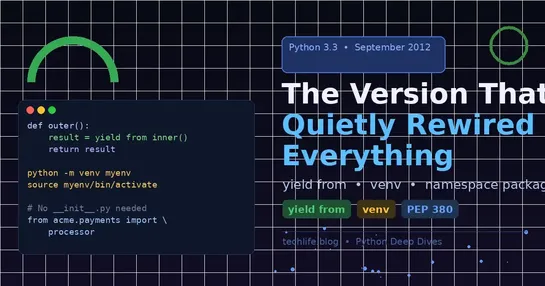
Python 3.3: The Version That Quietly Rewired Everything

Python 3.3 introduced three key features that have had a lasting impact on Python development. Firstly, yield from simplified the composition of generators by allowing easy delegation between them. Secondly, venv standardized virtual environments in Python, improving isolation and reproducibility of.. read more  

Python 3.3: The Version That Quietly Rewired Everything
Link
@kaptain shared a link, 1 month, 2 weeks ago
FAUN.dev()

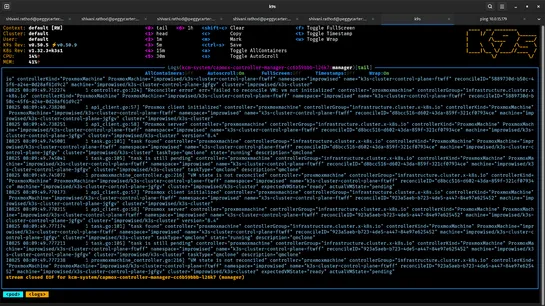
K3s on On-Prem Infrastructures the GitOps Way: Writing a Custom k0rdent Template from Scratch

Kubernetes, now 12 years old, has evolved into the universal operating system for modern infrastructure, running on various platforms like Proxmox. Using k0rdent, Proxmox, and K3s, users can provision and manage Kubernetes clusters on-premise in a declarative, repeatable, and clean manner. This appr.. read more  

K3s on On-Prem Infrastructures the GitOps Way: Writing a Custom k0rdent Template from Scratch
Link
@kaptain shared a link, 1 month, 2 weeks ago
FAUN.dev()

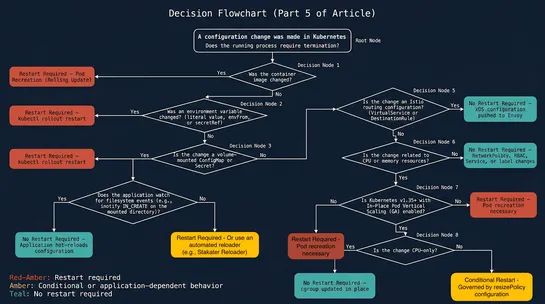
When Kubernetes restarts your pod - And when it doesn’t

Production internals guide verified against Kubernetes 1.35 GA. Engineers need to understand terminology differences to avoid flawed runbooks and bad on-call decisions. Kubelet watches the pod spec, not other resources like ConfigMaps or Secrets, to explain the majority of config update investigatio.. read more  

When Kubernetes restarts your pod - And when it doesn’t
Link
@kaptain shared a link, 1 month, 2 weeks ago
FAUN.dev()

Duolingo's Kubernetes Leap

Duolingo made a bold leap migrating 500+ services to Kubernetes, embracing Argo CD for blue-green deployments and leveraging GitOps for flexibility and control. This shift to a cellular architecture enabled them to isolate environments and manage developer trust while navigating AWS rate limits. Exc.. read more  

Link
@kaptain shared a link, 1 month, 2 weeks ago
FAUN.dev()

Kubernetes Monitoring Helm chart v4: Biggest update ever!

The Kubernetes Monitoring Helm chart version 4.0 is designed to solve real pain points that users have hit as their monitoring setups have grown. Destinations are now defined as a map instead of a list, making it easier to manage configurations for multiple clusters. Collectors are defined by the us.. read more  

Kubernetes Monitoring Helm chart v4: Biggest update ever!
Link
@kaptain shared a link, 1 month, 2 weeks ago
FAUN.dev()

How GitHub uses eBPF to improve deployment safety

GitHub hosts its own source code on github.com, creating a circular dependency. To mitigate this, GitHub maintains mirrors of its code and built assets. By using eBPF, GitHub can selectively monitor and block calls that create circular dependencies in their deployment system... read more  

How GitHub uses eBPF to improve deployment safety
Link
@kala shared a link, 1 month, 2 weeks ago
FAUN.dev()

Critical Claude Code vulnerability: Deny rules silently bypassed because security checks cost too many tokens

Clause Code security bypass: Anthropic's performance fix silently disabled deny rules for 500K+ developers when more than 50 subcommands were used in a command, impacting permission validation and security policy enforcement. The vulnerability stemmed from a tradeoff between security and performance.. read more  

Link
@kala shared a link, 1 month, 2 weeks ago
FAUN.dev()

Anthropic releases Claude Opus 4.7, narrowly retaking lead for most powerful generally available LLM

Anthropic has unveiled Claude Opus 4.7, a powerful large language model that outperforms key rivals like GPT-5.4 and Google's Gemini 3.1 Pro in benchmarks such as agentic coding and financial analysis. Opus 4.7 leads the market on the GDPVal-AA knowledge work evaluation with an Elo score of 1753 and.. read more  

AWX is the open source, community supported upstream project for Red Hat Ansible Automation Platform, formerly known as Ansible Tower. It gives teams a web based interface, a full REST API, and a distributed task engine on top of Ansible, turning command line playbook runs into a managed, auditable automation service.

The project began at AnsibleWorks as the commercial Ansible Tower product, and after Red Hat acquired Ansible, it open sourced the codebase as AWX in September 2017, positioning it as the development ground where new features land before they are hardened into the supported Automation Platform controller. With AWX, you organize automation around projects (synced from Git or other source control), inventories (static or dynamically pulled from cloud providers), credentials (stored encrypted and injected at runtime), and job templates that tie a playbook to its inventory and credentials. On top of that, it adds role based access control, a visual dashboard, job scheduling, workflow chaining, webhooks, and real time job output, so multiple teams can run, track, and delegate automation without sharing SSH keys or sitting at a terminal.

Modern AWX runs on Kubernetes or OpenShift through the AWX Operator, which manages installation, upgrades, and scaling declaratively, reflecting its shift from a single host application to a cloud native, container based platform. Because it is the upstream of a paid product, AWX moves fast and ships frequently, which makes it ideal for labs, learning, and self managed deployments, though teams needing formal support and long term stability typically run the downstream Automation Platform instead.