Join us

ContentUpdates and recent posts about AIStor..
News FAUN.dev() Team Trending
@kala shared an update, 5 months ago
FAUN.dev()

DeepSeekMath-V2 Launches with 685B Parameters - Dominates Math Contests

DeepSeekMath-V2

DeepSeekMath-V2, an AI model with 685 billion parameters, excels in mathematical reasoning and achieves top scores in major competitions, now available open source for research and commercial use.
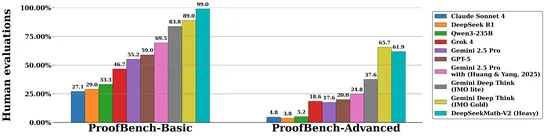
DeepSeekMath-V2 Launches with 685B Parameters - Dominates Math Contests
Link
@anjali shared a link, 5 months ago
Customer Marketing Manager, Last9

9 Monitoring Tools That Deliver AI-Native Anomaly Detection

A technical guide comparing nine observability platforms built to detect anomalies and support modern AI-driven workflows.

anamoly_detection
 Activity
@kala added a new tool DeepSeekMath-V2 , 5 months ago.
News FAUN.dev() Team
@kala shared an update, 5 months ago
FAUN.dev()

A New Challenger: INTELLECT-3's 100B Parameters Punch Above Their Weight

Ansible Lustre Slurm INTELLECT-3

INTELLECT-3, a 100B+ parameter model, sets new benchmarks in AI, with open-sourced training components to foster research in reinforcement learning.

A New Challenger: INTELLECT-3's 100B Parameters Punch Above Their Weight
 Activity
@kala added a new tool INTELLECT-3 , 5 months ago.
 Activity
@devopslinks added a new tool Lustre , 5 months ago.
 Activity
@varbear added a new tool Slurm , 5 months ago.
Course
@eon01 published a course, 5 months ago
Founder, FAUN.dev

Cloud Native CI/CD with GitLab

GitLab GitLab CI/CD Helm Prometheus Docker GNU/Linux Kubernetes

From Commit to Production Ready

Cloud Native CI/CD with GitLab
Course
@eon01 published a course, 5 months ago
Founder, FAUN.dev

Observability with Prometheus and Grafana

Prometheus Docker k3s Grafana GNU/Linux Kubernetes

A Complete Hands-On Guide to Operational Clarity in Cloud-Native Systems

Observability with Prometheus and Grafana
Course
@eon01 published a course, 5 months ago
Founder, FAUN.dev

Cloud-Native Microservices With Kubernetes - 2nd Edition

Helm Jaeger OpenTelemetry Prometheus Docker Grafana Loki Grafana Kubernetes Kubectl

A Comprehensive Guide to Building, Scaling, Deploying, Observing, and Managing Highly-Available Microservices in Kubernetes

Cloud-Native Microservices With Kubernetes - 2nd Edition
AIStor is an enterprise-grade, high-performance object storage platform built for modern data workloads such as AI, machine learning, analytics, and large-scale data lakes. It is designed to handle massive datasets with predictable performance, operational simplicity, and hyperscale efficiency, while remaining fully compatible with the Amazon S3 API. AIStor is offered under a commercial license as a subscription-based product.

At its core, AIStor is a software-defined, distributed object store that runs on commodity hardware or in containerized environments like Kubernetes. Rather than being limited to traditional file or block interfaces, it exposes object storage semantics that scale from petabytes to exabytes within a single namespace, enabling consistent, flat addressing of vast datasets. It is engineered to sustain very high throughput and concurrency, with examples of multi-TiB/s read performance on optimized clusters.

AIStor is optimized specifically for AI and data-intensive workloads, where throughput, low latency, and horizontal scalability are critical. It integrates broadly with modern AI and analytics tools, including frameworks such as TensorFlow, PyTorch, Spark, and Iceberg-style table engines, making it suitable as the foundational storage layer for pipelines that demand both performance and consistency.

Security and enterprise readiness are central to AIStor’s design. It includes capabilities like encryption, replication, erasure coding, identity and access controls, immutability, lifecycle management, and operational observability, which are important for mission-critical deployments that must meet compliance and data protection requirements.

AIStor is positioned as a platform that unifies diverse data workloads — from unstructured storage for application data to structured table storage for analytics, as well as AI training and inference datasets — within a consistent object-native architecture. It supports multi-tenant environments and can be deployed across on-premises, cloud, and hybrid infrastructure.