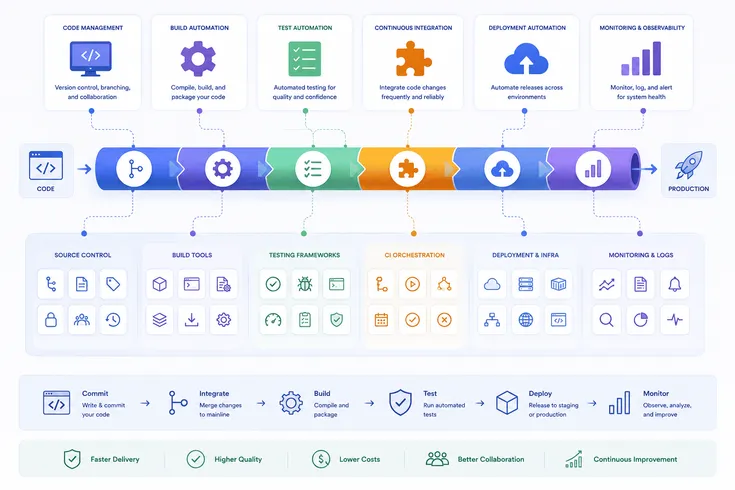
Production pipelines fail in ways that lab environments never reveal. I have seen pipelines that worked flawlessly in staging break the moment they reached production. Different load patterns. Different data volumes. Different failure modes. Different everything.
Teams that build production-ready pipelines do something different. They do not just deploy open source automation tools. They design pipelines around what actually works in production. They use open source automation tools to validate reality, not assumptions.
This is about the patterns that separate production-ready pipelines from pipelines that work until they do not.
The Pipeline Gap
Most pipelines are designed around ideal conditions. Tests pass. Deployments succeed. Systems behave as expected.
Production has different rules. Load varies. Data is messier. Failures happen unexpectedly. Systems interact in ways you did not predict.
Open source automation tools help bridge this gap. But only if used in patterns that account for production reality.
I have observed teams that struggle with pipelines despite using sophisticated open source automation tools. They have the right tools. But they are using them wrong. They are optimizing for lab performance, not production reliability.
Successful teams use open source automation tools differently. They build pipelines around patterns proven in production. They validate against reality. They account for failure modes.
Real Pattern 1: Progressive Deployment Validation
Production-ready pipelines do not deploy to everything at once.
Teams using open source automation tools for progressive deployment validate at each stage. Canary deployment to a small percentage. Monitor carefully. Expand to more users. Validate. Continue expanding.
This pattern requires multiple validation stages. Each stage tests different aspects. Early stages catch obvious problems. Later stages catch subtle issues that only appear at scale.
Open source automation tools support this pattern well. Automated validation at each stage. Different tests for different deployment percentages. Quick feedback if something goes wrong.
I have seen teams implement this using open source orchestration tools combined with open source testing frameworks. At each deployment stage, tests run. Results determine whether to proceed.
This pattern reduces risk significantly. If something goes wrong, it affects a small percentage of users. The team catches it. They can rollback without affecting everyone.
Real Pattern 2: Environment Parity Through Automation
Staging does not match production. Everyone knows this. But most pipelines pretend they do.
Production-ready pipelines use open source automation tools to validate that differences do not matter. They run the same tests in staging and production. They compare results. If results differ, they investigate.
This requires open source automation tools that provide visibility into what actually happens. Not what you expect to happen. What actually happens.
Teams implementing this pattern use open source infrastructure tools to configure staging as close to production as possible. Then they use open source testing tools to validate behavior matches.
I have worked with teams that discovered critical issues only because they enforced environment parity through automated validation. Staging and production handled connections differently. Staging had more memory available. Staging had different concurrency behavior. Tests caught these differences.
Without this pattern, these issues would have been discovered by customers in production.
Real Pattern 3: Failure Mode Validation
Production fails in specific ways. Your pipeline should validate those specific ways do not happen.
Open source automation tools let teams test failure modes explicitly. What happens when a database connection fails? What happens when an external API times out? What happens when a service is slow?
Production-ready pipelines include tests for these scenarios. Not as afterthoughts. As core validation.
This requires open source tools that support chaos engineering patterns. Failure injection. Timeout simulation. Resource constraint testing.
Teams using this pattern deploy with confidence. They know how the system behaves when things go wrong. They have tested it. They have validated recovery.
I have seen pipelines without failure mode validation fail in production in ways that could have been caught and fixed before deployment. A service times out. The code does not have proper timeout handling. Everything cascades.
With failure mode validation, this would be discovered during the pipeline. The team would fix it before production.
Real Pattern 4: Observation-Based Regression Testing
Production behavior is the source of truth. Pipelines should validate against that.
Traditional regression testing predicts what should not break. Observation-based approaches validate that actual behavior does not change.
Open source automation tools that observe actual system behavior provide more reliable validation than tools that rely on predictions.
Why? Because predictions are incomplete. Actual behavior is complete. When you validate against actual behavior, you catch problems you did not predict.
I have seen teams reduce production incidents significantly by switching from prediction-based to observation-based regression testing. Not because the tools were different. Because the validation approach was different.
Open source tools that support behavior recording are becoming more valuable for pipeline validation. They validate that the system continues doing what it actually does, not what you think it should do.
Keploy demonstrates this approach for API testing. Instead of predicting API responses, Keploy records actual API behavior during testing. Pipeline tests then validate APIs continue producing the same behavior in production-like conditions. This observation-based approach catches regressions that prediction-based tests miss.
Real Pattern 5: Monitoring-Driven Validation
Tests pass. Deployment happens. Monitoring tells a different story.
Production-ready pipelines integrate monitoring data into pipeline decisions. Tests pass. But if production metrics look wrong, something is still wrong.
This requires open source automation tools that integrate with monitoring systems. Pipeline tests run. Monitoring data is collected. Results are compared. If metrics degraded, something is wrong even if tests passed.
This pattern catches performance regressions that unit tests never would. Memory usage increases. CPU usage increases. Response times increase. Tests pass. But users experience slowdown.
I have seen teams implement this pattern using open source monitoring tools combined with open source testing tools. Same pipeline. But with monitoring feedback integrated.
The investment is significant. But the payoff is substantial. Production issues are caught before users see them.
Real Pattern 6: Dependency Validation
Modern systems depend on external services. APIs. Databases. Message queues. Cache systems.
Production-ready pipelines validate that dependencies work correctly. Open source automation tools help here.
But this requires understanding that dependencies fail in specific ways. Timeouts. Connection failures. Partial failures. Rate limiting.
Teams building production-ready pipelines validate all these scenarios. Not once. Every deployment.
This requires open source tools that can simulate dependency failures. Mock services that fail at specific times. APIs that timeout. Databases that are slow.
I have seen systems fail in production because a dependency was slow. The code did not have proper timeout handling. Everything cascaded. Tests never caught it because the dependency was fast in staging.
With dependency validation in the pipeline, this would be discovered before production.
Real Pattern 7: Data-Driven Validation
Real data is different from test data.
Production-ready pipelines validate against data patterns similar to production. Volume. Distribution. Edge cases.
Open source automation tools help teams generate realistic test data. Or use production-like data for validation.
This pattern requires discipline. Teams need to understand production data patterns. Then they need to create tests using similar patterns.
I have seen systems fail with production data that worked perfectly with test data. Test data was too clean. Too regular. Production data was messy. Real data had edge cases. Null values. Unexpected formats.
With data-driven validation, these issues are discovered before production.
Real Pattern 8: Deployment Rollback Automation
Things go wrong. Production-ready pipelines can recover.
Open source automation tools support automated rollback. If post-deployment validation fails, rollback automatically. Do not wait for manual intervention.
This requires trust in the rollback process. Teams need to validate that rollback works. They need to test it.
This pattern requires open source orchestration tools that support automated rollback. Infrastructure-as-code tools that can revert changes. Deployment tools that can roll back automatically.
I have seen teams confidently deploy because they know rollback is automated and tested. If something goes wrong, the system recovers automatically.
Real Pattern 9: Pipeline Observability
You cannot manage what you cannot see.
Production-ready pipelines have complete visibility. What tests ran? What passed? What failed? What took too long? What used too many resources?
Open source automation tools generate this data. But teams need to collect it. Analyze it. Act on it.
This pattern requires open source tools for log aggregation. Metrics collection. Test reporting.
I have seen teams implement comprehensive pipeline observability. Every deployment is tracked. Every test is logged. Trends are analyzed. Anomalies are detected.
Common Mistakes Teams Make
Teams building production-ready pipelines make predictable mistakes.
Testing only happy paths. Tests pass. But failure scenarios break in production.
Assuming staging matches production. Staging is different. Tests that pass in staging fail in production.
Not testing for scale. Tests with one user pass. Production with a thousand users fails.
Ignoring monitoring. Tests pass. But production metrics are bad.
Not validating dependencies. Tests mock dependencies. Production dependencies behave differently.
Not testing rollback. Forward deployment is tested. Rollback is not. When rollback is needed, it fails.
Avoiding failure mode testing. Tests assume nothing fails. Production has failures. Systems are not prepared.
Conclusion
Production-ready pipelines are not built by choosing the right open source automation tools. They are built by using open source automation tools in patterns proven to work in production.
Progressive deployment validation. Environment parity. Failure mode testing. Observation-based regression testing. Monitoring-driven validation. Dependency validation. Data-driven testing. Automated rollback. Pipeline observability.
These patterns require discipline. They require investment. But the payoff is systems that are reliable in production. Deployments that have high confidence. Issues that are caught before users see them.
Open source automation tools enable these patterns. But patterns are what matter.
Build production-ready pipelines using these patterns. Your production systems will be more reliable. Your deployments will be more confident. Your teams will be more effective.