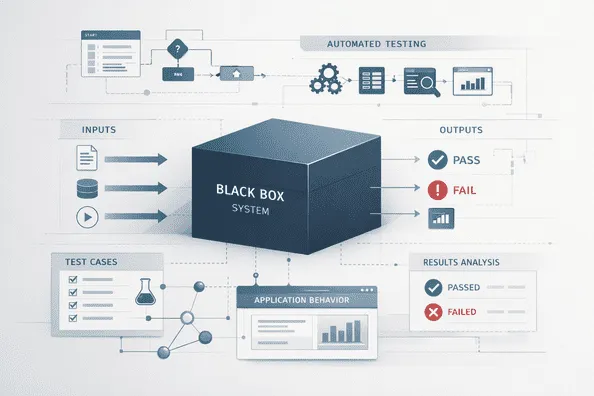
Ensuring comprehensive test coverage is one of the biggest challenges in software testing. As applications grow in complexity, it becomes increasingly difficult to validate every possible scenario. This is where black box testing techniques play a crucial role.
By focusing on inputs and outputs rather than internal code structure, these techniques help testers evaluate software behavior from a user’s perspective. When applied effectively, they significantly improve test coverage and reduce the risk of undetected defects.
What Are Black Box Testing Techniques?
Black box testing techniques are methods used to design test cases without any knowledge of the internal implementation of the application. Testers interact with the system as end users would, validating whether it behaves as expected.
These techniques are especially useful for:
- Functional testing
- System testing
- Acceptance testing
They help ensure that the application meets business requirements and user expectations.
Why Test Coverage Matters
Test coverage refers to the extent to which your application is tested. Higher coverage means a greater likelihood of identifying defects before release.
Poor test coverage can lead to:
- Undetected bugs in production
- Inconsistent user experience
- Increased maintenance costs
Using structured testing techniques helps teams systematically cover more scenarios without relying on guesswork.
Key Black Box Testing Techniques to Improve Coverage
1. Equivalence Partitioning
Equivalence partitioning divides input data into groups, or partitions, where the system is expected to behave similarly.
How it improves coverage:
- Reduces the number of test cases while maintaining effectiveness
- Ensures representation of all input categories
Example:
If a field accepts values from 1 to 100:
- Valid partition: 1–100
- Invalid partitions: below 1, above 100
Instead of testing every value, you test representative values from each group.
2. Boundary Value Analysis
Boundary value analysis focuses on testing values at the edges of input ranges, where defects are most likely to occur.
How it improves coverage:
- Identifies edge-case issues
- Strengthens validation logic testing
Example:
For an input range of 1 to 100:
- Test values: 0, 1, 100, 101
These boundary values often reveal hidden bugs.
3. Decision Table Testing
Decision table testing is used when outcomes depend on multiple conditions. It maps combinations of inputs to expected outputs in a structured table.
How it improves coverage:
- Covers complex logic systematically
- Ensures all condition combinations are tested
Example:
A discount system based on user type and purchase amount can be tested using a decision table to cover all possible combinations.
4. State Transition Testing
State transition testing evaluates how a system behaves when it transitions between different states.
How it improves coverage:
- Validates dynamic behavior
- Ensures correct handling of state changes
Example:
Testing login attempts:
- Valid login
- Invalid login
- Account lock after multiple failed attempts
This ensures all possible transitions are covered.
5. Use Case Testing
Use case testing focuses on real-world user scenarios, validating end-to-end workflows.
How it improves coverage:
- Ensures business-critical paths are tested
- Aligns testing with user expectations
Example:
An e-commerce use case might include:
- Browsing products
- Adding items to cart
- Completing checkout
Testing these flows ensures practical coverage.
6. Error Guessing
Error guessing relies on tester experience and intuition to identify potential problem areas.
How it improves coverage:
- Identifies scenarios not covered by formal techniques
- Leverages past defect patterns
Example:
Testing unexpected inputs such as:
- Special characters
- Empty fields
- Extremely large values
While less structured, this technique complements other methods effectively.
Combining Techniques for Better Results
No single technique can guarantee complete coverage. The most effective strategy is to combine multiple approaches.
For example:
- Use equivalence partitioning to reduce test cases
- Apply boundary value analysis for edge cases
- Use decision tables for complex logic
- Add use case testing for real-world validation
This layered approach ensures both breadth and depth in testing.
Role in Modern Testing Environments
In Agile and CI/CD environments, these techniques help teams maintain high coverage without slowing down development.
They are often used alongside software regression testing tools to ensure that both new and existing functionalities are thoroughly validated. By combining structured test design with automation, teams can achieve efficient and scalable testing processes.
Best Practices for Applying Black Box Testing Techniques
- Start with clear requirements and user stories
- Prioritize high-risk and high-impact areas
- Combine multiple techniques for comprehensive coverage
- Continuously update test cases as the application evolves
- Integrate testing into CI/CD pipelines
Following these practices ensures that testing remains effective and relevant.
Common Mistakes to Avoid
- Relying on a single testing technique
- Ignoring edge cases and boundary conditions
- Overlooking real-world user scenarios
- Not updating test cases after changes
Avoiding these pitfalls helps maintain strong test coverage over time.
Conclusion
Black box testing techniques are essential for improving test coverage in modern software development. By focusing on user behavior and system outputs, they help uncover defects that might otherwise go unnoticed.
When applied strategically and combined with other testing approaches, these techniques enable teams to deliver reliable, high-quality software while keeping pace with fast development cycles.