Angular vs React: Side-by-Side Comparison
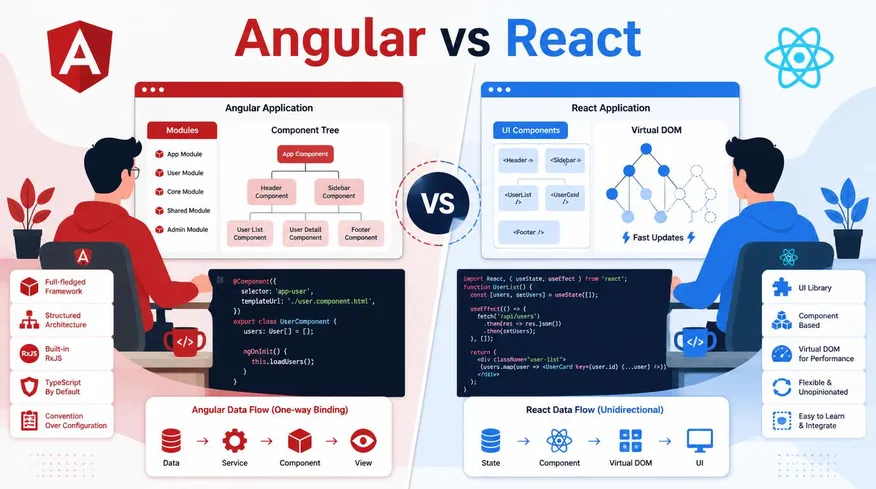
Type: Angular is a complete framework. It provides everything you need to build an application right out of the box. React, on the other hand, is a UI library that focuses solely on creating the view layer of your app.
Maintained By: Angular is developed and maintained by Google, while React is supported by Meta (Facebook). Both have strong backing, so neither is vanishing anytime soon.
Language: Angular uses TypeScript by default. This offers built-in type safety and structured code from day one. React is written in JavaScript with JSX, which allows you to write HTML-like code inside JavaScript, although you can manually add TypeScript if you want.
Learning Curve: Angular has a steeper learning curve. You need to be familiar with TypeScript, decorators, modules, and dependency injection before you can feel productive. React's core concepts, such as components, props, state, and hooks, are quicker to learn, making it more friendly for beginners.
Architecture: Angular follows a specific MVC (Model-View-Controller) pattern, meaning the structure is mostly decided for you. React, however, takes a flexible, component-based approach where you make the architectural choices yourself.
Data Binding: Angular supports two-way data binding out of the box. Changes in the UI automatically reflect in the data model and vice versa. React uses one-way data binding, where data flows in a single direction. You manually handle updates, giving you more control but needing more code.
Performance: Both are excellent in 2026. Angular uses the Ivy rendering engine, which creates smaller bundles and faster compile times. React relies on a Virtual DOM to reduce expensive real DOM updates. In practice, performance differences are small; both tools can handle high-traffic, complex applications easily.
Ecosystem: Angular includes many features such as routing, forms, HTTP, animations, and testing utilities. They all come with the framework. React's ecosystem is rich and modular, allowing you to pick and combine the best tools for your needs, but it requires more initial decision-making.
Best For: Angular is best for enterprise applications and large teams where consistency and structure are important. React works well for startups, product teams, and projects where speed of development and flexibility are priorities.
npm Downloads (2026): React leads in adoption, getting over 25 million downloads per week on npm. Angular has around 3 million downloads per week, which is healthy but shows React's wider mainstream usage in the industry.








Hay, thank for this valuable content, I learn lots of from your article.