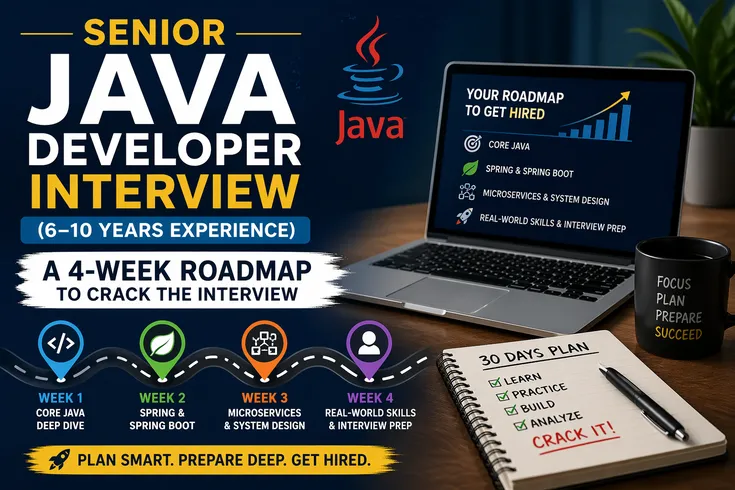
What Changes at 6–10 Years (And Why Most People Get Stuck)
At this level, expectations shift dramatically. Interviewers want you to:
Design systems, not just write code
Debug production issues, not just fix bugs
Make decisions, not just follow patterns
Explain trade-offs, not just list technologies
💡 The biggest mistake?
Most engineers still prepare like mid-level developers.
📅 Week 1 (Days 1–7): Core Java Deep Dive
Goal: Strengthen fundamentals and internal understanding
Focus on:
JVM internals (Heap, Stack, Metaspace, class loading lifecycle)
Garbage Collection (G1, ZGC, tuning, real-world behavior)
Concurrency & multithreading (race conditions, thread safety)
Executors & thread pools (internals, tuning, pitfalls)
Locks & synchronization (synchronized vs ReentrantLock, deadlocks)
Asynchronous programming (CompletableFuture, non-blocking flows)
Collections internals (HashMap, ConcurrentHashMap)
Java Streams (performance, when not to use them)
OOP principles in real systems
Exception handling strategies
Memory leaks & performance debugging
👉 Daily plan:
2 hours concepts
1 hour coding
30 mins explaining concepts out loud
💡 Outcome:
You should confidently answer:
“How does HashMap work internally?”
“How do you debug a memory issue in production?”
📅 Week 2 (Days 8–14): Spring & Spring Boot Internals
Goal: Move beyond annotations → understand what’s happening underneath
Focus on:
IoC & Dependency Injection
Bean lifecycle
Spring Boot auto-configuration
AOP (proxies, real use cases)
JPA/Hibernate internals
Lazy vs eager loading, N+1 problem
Transaction management (@Transactional, isolation, propagation)
Spring Security basics (OAuth2, JWT)
👉 Practice:
Build a small project and trace what happens during startup.
💡 Outcome:
You should clearly explain:
“What happens when a Spring Boot app starts?”