AI vs. Machine Learning vs. Generative AI: A Quick Side-by-Side
Now that you've got AI and machine learning sorted, there's one more term worth pinning down since it's probably the reason you ended up Googling any of this in the first place. Generative AI services like chatbots and image generators have become part of daily life, so here's a quick side-by-side to keep all three concepts straight.
Artificial Intelligence (AI)
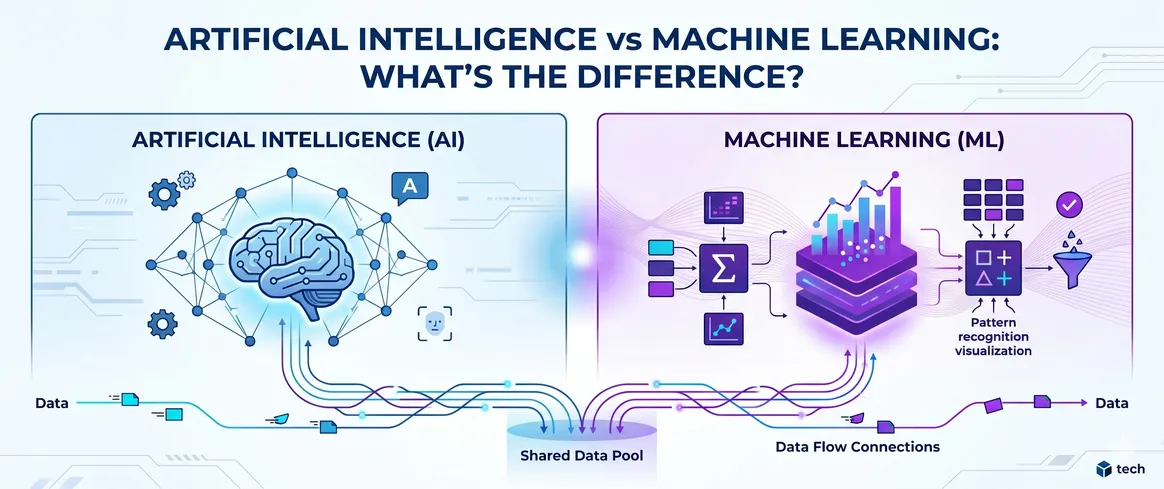
AI is the broad goal of making machines act intelligently. Think of it as the umbrella everything else sits under. It doesn't always require data to function; a rule-based chess program from the 1980s counts as AI without learning a single thing from experience. The output can be decisions, actions, or responses depending on what the system is built to do. You'll find it working quietly inside voice assistants, navigation apps, and fraud detection systems. The core evaluation question is simple: does it behave intelligently?
Machine Learning (ML)
Machine learning is a method within AI where systems learn from data rather than following fixed, hand-coded rules. It almost always needs data and lots of it to identify patterns and improve over time. A spam filter that gets sharper the more emails it processes is a textbook example. The output tends to be predictions, classifications, or recommendations rather than direct actions. It powers applications such as sales forecasting, predictive maintenance, and recommendation engines. For businesses exploring machine learning development services, the key question is always: how accurate are its predictions?
Generative AI
Generative AI is a specialized branch of machine learning focused specifically on creating new content rather than just analyzing or classifying existing data. It typically requires massive datasets to learn patterns well enough to produce something original. A tool that writes product descriptions, designs visuals, or holds a natural conversation is generative AI in action. The output is brand-new text, images, audio, or code, not just a prediction or recommendation. Generative AI services are increasingly used for personalized marketing copy, image generation, and conversational chatbots. The evaluation focus shifts entirely to how coherent, original, and relevant the output actually is.