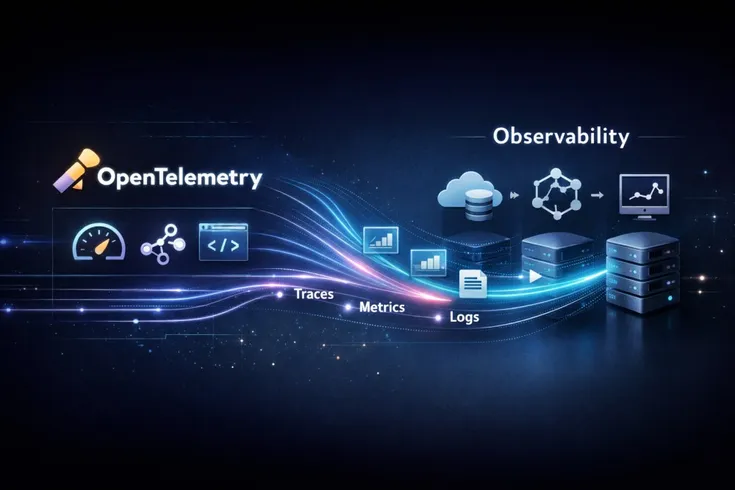
OpenTelemetry migration is becoming more relevant as OTel moves deeper into production use. In the OpenTelemetry project’s 2025 Collector follow-up survey, 65% of respondents said they run more than 10 Collectors in production.
That matters because many teams want to change observability backends, but their instrumentation, agents, exporters, and dashboards are still tightly coupled to the old stack. OpenTelemetry gives teams a vendor-neutral way to generate, collect, and export telemetry, which can make migration less disruptive, even if it does not make it effortless.
This article explains what OpenTelemetry actually standardizes, where it reduces migration pain, and which parts of a backend change still need careful validation.
The migration problem with backend-coupled instrumentation
Changing observability backends sounds straightforward on paper. It gets messy when telemetry is tightly tied to one vendor’s agents, exporters, naming patterns, and query model.
Vendor-specific agents make the stack harder to move
Many teams start with whatever agent or collector their current backend supports best. That works well early on, but it can create friction later when the telemetry pipeline is built around one vendor’s collection method instead of a more portable model. This is a problem because:
- Agents may be configured specifically for one backend
- Rollout patterns get tied to one vendor’s tooling
- Replacing them across many services or hosts increases migration effort
OpenTelemetry positions the Collector differently. Its official docs describe it as a vendor-agnostic way to receive, process, and export telemetry data, including sending to one or more backends.
Backend-specific exporters limit portability
Another common problem is an export logic that is built around one destination. Even if the application already emits useful telemetry, the path out of the service may still depend on one backend’s exporter or ingestion model. That matters because migration is not just about pointing data somewhere else.
Teams need to:
- Rework exporter configuration
- Validate data shape and signal coverage
- Retest how traces, metrics, and logs arrive in the new system
OpenTelemetry reduces some of that risk by standardizing telemetry generation and transport components, including the Collector and standard protocols used across the ecosystem.
Custom naming creates hidden migration work
A lot of migration pain comes from naming choices that seemed harmless at the time. Teams may use custom attribute names, inconsistent service identifiers, or backend-specific field conventions that make sense only inside the current platform. At scale, this becomes harder because the same concept may be named differently across teams.
OpenTelemetry addresses this with semantic conventions. Its docs describe it as a common naming schema used to standardize telemetry across code bases and platforms.
Dashboards and alerts are tied to one data model
Even when telemetry is successfully moved, the operational layer still has to work. Dashboards, alerts, saved queries, and investigation workflows are often built around one backend’s query language, field structure, and assumptions about how services are identified.
That is why migration requires:
- Rebuilding or adapting dashboards
- Validating alert logic
- Checking service grouping and dependency views
- Confirming that engineers can still troubleshoot quickly after the cutover
OpenTelemetry’s resource model helps here by defining the entity producing telemetry as resource attributes, which improves consistency when teams investigate telemetry in a backend.
The real issue is coupling across the whole telemetry path
The deeper problem is not one agent or one exporter by itself. It is the combined coupling across instrumentation, collection, naming, and downstream operations. Once those layers are tightly linked to a single backend, migrations get more expensive. Validation also takes longer, and production cutovers become riskier.
OpenTelemetry’s migration guidance supports an incremental approach rather than a big-bang replacement, which helps teams reduce burden and avoid breaking observability while they move.
A practical example
Imagine a company with 60 microservices running across Kubernetes and VMs.
Over time, different teams adopted the current backend in slightly different ways. Some services use one agent, others rely on direct exporters, and several teams created their own field names for environment, region, and service tier. Their dashboards and alerts depend on those names, and incident responders use backend-specific queries during outages.
Now the platform team wants to evaluate a new backend. The issue is not just shipping the same traces and metrics somewhere else. They also have to make sure services are still identified consistently, alerts still fire correctly, dashboards still group the right workloads, and engineers can still move from a latency spike to the affected service or pod without losing context.
In an environment like that, the larger risk is the amount of operational logic attached to the old backend’s model apart from data movement. OpenTelemetry’s resource model, semantic conventions, and vendor-agnostic Collector exist to reduce exactly that kind of coupling.
What OpenTelemetry actually standardizes
OpenTelemetry is useful in migrations because it standardizes the telemetry layer before the data reaches any backend. Instead of tying instrumentation too closely to one platform’s collection and export model, it gives teams a common way to generate, describe, move, and process telemetry.
OpenTelemetry’s official docs define it as a vendor-neutral framework for instrumenting, generating, collecting, and exporting telemetry such as traces, metrics, and logs.
APIs and SDKs define how telemetry is created
OpenTelemetry APIs define how applications generate telemetry, while language SDKs implement that behavior and handle export. This gives teams a more consistent instrumentation model across languages and services. This standardizes how:
- Telemetry is generated in application code
- Language implementations follow the OpenTelemetry specification
- Instrumentation libraries connect with application telemetry
Traces, metrics, and logs give teams a shared telemetry model
OpenTelemetry standardizes the main telemetry signals teams use to understand system behavior: traces for request flow, metrics for measurements over time, and logs for event records. That matters because:
- Teams work from a shared signal model
- Instrumentation becomes less backend-specific
- Migration planning can focus on pipelines and backend behavior, not signal definitions
Context propagation links telemetry across service boundaries
Context propagation is what allows work happening in one service to stay connected to work happening in another. It helps traces preserve causal relationships across process and network boundaries and supports correlation across signals. This helps in:
- Following requests across distributed services
- Preserving trace context between upstream and downstream systems
- Keeping telemetry connected during investigations
OpenTelemetry says context propagation allows traces to build causal information across services and also helps correlate traces, metrics, and logs.
Resources identify what produced the telemetry
A resource represents the entity producing telemetry. That might be a service, container, pod, host, process, or deployment. This is important because:
- Backends need a consistent service identity
- Teams need stable attributes for grouping and filtering
- Migration gets harder when entity naming changes between systems
Semantic conventions standardize attribute names
Semantic conventions give common names to commonly observed operations and data. They help teams avoid inconsistent naming across services, libraries, and platforms.
Why this matters:
- Dashboards and alerts depend on stable field names
- Teams reduce translation work between systems
- Cross-service analysis becomes more consistent
OpenTelemetry says semantic conventions provide a common naming schema that can be standardized across code bases and platforms. (opentelemetry.io)
OTLP standardizes telemetry transport
OTLP is the OpenTelemetry Protocol. It defines how telemetry is encoded, transported, and delivered between sources, collectors, and backends.
What this helps standardize:
- The path telemetry takes out of services
- The format used between pipeline components
- Delivery between telemetry producers, collectors, and backends
The OTLP specification describes it as the encoding, transport, and delivery mechanism of telemetry data between telemetry sources, intermediate nodes such as collectors, and telemetry backends. (opentelemetry.io)
The Collector standardizes processing and routing before export
The OpenTelemetry Collector sits in the pipeline between telemetry producers and backends. It can receive, process, filter, and export telemetry, including to more than one destination.
That makes it important in migrations because it can:
- Centralize routing logic
- Reduce backend-specific logic inside applications
- Support validation across one or more backends during a transition
OpenTelemetry describes the Collector as a vendor-agnostic implementation to receive, process, and export telemetry data, including sending to one or more backends.
Why this matters in migrations
When telemetry is created in a standard format and moved through a standard pipeline, changing the backend becomes more manageable. Teams still need to adapt dashboards, alerts, and backend-specific workflows, but they reduce how much backend-specific logic lives inside the application and telemetry pipeline itself. That is the real value of OpenTelemetry standardization.
What “keep your instrumentation, change your backend” really means
The phrase sounds bigger than it is. It does not mean a team can swap observability platforms without touching anything. It means OpenTelemetry can help preserve more of the telemetry layer so that a backend change does not force a full instrumentation rewrite.
What teams can often keep
If a team has already adopted OpenTelemetry well, a lot of the core telemetry foundation can stay in place during a migration. That often includes:
- Much of their application instrumentation
- OTLP-based telemetry emission
- Collector-based pipeline design
- Resource and attribute strategy
This is the main advantage of standardization. If services already generate telemetry through OpenTelemetry APIs and SDKs, emit it using OTLP, and send it through the Collector, the application side of the migration is usually more stable. OpenTelemetry defines OTLP as the mechanism for encoding, transporting, and delivering telemetry between sources, collectors, and backends, while the Collector is designed to receive, process, and export telemetry in a vendor-agnostic way.
What still needs work
Even with OpenTelemetry in place, teams still have to adapt the backend-facing parts of the stack. That usually includes:
- Exporters
- Collector configuration
- Backend-specific dashboards
- Alerts
- Retention rules
- Query logic
This is where migrations still take real effort. Telemetry may continue to flow in a standard way, but the way a backend stores, queries, visualizes, and alerts on that telemetry can still differ. OpenTelemetry helps preserve the production of telemetry more than the experience built on top of that telemetry inside a specific platform. Resources and attributes can stay consistent, but dashboards and operational workflows often still need to be rebuilt or validated.
Why the OpenTelemetry Collector is the pivot point
The Collector is the part of OpenTelemetry that turns instrumentation into an operational pipeline. Instead of having every service talk directly to a backend in its own way, teams can send telemetry to the Collector first, then manage processing and export from one place.
OpenTelemetry describes the Collector as a vendor-agnostic way to receive, process, and export telemetry data, and notes that it can send data to one or more open source or commercial backends.
It sits in the middle of the telemetry path
The Collector is central because it handles the work between telemetry production and telemetry storage. What it does:
- Receives data from applications and agents
- Processes telemetry before it leaves the pipeline
- Supports additional handling such as retries, batching, encryption, and sensitive data filtering
- Exports data to one or more destinations
This matters in migrations because teams do not have to push backend-specific logic into every service. OpenTelemetry’s docs recommend using a Collector alongside services in general, since the service can offload data quickly and let the Collector take care of operational handling.
It simplifies migration work in practice
The Collector also brings practical advantages that matter during a backend transition.
Those include:
- Centralized configuration
- Reduced the need to run and maintain multiple agents or collectors
- Easier multi-backend validation during migration
- Better scalability as telemetry volume grows
That is why, for many teams, the Collector is what turns OpenTelemetry from a library choice into a migration strategy. It gives them one control point for routing and processing telemetry instead of changing every application independently.
In Kubernetes, the Operator makes rollout easier
In Kubernetes environments, the OpenTelemetry Operator manages Collectors and auto-instrumentation of workloads. The docs say it manages Collector instances through a custom resource and also manages auto-instrumentation, which makes rollout more practical in cluster-based environments.
A realistic migration path teams can follow
There is no single official OpenTelemetry migration playbook that fits every stack. A more accurate way to frame it is as a common migration pattern: move in phases, keep the telemetry pipeline stable, and avoid changing everything at once.
That matches OpenTelemetry’s own migration guidance, which recommends migrating incrementally rather than doing an all-at-once replacement.
Phase 1: Inventory what exists today
Start by mapping the current observability setup before changing anything. What to review:
- Current instrumentation libraries
- Agents and collectors
- Exporters and ingestion paths
- Dashboards and alerts
- Service naming, resources, and attributes
This step matters because migration issues usually come from hidden dependencies, not just from where telemetry is sent.
Phase 2: Introduce OpenTelemetry where it makes sense
Next, begin adopting OpenTelemetry in the application layer. That may mean SDK-based instrumentation in some services and zero-code instrumentation in others.
What helps here:
- Manual instrumentation for services that need a richer context
- Zero-code instrumentation for faster early adoption
- Language-by-language rollout instead of changing everything at once
OpenTelemetry supports zero-code instrumentation, and in Kubernetes, the Operator can inject it for .NET, Java, Node.js, Python, and Go workloads.
Phase 3: Route telemetry through the Collector using OTLP
Once OpenTelemetry is in place, send telemetry through the Collector using OTLP.
Why this phase matters:
- OTLP standardizes transport
- The Collector centralizes processing and routing
- Backend-specific logic moves out of individual services
OpenTelemetry defines OTLP as the protocol for encoding, transporting, and delivering telemetry between sources, collectors, and backends, while the Collector is the vendor-agnostic component that receives, processes, and exports it.
Phase 4: Dual-export for validation
Before cutting over, export to both the current backend and the target backend where practical. What to compare:
- Signal coverage
- Service identity and attributes
- Dashboard behavior
- Alert results
This gives teams a safer way to validate that the new backend is receiving the right data before they rely on it operationally. The Collector supports exporting to one or more backends, which makes this pattern practical.
Phase 5: Fix gaps and cut over gradually
Use the validation period to find missing telemetry, broken naming assumptions, and alert mismatches. Then move traffic and teams over in stages rather than in one big switch. OpenTelemetry’s guidance favors this kind of iterative migration because it lowers the risk of losing observability during the transition.
Phase 6: Retire old vendor-specific pieces over time
After cutover, clean up the old exporters, agents, and instrumentation that are no longer needed. The goal is not just to add OpenTelemetry, but to reduce the backend-specific parts of the stack over time.
Common mistakes that make migrations harder
Most migration pain comes from inconsistency, not from OpenTelemetry itself. Teams usually run into trouble when service identity, resource attributes, signal coverage, and operational workflows are not standardized before the cutover.
- Not setting service.name clearly: OpenTelemetry’s resource docs say service.name is the logical name of the service and that SDKs default it to unknown_service, so teams should set it explicitly. If they do not, services become harder to identify, and dashboards or alerts may group telemetry incorrectly.
- Using inconsistent resource attributes: Resources identify the entity producing telemetry. When teams use different names for environment, region, version, or deployment attributes across services, grouping and filtering become inconsistent, which makes migration and validation harder.
- Assuming auto-instrumentation gives full business context: Auto-instrumentation helps teams move faster, but it does not automatically add all the domain-specific context needed for troubleshooting. Custom business attributes, workflow steps, and application logic often still require manual instrumentation.
- Forgetting language-specific differences: OpenTelemetry supports many languages, but teams still need to check language-specific SDKs, exporters, and instrumentation support instead of assuming feature parity everywhere. That is why the project maintains separate language documentation.
- Migrating exporters but not validating dashboards and alerts: A migration is not complete just because telemetry reaches the new backend. Teams still need to confirm that dashboards, alerts, service views, and saved queries behave as expected after the move.
- Keeping old naming habits: If inconsistent field names and backend-specific conventions stay in place, teams carry the same confusion into the new system. OpenTelemetry’s semantic and resource conventions help most when they are used consistently across services.
Where OpenTelemetry helps most, and where it does not
OpenTelemetry is most useful when teams want to make telemetry more portable across tools and environments. It does not remove migration work, but it does standardize much of the telemetry layer before the data reaches a backend. That is why it is best understood as a portability layer for telemetry, not a magic migration button.
Where OpenTelemetry helps most
- Reducing backend coupling: OpenTelemetry lowers how much backend-specific logic has to live inside application instrumentation and telemetry pipelines, which gives teams a cleaner foundation when they want to change platforms later.
- Standardizing telemetry generation: OpenTelemetry provides common APIs, SDKs, resources, semantic conventions, and OTLP-based transport, which makes telemetry more consistent across services and environments.
- Simplifying multi-backend export: The Collector can receive, process, and export telemetry to one or more backends, which makes staged validation and gradual migration more practical.
- Making future migrations easier: Once telemetry is already flowing through OpenTelemetry and the Collector, the next backend change is usually less disruptive than a move from vendor-specific instrumentation. That is an advantage of standardization, not a promise of zero effort.
Where it does not remove work
- Rebuilding backend-specific dashboards: Teams still need to rebuild or validate dashboards because visualizations and queries are often tied to how a specific backend stores and presents telemetry.
- Preserving feature parity across vendors: OpenTelemetry standardizes telemetry, but it does not guarantee that every backend will offer the same user experience, analytics, or troubleshooting features.
- Replacing all manual instrumentation needs: OpenTelemetry supports both manual and zero-code instrumentation, but zero-code approaches do not automatically capture all business-specific context.
- Solving every schema or query difference automatically: Even with OpenTelemetry in place, teams still need to validate field naming, service grouping, saved queries, alerts, and retention behavior in the target backend.
So the real value of OpenTelemetry is not that it makes migration effortless. It makes the telemetry layer more durable, which reduces how much of the stack has to change when the backend does.
Conclusion
OpenTelemetry does not make backend migration free, but it does give teams a more durable observability foundation. By standardizing how telemetry is generated, described, transported, and processed, it reduces how much of the migration has to happen inside application code and collection pipelines.
So, teams must standardize telemetry first, then treat backend choice as a separate decision. That will not remove the need to rebuild dashboards, validate alerts, or adapt backend-specific workflows, but it makes those changes more manageable.
If you’re evaluating an OpenTelemetry-native backend,explore CubeAPM to see how OTLP, the Collector, and unified support for logs, metrics, and traces can fit into a less backend-coupled observability workflow.
FAQs
- Can OpenTelemetry really let you switch observability backends without re-instrumenting everything?
OpenTelemetry can reduce how much instrumentation you need to redo, especially if you already emit OTLP and use the Collector, but dashboards, alerts, and backend-specific logic still need validation. - What part of the migration does OpenTelemetry simplify the most?
OpenTelemetry standardizes telemetry generation and transport, which reduces dependency on backend-specific agents and exporters. - Do teams still need manual instrumentation if they use OpenTelemetry auto-instrumentation?
Often yes. Zero-code instrumentation helps teams move faster, but manual instrumentation is still valuable for domain-specific context and business logic. - Why is the OpenTelemetry Collector important in backend migrations?
Because it provides a vendor-agnostic control point for receiving, processing, and exporting telemetry to one or more backends. - What are the biggest mistakes teams make when adopting OpenTelemetry for migration?
Not standardizing resource attributes, not setting service.name, assuming auto-instrumentation covers everything, and not validating dashboards and alerts after the backend swap.