


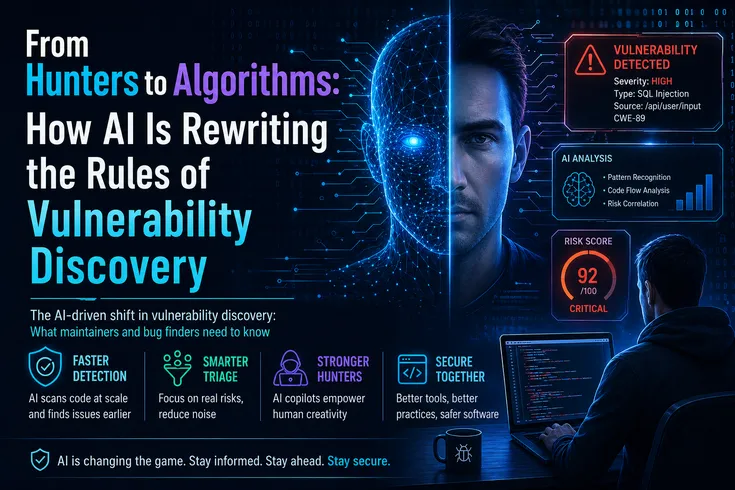
There was a time when vulnerability discovery felt like detective work under dim light—manual audits, intuition, and a bit of luck. Today, that dim room has been replaced by a stadium full of floodlights powered by AI. The game hasn’t just sped up—it’s been fundamentally rewritten.
Let’s unpack what this shift really means for maintainers and bug hunters navigating this new terrain.
1. The New Reality: AI Doesn’t Sleep, and It Doesn’t Miss Much
AI-driven tools are now capable of scanning massive codebases in minutes, identifying patterns that would take humans days—or weeks—to notice. These systems don’t just rely on known signatures; they learn from vast datasets of vulnerabilities and extrapolate potential weaknesses.
What changed?
- Scale: Entire ecosystems (not just single repos) can be analyzed continuously
- Speed: Near real-time detection during development cycles
- Pattern Recognition: AI spots subtle anti-patterns humans often overlook
This means vulnerabilities are being discovered earlier—but also more frequently.
2. For Maintainers: Your Role Just Got More Strategic
Maintainers are no longer just patching issues—they’re managing an ongoing stream of AI-generated findings.
Key Shifts
What You Should Do
- Integrate AI-based scanning into pipelines
- Establish triage workflows for AI findings
- Focus on root-cause fixes, not just patches
- Build security guardrails into development practices
3. For Bug Hunters: The Game Isn’t Over—It’s Evolved
Some fear AI will replace bug bounty hunters. Reality check: it won’t—but it will change how you operate.
AI Is Your Co-Pilot, Not Your Replacement
Smart hunters are already using AI to:
- Automate reconnaissance
- Generate attack scenarios
- Identify unusual code paths
- Reverse-engineer logic faster
Where Humans Still Win
AI struggles with:
- Business logic vulnerabilities
- Creative exploitation chains
- Context-aware attacks
- Social engineering vectors
That’s your playground.
New Skillset for Bug Hunters
- Prompt engineering for security tools
- Understanding AI model limitations
- Combining automated findings into exploit chains
- Deep domain knowledge (APIs, auth flows, cloud infra)
4. The Rise of “AI vs AI” Security
Here’s where it gets interesting.
Attackers are also using AI.
- AI-generated exploits
- Automated fuzzing at scale
- Intelligent phishing campaigns
- Code mutation to evade detection
This creates a loop:
Defensive AI finds vulnerabilities → Offensive AI exploits them faster → Defensive AI adapts again
It’s an arms race—but faster and more autonomous.
5. Open Source: The Pressure Cooker
Open-source projects are feeling the heat the most.
Why?
- Public code = easy AI training ground
- Maintainers often understaffed
- Sudden spikes in vulnerability reports
AI can flood maintainers with issues, creating burnout if not managed well.
Survival Tips for Maintainers
- Automate triage as much as possible
- Define clear contribution/security guidelines
- Use severity scoring aggressively
- Don’t chase every low-impact issue
6. The Ethics Layer: Who Owns AI-Found Bugs?
A new gray area is emerging:
- If AI finds a vulnerability, who gets credit?
- Should AI-generated reports qualify for bug bounties?
- What about mass-reporting bots?
Expect platforms to evolve policies around:
- AI-assisted disclosures
- Rate limits on automated submissions
- Proof-of-exploit requirements
7. What the Future Looks Like
The trajectory is clear:
- Continuous vulnerability discovery becomes the norm
- Security shifts left even further into development
- AI copilots become standard for both defenders and attackers
- Human expertise becomes more specialized and strategic
Think of it like this:
AI is the metal detector sweeping the beach.
Humans are still the ones who decide what’s treasure—and what’s just a bottle cap.
Final Thoughts
The AI-driven shift isn’t about replacing people—it’s about amplifying both sides of the security equation. Maintainers must become orchestrators of intelligent systems, while bug hunters evolve into creative strategists who know how to outthink automation.
Ignore this shift, and you’ll drown in noise.
Embrace it, and you’ll operate at a level that simply wasn’t possible before.



AI is changing the speed of vulnerability discovery—but do you think it’s also increasing noise and false positives? Curious how others are handling this 👇