Modern software development moves fast.
Teams deploy features daily, APIs evolve constantly, and cloud-native applications are becoming increasingly distributed. In this high-speed environment, one testing practice continues to remain fundamental across every stage of development: functional testing.
No matter how advanced architectures become, applications still need to answer one simple question:
Does the software actually work as expected?
That is exactly what functional testing is designed to verify.
What Is Functional Testing?
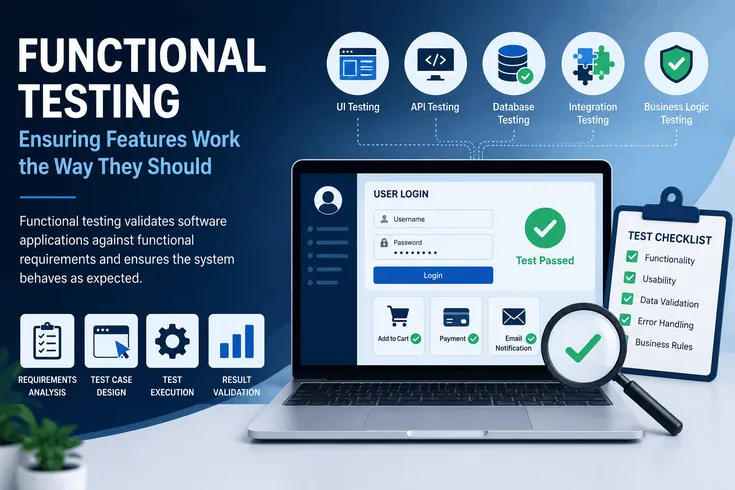
Functional testing validates whether an application behaves according to business and user requirements.
Instead of focusing on internal code structure, functional testing checks the software from an external perspective by validating inputs, outputs, workflows, and expected behavior.
Examples include:
- Login authentication
- API responses
- Payment processing
- User registration workflows
- Database-driven operations
- Form validation
The primary goal is straightforward:
Ensure every feature performs correctly under expected conditions.
Why Functional Testing Matters More Than Ever
As systems become more interconnected, failures often happen at the user workflow level rather than inside isolated functions.
A single broken integration can impact:
- Customer onboarding
- Payments
- Authentication
- Notifications
- Data synchronization
Functional testing helps identify these issues before they affect real users.
Without proper functional testing, teams risk deploying features that technically compile successfully but fail during real-world usage.
Functional Testing vs Unit Testing
Many developers confuse functional testing with unit testing, but they solve different problems.
Unit testing validates individual pieces of code in isolation.
Functional testing validates complete application behavior from the user or system perspective.
For example:
- A unit test may confirm a function returns the correct response.
- A functional test verifies whether the entire login workflow actually works correctly.
Both are important, but functional testing focuses more on business reliability and user-facing behavior.
The Growing Complexity of Modern Applications
Modern engineering environments introduce several new testing challenges:
- Microservices communication
- API dependencies
- Third-party integrations
- Cloud infrastructure
- Event-driven workflows
- Continuous deployments
Traditional manual validation becomes difficult at scale.
As deployment frequency increases, automated functional testing becomes essential for maintaining software quality without slowing development cycles.
Functional Testing in CI/CD Pipelines
Continuous delivery pipelines rely heavily on automated functional testing.
Modern teams integrate functional tests directly into CI/CD workflows to:
- Detect regressions early
- Validate business-critical workflows
- Prevent broken deployments
- Improve release confidence
- Reduce production incidents
The faster teams deploy software, the more important automated functional testing becomes.
Without it, rapid deployments quickly become risky.
API Functional Testing Is Becoming Critical
Today’s applications rely heavily on APIs.
A large percentage of modern functionality now depends on backend services communicating correctly with databases, microservices, and external platforms.
This is why API functional testing has become a major focus area for modern engineering teams.
Developers now need to validate:
- Request-response behavior
- Authentication flows
- Service communication
- Error handling
- Data consistency
- Real-world workflows
As APIs become central to modern applications, functional testing evolves from optional quality assurance into a core engineering requirement.
The Shift Toward Intelligent Test Automation
One of the biggest challenges with functional testing is maintenance overhead.
Traditional automated tests often break because of:
- UI changes
- API updates
- Dependency modifications
- Dynamic environments
Modern testing platforms are now moving toward smarter automation approaches that reduce manual test maintenance while improving reliability.
Tools like Keploy help developers simplify API and functional testing workflows by generating tests from real application traffic and reducing repetitive setup effort.
This allows teams to scale testing more efficiently without constantly rewriting test cases.
Final Thoughts
Functional testing remains one of the most important layers of modern software quality assurance.
As applications continue becoming more distributed and API-driven, validating real business workflows becomes critical for maintaining reliability and user trust.
Automation may accelerate development, but functional testing ensures software continues delivering the behavior users actually expect.
And in modern software engineering, reliability is everything.