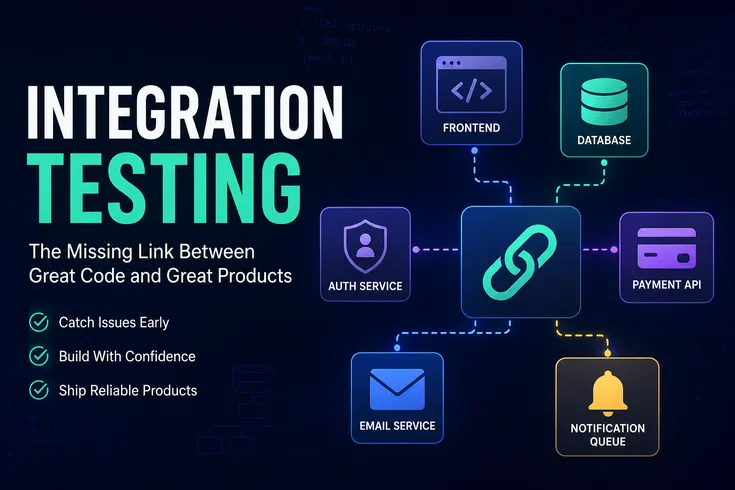
Modern software systems are built from multiple components working together—APIs, databases, microservices, third-party tools, and user interfaces. While unit testing verifies individual functions or modules, it does not guarantee that these parts will communicate properly when combined. That is where integration testing becomes essential.
As applications become more distributed and complex, ensuring that connected systems behave correctly is no longer optional. A strong testing strategy must include integration testing to catch issues before they impact production users.
What Is Integration Testing?
Integration testing is a software testing method used to validate how different modules, services, or components interact with each other. Instead of testing isolated units of code, this approach checks whether combined parts exchange data correctly, handle errors properly, and meet business expectations.
For example:
- Does the login service correctly connect to the user database?
- Is the payment gateway responding as expected?
- Can one microservice consume another service’s API without failure?
- Does data flow accurately between frontend and backend systems?
These are problems unit tests often miss, but integration tests are designed to catch.
Why Integration Testing Matters
Many software failures happen not because one function is broken, but because two working systems fail when connected.
Common reasons include:
- Incorrect API contracts
- Database schema mismatches
- Authentication token failures
- Timeout and retry issues
- Unexpected response formats
- Broken third-party integrations
By running integration testing early and continuously, teams reduce deployment risk and improve product stability.
Integration Testing vs Unit Testing
Both testing methods are valuable, but they solve different problems.
Testing TypeFocus AreaScopeUnit TestingIndividual functions/classesSmallIntegration TestingInteraction between modulesMediumEnd-to-End TestingFull user workflowsLarge
Unit tests are faster and easier to maintain, but they cannot replace integration tests. Real confidence comes from combining both.
Common Types of Integration Testing
1. Big Bang Integration Testing
All modules are combined at once, then tested together.
Pros: Quick setup for small projects
Cons: Hard to isolate failures
2. Incremental Integration Testing
Components are integrated step by step.
This includes:
- Top-down testing
- Bottom-up testing
- Sandwich/hybrid testing
This method is more structured and preferred for larger systems.
3. API Integration Testing
Tests communication between internal or external APIs. This is especially useful in SaaS platforms and microservice architectures.
4. Database Integration Testing
Validates interactions between applications and databases, including CRUD operations, transactions, and data consistency.
Real-World Example of Integration Testing
Imagine an eCommerce checkout flow:
- User adds product to cart
- Pricing engine calculates totals
- Payment service processes transaction
- Inventory service updates stock
- Notification system sends confirmation email
Each system may pass unit tests independently. But if inventory updates fail after payment succeeds, the business has a serious issue.
This is exactly why integration testing is critical.
Best Practices for Effective Integration Testing
Use Production-Like Environments
Testing in unrealistic environments can hide defects. Use staging systems that mimic production infrastructure.
Test Critical Flows First
Focus on revenue-impacting and customer-facing journeys such as authentication, checkout, onboarding, and billing.
Mock Only When Necessary
Over-mocking removes realism. Use real dependencies whenever practical.
Automate in CI/CD Pipelines
Run integration tests automatically during builds and deployments to detect regressions quickly.
Validate Negative Scenarios
Test timeouts, invalid payloads, partial failures, and dependency downtime.
Challenges in Integration Testing
Although valuable, integration testing can be harder than unit testing.
Common challenges:
- Slow execution times
- Difficult environment setup
- Flaky tests due to shared dependencies
- Test data management complexity
- Third-party service instability
Teams need the right tooling and discipline to overcome these issues.
Modern Integration Testing for APIs and Microservices
Today’s systems rely heavily on APIs. That makes API-focused integration testing more important than ever.
Instead of manually writing complex mocks, modern tools like Keploy help developers generate test cases from real traffic, replay dependencies, and automate backend testing workflows. This can significantly reduce the time spent building and maintaining test suites.
For engineering teams shipping rapidly, this modern approach helps scale integration testing without slowing development.
When Should You Run Integration Tests?
Run them:
- After unit tests pass
- Before staging deployments
- During pull request validation
- Before production releases
- Continuously for core workflows
The earlier issues are caught, the cheaper they are to fix.
Metrics to Track
To improve your integration testing strategy, monitor:
- Test pass/fail rate
- Execution duration
- Flaky test frequency
- Coverage of service interactions
- Bugs caught before production
These insights help optimize both quality and speed.
Final Thoughts
Software systems fail at the connection points. A feature may look perfect in isolation but break when it interacts with databases, APIs, queues, or third-party tools.
That is why integration testing is one of the most important layers in any modern quality strategy. It bridges the gap between unit testing and end-to-end validation, giving teams confidence that real systems work together as intended.
As applications become increasingly service-driven, investing in reliable integration testing is no longer just best practice—it is essential for shipping stable software at speed.